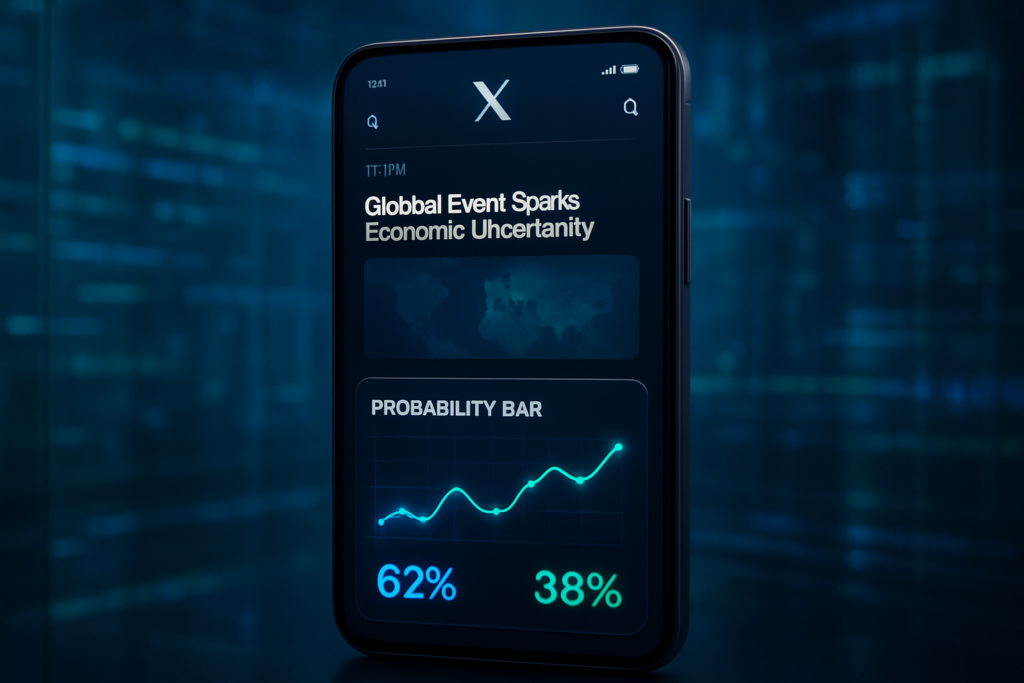
As of January 30, 2026, the way we consume news on X (formerly Twitter) has undergone a fundamental shift. No longer just a scroll of opinions and viral clips, the platform has transformed into what analysts are calling an "Information Finance" (InfoFi) engine. The cornerstone of this transformation is the seamless integration of live prediction market data, where every major news event—from Federal Reserve rate decisions to the capture of foreign leaders—is accompanied by a "Probability Bar" showing the real-time consensus of the betting public.
Currently, the market for "X’s Proprietary Prediction Exchange" is trading at a 31% probability of launching by year-end, reflecting intense speculation that Elon Musk will soon move beyond his current partnership with Polymarket to build a native betting ecosystem. This integration has moved prediction markets from a niche hobby for "superforecasters" to a primary layer of "consensus reality" for millions of users. The result is a surge in market liquidity, with single-day volumes on platforms like Kalshi and Polymarket recently hitting a record $701.7 million, driven largely by the "social-to-market" pipeline established on X.
The Market: What's Being Predicted
The most actively watched market currently integrated into the X ecosystem is the "2026 Midterm Election Control" series, which has already seen over $8 billion in open interest across both Polymarket and Kalshi. These odds are now natively displayed in the X search bar. When a user searches for "Senate Majority," the top result is no longer a poll or a news article, but a live widget showing a 58% implied probability for a Republican-controlled Senate.
Beyond politics, the integration has birthed "Mindshare Markets," where traders bet on the viral potential of creators or the success of specific X-exclusive shows. The primary platform for these trades remains Polymarket, which became X’s "Official Prediction Market Partner" in June 2025. However, the regulated U.S. side of the volume is increasingly captured by Kalshi, following its massive partnership with Coinbase Global (NASDAQ: COIN) that brought prediction trading to all 50 states earlier this month.
Liquidity has reached a tipping point. By late 2025, major market makers began providing deep liquidity to these event contracts, treating them as legitimate financial hedges. The resolution criteria for these markets are now often tied to "Grok-verified" outcomes—where X’s AI, Grok, synthesizes data from multiple news agencies and government filings to provide a definitive settlement trigger, a move that has significantly reduced "dispute" wait times on decentralized platforms.
Why Traders Are Betting
The primary driver of the current betting frenzy is the discovery of "alpha" within the social feed. The capture of Nicolás Maduro on January 3, 2026, serves as the ultimate case study. Hours before President Trump announced the operation on Truth Social, an anonymous trader on Polymarket placed a $32,000 bet that Maduro would be out of power by the end of the month. The odds were a mere 5.5% at the time; the trader walked away with a profit of over $436,000.
This incident highlighted the "insider" nature of prediction markets—where those with unique information or superior data-processing capabilities can profit before the news hits the mainstream. For the average X user, these markets are becoming a more trusted source than traditional polling. While traditional pollsters were still debating "margin of error" during the recent special elections, prediction markets accurately moved in real-time as precincts reported, often leading the news cycle by 15 to 20 minutes.
Institutional interest has also spiked. Firms that once viewed these platforms as "gambling" are now using them for risk management. For example, airline companies are using "Travel Demand" event contracts on Interactive Brokers (NASDAQ: IBKR) to hedge against fuel price volatility, while retail traders are using Robinhood Markets (NASDAQ: HOOD) to bet on everything from FDA approvals to box office numbers, treating event contracts as a high-leverage alternative to traditional options.
Broader Context and Implications
The integration of prediction data on X is a symptom of a larger trend: the "Financialization of Truth." In an era of AI-generated misinformation and deepfakes, prediction markets provide a financial incentive for accuracy. If a viral video is faked, the market odds for the related event typically don't move, or they move against the fake, acting as a "real-time truth widget" for the public.
However, this transition has not been without controversy. The Maduro incident sparked a regulatory firestorm, leading Representative Ritchie Torres to introduce the "Public Integrity in Financial Prediction Markets Act" in January 2026. This bill aims to prohibit federal officials and their staff from trading on these markets, citing the risk of "information-based frontrunning."
The competitive landscape is also heating up. Alphabet Inc. (NASDAQ: GOOGL) has integrated Kalshi data directly into Google Finance and Search "Probability Widgets," while Meta Platforms, Inc. (NASDAQ: META) is reportedly testing its own "Truth Widgets" for Instagram and Threads. Even gaming giants like DraftKings (NASDAQ: DKNG) have entered the fray, launching standalone prediction apps to capture the "sports-adjacent" market of cultural events. This suggests that the "wisdom of the crowd" is becoming the standard metric for news validation across the entire tech industry.
What to Watch Next
The coming months will be a stress test for the "InfoFi" ecosystem. The primary milestone to monitor is the potential IPO of Kalshi, which is currently trading at a 62% probability for a 2026 debut. A successful IPO would signal that regulators and institutional investors have fully embraced event derivatives as a permanent fixture of the U.S. financial system.
Investors should also watch the "X Coin" or "X Stablecoin" rumors. There is a 10% probability on Polymarket that X will launch its own USD-pegged stablecoin by the end of 2026. If this occurs, it could allow X to bypass third-party payment processors and create a closed-loop betting ecosystem, potentially increasing its market share against decentralized competitors.
Finally, keep an eye on the "Grok-3" rollout scheduled for later this quarter. If the next iteration of the AI can execute trades autonomously based on news sentiment, we could see a massive spike in "algorithmic forecasting," further increasing liquidity but also increasing the risk of "flash crashes" in specific event contracts.
Bottom Line
The integration of live prediction data into X has fundamentally changed the relationship between information and value. We are no longer just passive observers of the news; we are active participants in its valuation. By attaching a price tag to the "truth," prediction markets have created a more efficient, albeit more volatile, information ecosystem.
For prediction markets, this is the "mainstream moment" many have forecasted for a decade. The partnership between X and Polymarket, coupled with the institutional backing from companies like Intercontinental Exchange (NYSE: ICE), has provided the infrastructure needed for these markets to scale. While regulatory hurdles like the Torres Bill remain, the momentum of "InfoFi" appears irreversible.
Ultimately, the probability widgets on our feeds are telling us more than just the "odds"—they are reflecting a new world where "consensus reality" is determined not by what we say, but by where we are willing to put our money.
This article is for informational purposes only and does not constitute financial or betting advice. Prediction market participation may be subject to legal restrictions in your jurisdiction.
PredictStreet focuses on covering the latest developments in prediction markets.
Visit the PredictStreet website at https://www.predictstreet.ai/.