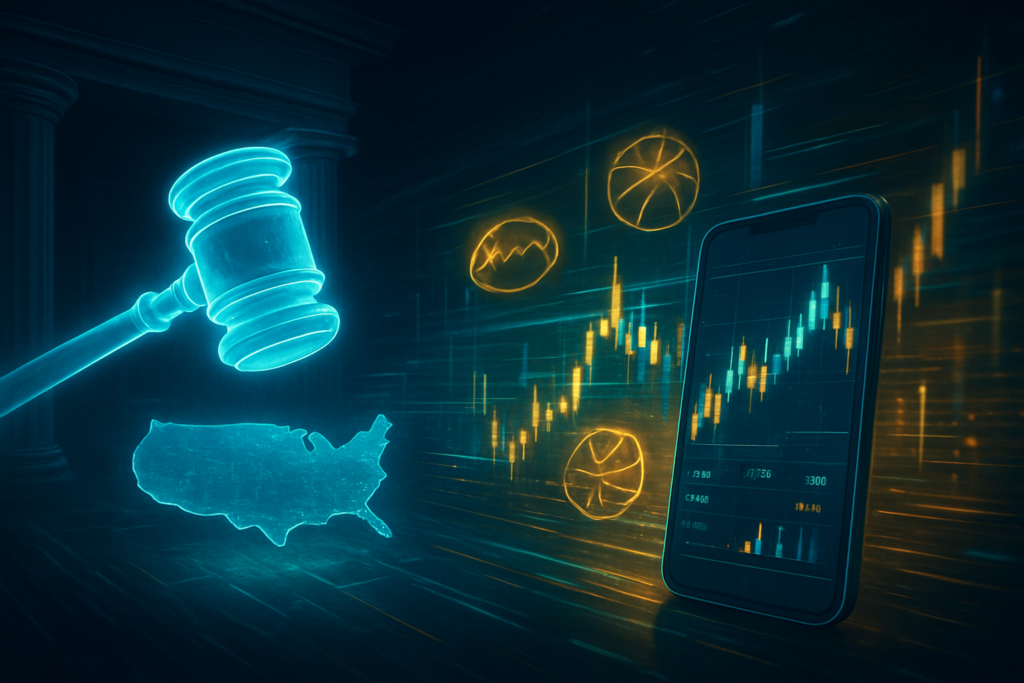
As of January 21, 2026, the American financial landscape is locked in a high-stakes jurisdictional civil war. On one side, federal regulators and Silicon Valley giants argue that prediction markets are sophisticated hedging tools—derivatives no different than corn futures or interest rate swaps. On the other, state attorneys general and powerful tribal gaming interests contend they are nothing more than unlicensed, high-tech sportsbooks masquerading as financial exchanges.
At the heart of this conflict is a simple question with a multi-billion dollar answer: Is predicting the outcome of a Sunday night NFL game an act of financial risk management or a common bet? With Robinhood Markets, Inc. (HOOD:NASDAQ) reporting over 11 billion contracts traded on its platform in the last year, and Kalshi expanding its reach into every major professional league, the outcome of this legal debate will determine the future of how Americans interact with risk.
The Market: What's Being Predicted
The current prediction market ecosystem has evolved far beyond its humble origins of political forecasting. Today, platforms like Kalshi and the newly launched Fanatics Markets—a joint venture between Crypto.com and the sports merchandise giant—offer a dizzying array of "event contracts." These include everything from the point spread of the Super Bowl to the number of passing yards a specific quarterback will achieve in a season.
Unlike traditional sportsbooks, these markets operate as peer-to-peer exchanges. On Kalshi, for instance, the "NFL: Chiefs to Win Super Bowl LX" contract currently trades at 18 cents, implying an 18% probability of victory. Prices are dictated by supply and demand rather than a house-set line. Trading volume has reached unprecedented heights; since Robinhood (HOOD:NASDAQ) acquired its own Designated Contract Market (DCM), MIAXdx, liquidity has surged, with daily volumes often rivaling mid-cap stocks.
The resolution of these markets is strictly binary. If the event occurs, the contract settles at $1.00; if it doesn't, it goes to zero. While this sounds like a bet, the platforms argue the underlying mechanics—regulated by the Commodity Futures Trading Commission (CFTC)—make them legitimate financial instruments.
Why Traders Are Betting
The surge in volume is driven by a new class of "hedgers" who view sports outcomes as a unique asset class. Professional ticket brokers, for example, use these markets to hedge against a local team being eliminated from the playoffs, which would crater their inventory value. Similarly, small businesses in "sports towns" are using prediction markets to offset the loss of revenue that occurs when a home team underperforms.
"We aren't gambling; we're managing exposure," says one high-frequency trader who recently moved a significant portion of his portfolio into sports derivatives. "If I have a massive position in regional brewery stocks, I am fundamentally exposed to the performance of the local sports teams that drive bar traffic. These markets allow me to offset that risk with surgical precision."
However, traditional gaming interests and the American Gaming Association (AGA) argue this is a semantic distraction. They point to the "whale" activity on these platforms—multi-million dollar positions on individual game outcomes—as evidence of speculative gambling. Critics argue that the lack of traditional "gaming taxes" gives these platforms an unfair competitive advantage over licensed sportsbooks like DraftKings Inc. (DKNG:NASDAQ) or FanDuel.
Broader Context and Implications
The legal friction is currently manifesting in a "federal-state divide." While the CFTC, under the leadership of Chairman Michael Selig, has embraced a "Future-Proof" initiative to accommodate these markets, state regulators are pushing back. Just yesterday, January 20, 2026, a Massachusetts judge issued a preliminary injunction against Kalshi, ruling that sports "prop bets" are "substantively indistinguishable" from wagering and require a state gaming license.
This conflict is further complicated by the Indian Gaming Regulatory Act (IGRA). A coalition of California tribes, including the Blue Lake Rancheria, has sued Robinhood (HOOD:NASDAQ) and Kalshi, alleging that allowing users to trade these contracts on tribal lands violates their exclusive gaming rights. This is not merely a regulatory spat; it is an existential threat to the tribal gaming model, which generates over $40 billion in annual revenue.
Historically, prediction markets have been more accurate than pundits or polls because traders have "skin in the game." If the legal system ultimately classifies them as gambling, they will be subjected to a fragmented state-by-state regulatory regime that could kill the liquidity necessary for them to function as accurate forecasting tools.
What to Watch Next
The immediate future of the industry hinges on the Ninth Circuit Court of Appeals. The court is currently reviewing Blue Lake Rancheria v. Kalshi, a case that could determine whether federal law (the Commodity Exchange Act) preempts tribal and state gaming regulations. A ruling is expected by mid-summer 2026.
Additionally, monitor the Ho-Chunk Nation’s lawsuit in Wisconsin, which has a trial date set for May 2027. This case specifically targets the definition of "occurrence" versus "outcome." If the court finds that a football game is an "occurrence" (a neutral event) rather than a "gamble," it will provide a massive legal shield for the industry.
Finally, keep an eye on the partnership between Crypto.com and the "Plaee" infrastructure. If more crypto-native platforms gain DCM status, the sheer volume of "on-chain" prediction trading may become too large for state regulators to effectively police, forcing a federal legislative solution from Congress.
Bottom Line
The battle over sports prediction markets is a proxy for a larger debate about the nature of risk in the 21st century. To the platforms and their millions of users, these are the ultimate democratized financial tools—allowing anyone to hedge against the unpredictable. To the states and tribes, they are a "Trojan Horse" for unregulated gambling that bypasses years of established law and tax revenue.
The data from the first few weeks of 2026 suggests that the market’s appetite for these contracts is insatiable. However, the "Massachusetts Injunction" served as a cold reminder that federal approval does not mean a clear path forward. For investors in companies like Robinhood (HOOD:NASDAQ), the legal bills may be as significant as the trading fees in the years to come.
Ultimately, the resolution of this debate will likely require a Supreme Court ruling or a comprehensive new act of Congress. Until then, prediction markets will continue to operate in a gray zone—part hedge fund, part stadium concourse—testing the limits of American financial law.
This article is for informational purposes only and does not constitute financial or betting advice. Prediction market participation may be subject to legal restrictions in your jurisdiction.
PredictStreet focuses on covering the latest developments in prediction markets.
Visit the PredictStreet website at https://www.predictstreet.ai/.