Toronto, Ontario--(Newsfile Corp. - May 12, 2026) - Omai Gold Mines Corp. (TSXV: OMG) (OTCQB: OMGGF) ("Omai Gold" or the "Company") is pleased to announce assay results from seven additional drill holes from the current drill program at its 100% owned Omai Gold Project in Guyana, South America.
Three of the seven holes were collared in Central Wenot, two in East Wenot and one at the western end of the Wenot deposit. One exploration hole was drilled south-southwest of the Wenot pit targeting a magnetic geophysical anomaly. All Wenot drill holes intersected multiple zones of gold mineralization. The objective of these holes and the ongoing 50,000m drill program is to fill gaps within the broader Wenot deposit's new constraining pit, to convert mineralized material into the higher confidence level, and to provide further testing of the limits of the Wenot gold system.
Highlights* from the recent drilling include:
(refer to Table 1 for full assays and downhole depths):
- Hole 26ODD-173
- 3.49 g/t Au over 16.9m
- Including 13.21 g/t Au over 1.5m
- Including 46.68 g/t Au over 0.6m
- 3.86 g/t Au over 23.8m
- Including 66.21 g/t Au over 0.8m
- Including 28.33 g/t Au over 0.9m
- 3.49 g/t Au over 16.9m
- Hole 26ODD-169
- 2.90 g/t Au over 22.9m
- Including 9.13 g/t Au over 4.1m
- 2.64 g/t Au over 19.2m
- Including 4.90 g/t Au over 8.9m
- 2.90 g/t Au over 22.9m
- Hole 26ODD-171
- 2.02 g/t Au over 21.5m
- Including 3.75 g/t Au over 8.7m
- 2.65 g/t Au over 17.2m
- Including 14.73 over 2.2m
- 2.02 g/t Au over 21.5m
Elaine Ellingham, President & CEO commented: "The 50,000m drill program at Omai is well underway with five drills turning. Results will continue as we focus on upgrading the large inferred Mineral Resource Estimate ("MRE") at the Wenot deposit to Indicated MRE. At the same time, we will continue to drill certain nearby targets that are either geophysics targets or will further test the extent of Wenot.
We are excited to announce that we will be commencing another deep hole to test the long-term potential at Omai. This time, we are planning a steep hole into our Gilt intrusion-hosted gold deposit to explore its depth potential. Historical drilling reached down to a 965m depth with a single hole, and we are targeting a hole in the 1.2 to 1.5km range, depending on results. Deeper holes can present challenges, however in 2025 the Omai team and our drillers from Orbit Garant were able to drill a 2,014m drill hole that intersected the Wenot deposit at a vertical depth of approximately 1,200m, a full 700m below the known Wenot deposit. These deep holes can provide an indication of the potential at depth and potential for an extended mine life."
Current Drill Results
Central Wenot
Hole 26ODD-169, drilled in Central Wenot, confirmed the continuity of mineralization along the dike corridor and extended coverage into the sedimentary sequence. The hole also confirmed the continuity of mineralization to depth and targeted mineralization previously intersected in adjacent holes 21ODD-014 (56.0 g/t Au over 1.5m from 389.3m downhole) and 25ODD-107 (2.67 g/t Au over 21.4m from 507m downhole and 2.31 g/t Au over 24.6m from 620m downhole). Hole 169 intersected several gold zones in the volcanics, with the best intercept being 2.90 g/t Au over 22.9m from 371.6m downhole in quartz-ankerite veins hosted in andesite, including 9.13 g/t Au over 4.1m. Next, a sequence of strongly altered and sulphide-rich andesite and basalt returned two modest mineralized gold intervals including 1.29 g/t Au over 8.6m and 1.38 g/t Au over 1.2m. The CQFP in hole 169 is well mineralized with disseminated pyrite and multiple visible gold occurrences and returned 2.64 g/t Au over 19.2m including 4.9 g/t Au over 8.9m. A minor interval of 0.74 g/t Au over 3.6m was intersected within the sediments.
Hole 26ODD-172 was collared on the north side of Central Wenot and drilled to the south. The hole tested the down-dip extension of mineralized gold zones within the dike corridor in hole 21ODD-021, that included 5.16 g/t Au over 8.4 m and 5.0 g/t Au over 6.0m. Hole 172 also intersected multiple gold zones in the volcanics including 4.19 g/t Au over 6.0m, 4.48 g/t Au over 6.0m, and 2.18 g/t Au over 8.0m. Further downhole, the CQFP was intersected yielding 0.45 g/t Au over 19.3m. No significant mineralization was encountered within the southern sedimentary rocks in this area.
Hole 26ODD-173, collared on the north side of Central Wenot, was drilled to the south. The hole tested the down-dip extension of mineralized gold zones encountered in hole 25ODD-102 including 8.98 g/t Au over 5.0m in the volcanics, 28.04 g/t Au over 9.3m and 3.36 g/t Au over 12.5m in the dike corridor, and 4.55 g/t Au over 7.0m in the CQFP. Hole 173 intersected 3.49 g/t Au over 16.9m (including 46.68 g/t Au over 0.6m) within a diorite dike, highlighted by quartz-ankerite veining with visible gold. Additional mineralization, including visible gold, was encountered in quartz-ankerite veins in andesites which returned 3.86 g/t Au over 23.8m (including 66.21 g/t Au over 0.8m). This hole was terminated within the northern volcanics due to dip deviation and hole 173W was then wedged at 300m and continued to a downhole depth of 718m intersecting the remaining Wenot zones. Results for 173W are pending.
West Wenot
Hole 26ODD-170 was collared at the western end of Wenot and drilled southward, targeting the downdip extension of gold mineralization intersected within volcanics in hole 22ODD-039 (2.32 g/t Au over 17.1m) at a vertical depth of approximately 140m. Hole 170 intersected four minor intervals of gold mineralization in the volcanic sequence mostly associated with disseminated pyrite and quartz-ankerite veinlets within the volcanics and intruded felsic dikes. The CQFP returned an anomalous 0.29 g/t Au over 9.9m in finely disseminated pyrite and quartz-ankerite veinlets. Within the southern sediments, hole 170 intersected five gold-mineralized zones, the best interval being 1.72 g/t Au over 8.6m.
East Wenot
Hole 26ODD-168 was collared from the north at the eastern end of Wenot and drilled south to fill the gap and confirm mineralization between sections 305730E and 305830E. Hole 21ODD-024 on section 305730E previously intersected 15.15 g/t Au over 6m from 260m downhole, approximately 50m to the west. Hole 168 intersected several zones with visible gold in quartz and ankerite veins in the volcanics and a best interval of 4.88 g/t Au over 6.4m (including 22.8 g/t Au over 1.0m) from 432.0m downhole. An interval of 0.69 g/t Au over 9.9m was intersected in the CQFP. Minor gold was encountered within the southern sediments in this area, including 1.47 g/t Au over 5.0m in quartz veins with visible gold present.
Hole 26ODD-171 was also collared from the north side at East Wenot and drilled south, where there had been limited drilling. This is one of ten holes drilled in the northeastern part of the Wenot deposit, designed to test the down dip extension of the dike corridor and splays that previously had only been tested to a maximum depth of 250m. Some of these "deep corridor holes" were also extended to explore for mineralized zones within the southern sedimentary sequence. The main intervals within hole 26ODD-171 include seven mineralized intervals within the volcanics, associated with fine disseminated pyrite and/or quartz veining. The best interval returned 2.02 g/t Au over 21.5m, including 3.75 g/t Au over 8.7m in a thick quartz vein in altered volcanics with 2% disseminated pyrite, and visible gold. The hole then intersected the CQFP hosting about 1% fine pyrite, 26 quartz veinlets, and alteration ranging from chlorite-magnetite to sericite-silica, grading 0.87 g/t Au over 25.5m, including 1.07 g/t Au over 13.5m. Within the sediments, a wide mineralized interval returned 2.65 g/t Au over 17.2m (including 14.73 g/t Au over 2.2m in a quartz-ankerite-chlorite vein zone within a diorite dike). These sediment-hosted zones will continue to contribute to expanding the resources within the same Wenot footprint, having the impact of decreasing the waste to ore (or strip) ratio.
Exploration Targets
A number of geophysics anomalies have been identified that warrant drill testing, given that the gold deposits at Omai show distinct magnetic signatures. Hole 26ODD-167 targeted a magnetic anomaly that may correlate to a roughly NE trending structure. The hole was collared south-southwest of the Wenot deposit. Historical drill holes in this area have not been very deep, with none extending beyond a length of 200m. Hole 167 reached a final depth of 277.5m but encountered no significant mineralization. Additional geophysical targets will be drilled during the course of the ongoing drill program.
Gilt Deposit Deep Hole
The Company has planned a deep drill hole to test the depth extent of the Gilt Deposit, that is expected to start before month end. Gold mineralization has been identified by drilling down to a 965m depth. The Gilt deposit is an intrusion-hosted orogenic gold deposit, which is expected to continue to significant depths. Hole 25ODD-122w, completed in Q4 2025, drilled across 708m of the Omai Stock. The upper portion of the Omai Stock produced 2.4 million ounces of gold between 1993-2005, from surface to a vertical depth of approximately 250m. The upper part of hole 122w was drilled from surface through a mafic volcanic sequence hosting some gold mineralization, then through the known diabase dike, and first intersected gold mineralization in the intrusions at a vertical depth of approximately 260m. Gold mineralization proved extensive throughout the Gilt intrusion and extends into the surrounding volcanic rocks as well. A 708.1m interval in hole 122w averaged 1.06 g/t Au with multiple higher-grade intervals. The updated Gilt MRE announced recently (news release April 14, 2026) reported 1,040,000 oz of gold (Indicated) at 3.33 g/t Au (9.7 Mt) and 1,465,000 oz of gold (Inferred) at 3.22 g/t Au (14.2 Mt).
The new proposed deep Gilt hole will be collared on the northern side of the Gilt pit and be oriented to test down the axis of the intrusion (Figure 2). The plan is to start the hole with HQ core (63.5mm diameter) that will provide material needed for advanced metallurgical testing (comminution work). Plans are to reduce the core diameter once sufficient large diameter sample is acquired and the hole is to continue to explore the depth extent below the known Gilt Deposit.
Ongoing Work Towards Preliminary Economic Assessment
The Company's independent consultants (SLR Consulting (Canada) Ltd.) continue to advance on the various components of an updated Preliminary Economic Assessment ("PEA") which will include a larger mine plan to incorporate the Gilt underground and a much-expanded Wenot super pit. The PEA is anticipated for completion by early Q3 2026. Omai is also advancing on the permitting front, currently working through the final review of the terms and scope of an Environmental Impact Assessment (EIA) with the Guyana EPA. Results for an extensive program of metallurgical test work are expected shortly for 73 representative samples from the two deposits on the Omai Gold Project. All technical programs, including environmental assessment, metallurgy, tailings, and mine planning are being advanced to a standard aligned with pre-feasibility and feasibility-level study requirements.
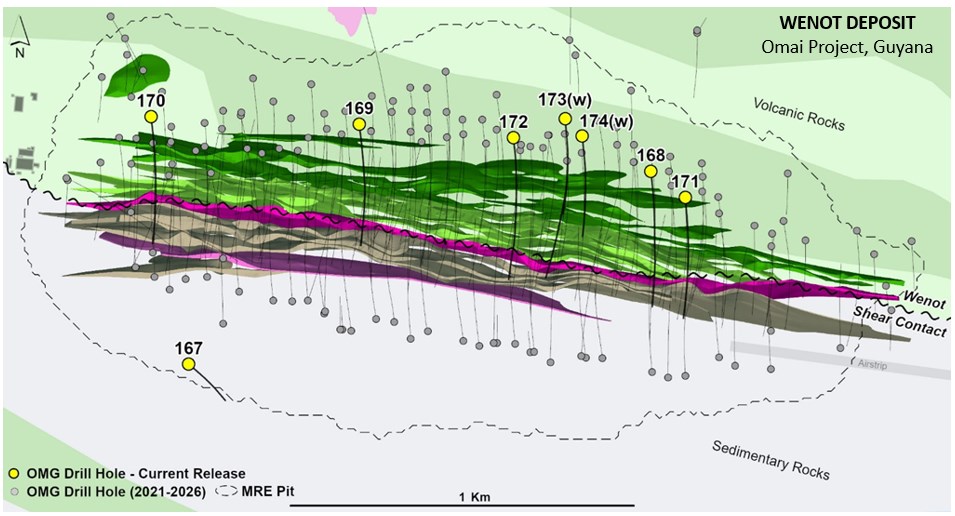
Figure 1. Plan Map of Wenot Showing Drill Hole Locations
To view an enhanced version of this graphic, please visit:
https://images.newsfilecorp.com/files/8712/297103_98a8122df4aacbbd_001full.jpg
Table 1. Recent Wenot Drill Results*
| DDH | FROM (m) | TO (m) | INTERVAL (m) | Grade (g/t Au) | Zone |
| 26ODD-167 | no significant intercepts | Geophysics | |||
| 26ODD-168 | 226.4 | 228.4 | 2.0 | 3.30 | Volcanics |
| 317.1 | 327.0 | 9.9 | 0.53 | ||
| 346.9 | 349.2 | 2.3 | 1.77 | ||
| 359.0 | 366.1 | 7.1 | 1.79 | ||
| 375.0 | 379.0 | 4.0 | 2.23 | ||
| 428.6 | 435.0 | 6.4 | 4.88 | ||
| including | 432.0 | 433.0 | 1.0 | 22.80 | |
| 518.4 | 528.3 | 9.9 | 0.69 | CQFP | |
| 605.0 | 610.0 | 5.0 | 1.47 | Sediments | |
| 616.0 | 617.2 | 1.2 | 0.86 | ||
| 622.0 | 623.5 | 1.5 | 0.85 | ||
| 631.0 | 640.0 | 9.0 | 0.52 | ||
| 26ODD-169 | 90.0 | 91.5 | 1.5 | 0.74 | Volcanics |
| 319.5 | 322.9 | 3.4 | 1.87 | ||
| 344.5 | 350.5 | 6.0 | 1.29 | ||
| 371.6 | 394.5 | 22.9 | 2.90 | ||
| Including | 389.1 | 393.2 | 4.1 | 9.13 | Shear Zone |
| 427.4 | 436.0 | 8.6 | 1.29 | Volcanics | |
| 475.2 | 476.4 | 1.2 | 1.38 | ||
| 497.3 | 516.5 | 19.2 | 2.64 | CQFP, Vein | |
| including | 506.1 | 515.0 | 8.9 | 4.90 | |
| 522.2 | 525.8 | 3.6 | 0.74 | Sediments | |
| 26ODD-170 | 220.2 | 223.6 | 3.4 | 0.32 | Volcanics |
| 317.0 | 321.5 | 4.5 | 1.04 | ||
| 349.8 | 354.0 | 4.2 | 0.53 | ||
| 369.4 | 376.5 | 7.1 | 1.33 | ||
| 409.1 | 419.0 | 9.9 | 0.29 | CQFP | |
| 430.8 | 436.2 | 5.4 | 0.51 | Sediments | |
| 458.5 | 462.5 | 4.0 | 1.72 | ||
| 482.3 | 486.4 | 4.1 | 0.40 | ||
| 504.7 | 505.8 | 1.1 | 2.94 | ||
| 513.4 | 522.0 | 8.6 | 1.72 | ||
| 26ODD-171 | 50.7 | 51.0 | 0.3 | 1.67 | Saprolite |
| 154.3 | 155.5 | 1.2 | 1.11 | Volcanics | |
| 205.3 | 207.2 | 1.9 | 0.58 | ||
| 287.7 | 290.0 | 2.3 | 1.52 | ||
| 297.5 | 299.0 | 1.5 | 2.58 | ||
| 334.0 | 355.5 | 21.5 | 2.02 | ||
| Including | 344.0 | 352.7 | 8.7 | 3.75 | |
| 369.6 | 382.7 | 13.1 | 3.49 | ||
| 394.4 | 419.9 | 25.5 | 0.87 | CQFP | |
| Including | 394.4 | 407.9 | 13.5 | 1.07 | |
| 460.5 | 477.7 | 17.2 | 2.65 | Sediments, Diorite, Vein | |
| Including | 475.5 | 477.7 | 2.2 | 14.73 | |
| 26ODD-172 | 244.5 | 250.5 | 6.0 | 4.19 | Andesite, Diorite |
| including | 244.5 | 246.0 | 1.5 | 14.97 | |
| 265.5 | 271.5 | 6.0 | 4.48 | ||
| 307.0 | 310.5 | 3.5 | 0.40 | ||
| 327.5 | 329.5 | 2.0 | 6.03 | ||
| 339.0 | 341.5 | 2.5 | 1.36 | ||
| 346.0 | 349.0 | 3.0 | 0.66 | ||
| 433.0 | 436.0 | 3.0 | 3.93 | ||
| including | 434.0 | 435.0 | 1.0 | 10.54 | |
| 482.0 | 490.0 | 8.0 | 2.18 | ||
| including | 485.6 | 488.7 | 3.1 | 3.79 | |
| 508.7 | 528.0 | 19.3 | 0.45 | CQFP | |
| 537.0 | 540.0 | 3.0 | 0.70 | Protomylonite | |
| 26ODD-173*** | 194.8 | 211.7 | 16.9 | 3.49 | Diorite, Quartz Vein |
| including | 200.5 | 202.0 | 1.5 | 13.21 | |
| including | 211.1 | 211.7 | 0.6 | 46.68 | |
| 391.6 | 415.4 | 23.8 | 3.86 | Andesite, Quartz Vein | |
| including | 393.0 | 393.8 | 0.8 | 66.21 | |
| including | 409.9 | 410.8 | 0.9 | 28.33 | |
| ***Hole 173 was terminated and hole 173W was wedged at 300m and extended to 718m. Results for 173W are pending. | |||||
*True widths vary as mineralization at Wenot is generally hosted within stockwork vein systems with alteration halos, with an estimated true width range of 70-90%. Cut-off grade 0.30 g/t Au with maximum 3.0m internal dilution is applied. **If indicated, a maximum 5.0m internal dilution was applied. All grades are uncapped unless otherwise noted.
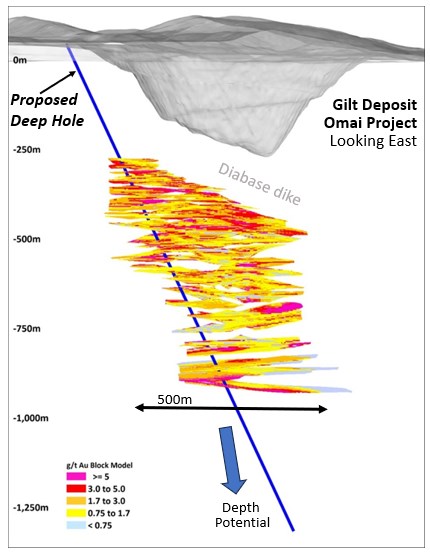
Figure 2. Cross section of the planned deep drill hole at the Gilt Deposit
To view an enhanced version of this graphic, please visit:
https://images.newsfilecorp.com/files/8712/297103_98a8122df4aacbbd_002full.jpg
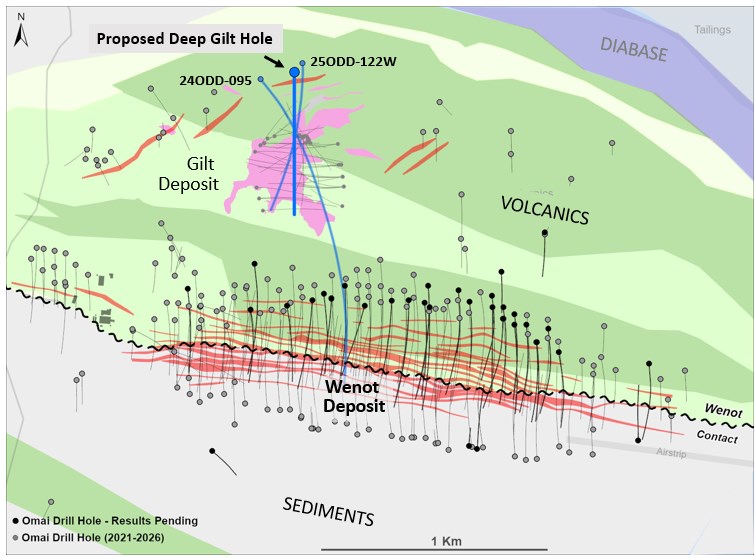
Figure 3. Plan Map of Omai Project Showing Proposed Deep Gilt Hole
To view an enhanced version of this graphic, please visit:
https://images.newsfilecorp.com/files/8712/297103_98a8122df4aacbbd_003full.jpg
Quality Control
Omai maintains an internal QA/QC program to ensure sampling and analysis of all exploration work is conducted in accordance with best practices. Certified reference materials, blanks and duplicates are entered at regular intervals. Samples are sealed in plastic bags.
Drill core samples (halved-core) were shipped to Act Labs and some batches to MSALABS, both certified laboratories in Georgetown Guyana, respecting the best chain of custody practices. At the laboratory, samples are dried, crushed up to 80% passing 2 mm, riffle split (250 g), and pulverized to 95% passing 105 μm, including cleaner sand. Fifty grams of pulverized material is then fire assayed by atomic absorption spectrophotometry (AA). Initial assays with results above 3.0 ppm gold are re-assayed using a gravimetric finish. For samples with visible gold and surrounding samples within deemed gold zones, two separate 250g or 500g pulverized samples are prepared, with 50 grams of each fire assayed by atomic absorption spectrophotometry, with assays above 3.0 ppm gold being re-assayed using a gravimetric finish. Certified reference materials and blanks meet with QA/QC specifications.
Qualified Person
Elaine Ellingham, P.Geo., is a Qualified Person (QP) under National Instrument 43-101 "Standards of Disclosure for Mineral Projects" and has reviewed and approved the technical information contained in this news release. Ms. Ellingham is a director and officer of the Company and is not considered to be independent for the purposes of National Instrument 43-101.
ABOUT OMAI GOLD
Omai Gold Mines Corp. is a Canadian gold exploration and development company focused on rapidly expanding the two orogenic gold deposits at its 100%-owned Omai Gold Project in mining-friendly Guyana, South America. The Company has established the Omai Gold Project as one of the fastest growing and well-endowed gold camps in the prolific Guiana Shield.
In April 2026, the Company announced an updated NI 43-101 Mineral Resource Estimate1 (MRE) which included expansions to both the Wenot Deposit and Gilt Deposit. Most significantly, the Wenot Indicated MRE increased 49.8% to 1,453,000 ounces ("oz") of gold with an average grade of 1.59 g/t Au, contained in 28.4 million tonnes ("Mt") and the Wenot Inferred MRE increased 7.6% to 3,999,000 oz grading 1.35 g/t Au, contained in 92.4 Mt. Similarly, the adjacent Gilt Deposit saw an overall increase in ounces over the previous MRE. Gilt's Inferred MRE increased 120% to 1,465,000 oz averaging 3.22 g/t Au (in 14.2 Mt), while the Indicated MRE decreased by 9.5% to 1,042,000 oz averaging 3.33 g/t Au (in 9.7 Mt).
Five diamond drills have commenced a 50,000m program for 2026: at Wenot the focus is to further test the limits of the deposit, including both east and west, and to commence converting the large Inferred MRE to Indicated. Additional drilling will continue to explore certain known gold occurrences for possible near-surface higher-grade satellite deposits. Following the current updated MRE, an updated PEA is planned for Q3 2026 to include the expanded Wenot open pit deposit and the adjacent Gilt Creek underground deposit. The Omai Gold Mine produced over 3.7 million ounces of gold from 1993 to 20052, ceasing operations when gold was below US$400 per ounce. The Omai site significantly benefits from existing infrastructure, including an on-site airstrip, and is connected by road to the two largest cities in Guyana, Georgetown and Linden.
1 Omai Gold Mines news release titled "Omai Gold Increases Indicated Mineral Resources to 2.5 Moz Au at 2.04 g/t Au (38.1 Mt) and Inferred to 5.5 Moz Au at 1.59 g/t Au (106.6 Mt) with Expansion of Wenot and Gilt Deposits" dated April 14, 2026.
2 Past production at the Omai Mine (1993-2005) is summarized in several Cambior Inc. documents available on www.sedarplus.ca, including March 31, 2006 AIF and news release August 3, 2006.
For further information, please see our website www.omaigoldmines.com or contact:
Elaine Ellingham, P.Geo.
President & CEO
elaine@omaigoldmines.com
+1.416.473.5351
Neither the TSX Venture Exchange nor its Regulation Services Provider (as that term is defined in the policies of the TSX Venture Exchange) accepts responsibility for the adequacy or accuracy of this release.
Table 2. Drill Hole Coordinates
| Hole ID | Azimuth | Inclination | Easting | Northing | Length | Status |
| (degrees) | (degrees) | (m) | ||||
| 26ODD-167 | 130 | -55 | 304433 | 601214 | 277.5 | Reporting |
| 26ODD-168 | 174 | -54 | 305780 | 601777 | 643.8 | Reporting |
| 26ODD-169 | 174 | -54 | 304930 | 601914 | 579.1 | Reporting |
| 26ODD-170 | 173 | -51 | 304323 | 601936 | 577.6 | Reporting |
| 26ODD-171 | 176 | -52 | 305880 | 601700 | 550.0 | Reporting |
| 26ODD-172 | 175 | -54 | 305379 | 601877 | 613.6 | Reporting |
| 26ODD-173 | 175 | -54 | 305530 | 601930 | 481.3 | Reporting |
Cautionary Note Regarding Forward-Looking Statements
This news release includes certain "forward-looking statements" under applicable Canadian securities legislation. Forward-looking statements include, but are not limited to, statements with respect to the timing of completion of the drill program, and the potential for the Omai Gold Project to allow Omai to build significant gold Mineral Resources at attractive grades, and forward-looking statements are necessarily based upon a number of estimates and assumptions that, while considered reasonable, are subject to known and unknown risks, uncertainties and other factors which may cause the actual results and future events to differ materially from those expressed or implied by such forward-looking statements. Such factors include, but are not limited to general business, economic, competitive, political and social uncertainties; delay or failure to receive regulatory approvals; the price of gold and copper; and the results of current exploration. Further, the Mineral Resource data set out in this news release are estimates, and no assurance can be given that the anticipated tonnages and grades will be achieved or that the indicated level of process recovery will be realized. There can be no assurance that forward-looking statements will prove to be accurate, as actual results and future events could differ materially from those anticipated in such statements. Accordingly, readers should not place undue reliance on forward-looking statements. The Company disclaims any intention or obligation to update or revise any forward-looking statements, whether as a result of new information, future events or otherwise, except as required by law.
Cautionary Note Regarding Mineral Resource Estimates
Until mineral deposits are actually mined and processed, Mineral Resources must be considered as estimates only. Mineral Resource Estimates that are not Mineral Reserves have not demonstrated economic viability. The estimation of Mineral Resources is inherently uncertain, involves subjective judgement about many relevant factors and may be materially affected by, among other things, environmental, permitting, legal, title, taxation, socio-political, marketing, or other relevant risks, uncertainties, contingencies and other factors described in the Company's public disclosure available on SEDAR+ at www.sedarplus.ca. The Inferred Mineral Resource in this estimate has a lower level of confidence than that applied to an Indicated Mineral Resource and must not be converted to a Mineral Reserve. It is reasonably expected that the majority of the Inferred Mineral Resource could be upgraded to an Indicated Mineral Resource with continued exploration. The accuracy of any Mineral Resource Estimates is a function of the quantity and quality of available data, and of the assumptions made and judgments used in engineering and geological interpretation, which may prove to be unreliable and depend, to a certain extent, upon the analysis of drilling results and statistical inferences that may ultimately prove to be inaccurate. Mineral Resource Estimates may have to be re-estimated based on, among other things: (i) fluctuations in mineral prices; (ii) results of drilling, and development; (iii) results of future test mining and other testing; (iv) metallurgical testing and other studies; (v) results of geological and structural modeling including block model design; (vi) proposed mining operations, including dilution; (vii) the evaluation of future mine plans subsequent to the date of any estimates; and (viii) the possible failure to receive required permits, licenses and other approvals. It cannot be assumed that all or any part of a "Inferred" or "Indicated" Mineral Resource Estimate will ever be upgraded to a higher category. The Mineral Resource Estimates disclosed in this news release were reported using Canadian Institute of Mining, Metallurgy and Petroleum Definition Standards for Mineral Resources and Mineral Reserves (the "CIM Standards") in accordance with National Instrument 43-101- Standards of Disclosure for Mineral Projects of the Canadian Securities Administrators ("NI 43-101").

To view the source version of this press release, please visit https://www.newsfilecorp.com/release/297103