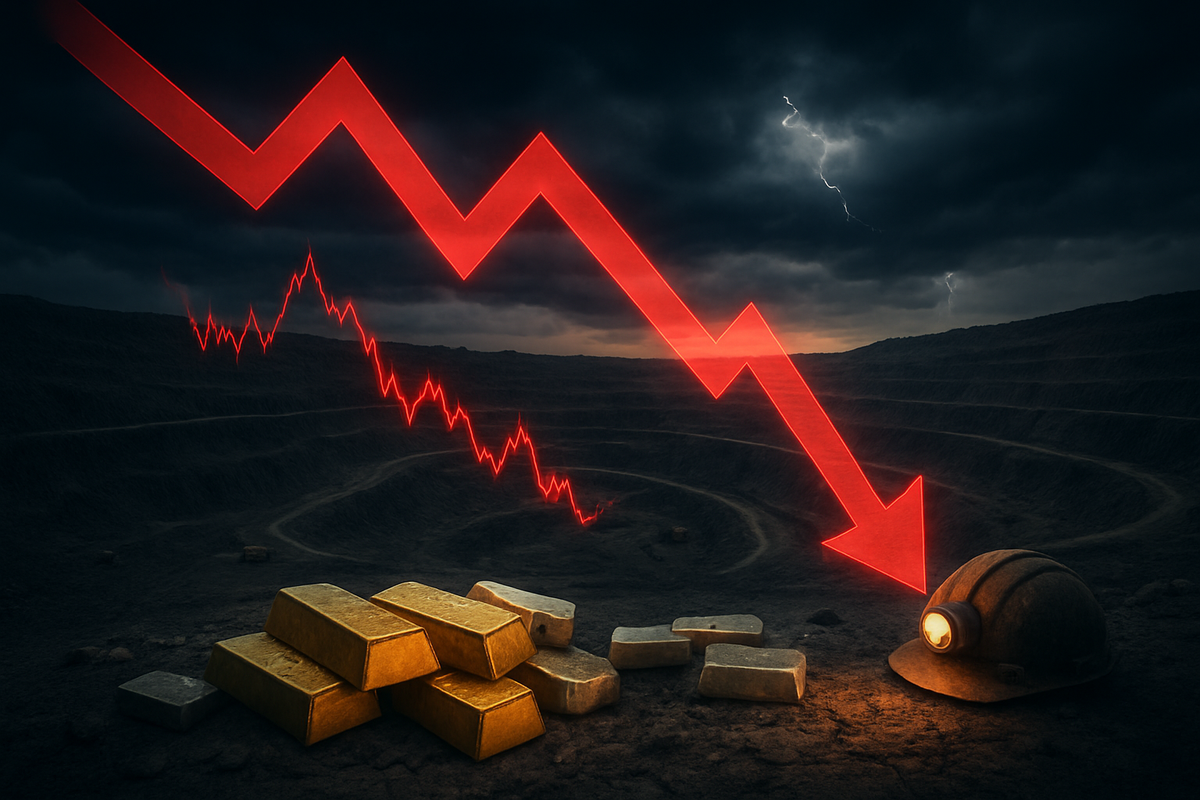
The era of easy gains for precious metals took a violent turn on March 19, 2026, as a massive sell-off erased billions in market capitalization from the world’s leading mining firms and exchange-traded funds. After a record-shattering 2025 that saw gold climb toward the $5,000 mark and silver touch triple digits, the sector hit a wall of institutional profit-taking and a "hawkish shock" from a newly aggressive Federal Reserve. The broad-based liquidation signaled a stark shift in market sentiment, transitioning from a speculative frenzy to a cold realization of a "higher-for-longer" interest rate environment.
The immediate implications of the March 19 crash have been felt across global exchanges, as the sudden surge in the U.S. Dollar Index (DXY) forced gold and silver into technical bear market territory. For investors who had viewed miners as the ultimate hedge against geopolitical instability—specifically the escalating tensions with Iran—the day served as a brutal reminder that even safe havens are not immune to liquidity crunches. As of early April, the sector remains in a state of fragile consolidation, with analysts debating whether this is a healthy correction or the beginning of a prolonged "Golden Hangover."
A Day of Reckoning: The March 19 Liquidity Rupture
The catalyst for the March 19 collapse was set just 24 hours prior during the March 18 FOMC meeting. The Federal Reserve, now under the leadership of Chair Kevin Warsh, delivered a unexpectedly stern "dot plot" that signaled only one interest rate cut for the remainder of 2026, despite growing market expectations for a pivot toward easing. This hawkish stance, combined with a surprise jump in core inflation driven by $119-per-barrel Brent crude oil, sent Treasury yields soaring. By the opening bell on March 19, the "Warsh Shock" had triggered an algorithmic exodus from non-yielding assets, specifically precious metals.
The sell-off was characterized by an "indiscriminate liquidation" style of trading, where institutional players dumped mining stocks to cover margin calls in other parts of their portfolios. As the U.S. Dollar surged, the technical support levels for gold at $4,800 and silver at $100 disintegrated in a matter of hours. The panic was visible in the trading volume, which reached three times the 30-day average for major mining equities. Markets were further rattled by reports that several large hedge funds were unwinding "silver squeeze" positions that had been highly profitable throughout the previous year.
Key stakeholders, including major institutional holders like BlackRock and Vanguard, appeared to be the primary drivers of the initial volume, shifting allocations toward short-term Treasuries. By midday, retail investors, who had flocked to the sector during the 2025 rally, joined the fray, turning a controlled retreat into a rout. Industry reactions were swift and somber; several mining CEOs released statements emphasizing their robust balance sheets, though these did little to stem the tide of red on the screens.
The timeline leading to this moment began in late 2024 and accelerated through 2025, a year characterized by aggressive de-dollarization and central bank gold buying. However, the parabolic nature of that rally left the sector vulnerable to a "mean reversion" event. The March 19 crash was not just a reaction to one Fed meeting, but the culmination of months of over-extension, where mining stock valuations had become decoupled from the rising operational costs—particularly the energy and labor expenses associated with extracting ore in a high-inflation environment.
Winners, Losers, and the Margin Squeeze
The heavyweights of the industry bore the brunt of the volatility. Newmont (NYSE: NEM), the world’s largest gold miner, saw its stock price crater by over 9%, falling below the psychological $100 support level to close at approximately $96.20. For Newmont, the loss was compounded by its revised 2026 guidance, which projected a slight decline in annual production. The market’s reaction suggests that investors are no longer willing to pay a premium for size if it is accompanied by rising All-In Sustaining Costs (AISC), which for Newmont are now approaching $1,680 per ounce.
Barrick Gold (NYSE: GOLD) also suffered significantly, dropping roughly 7% on the day. While Barrick had been praised for its free cash flow growth in 2025, the March 19 sell-off wiped out nearly four months of gains. The company’s heavy exposure to Nevada-based assets, which require significant energy inputs, made it a target for bears concerned about the impact of $119 oil on profit margins. Similarly, First Majestic Silver (NYSE: AG) acted as a high-beta proxy for the silver price collapse, plunging 10% to $18.94 as the underlying metal’s spot price plummeted from $110 toward $70.
The exchange-traded fund complex provided a bird’s-eye view of the carnage. The VanEck Gold Miners ETF (NYSE: GDX) and the VanEck Junior Gold Miners ETF (NYSE: GDXJ) fell 7% and 8% respectively, as the sell-off moved from the "Majors" to the more speculative "Juniors." The iShares Silver Trust (NYSE: SLV) experienced one of its worst single-day drawdowns in years, falling 11%. These ETFs, which often serve as the primary vehicle for retail exposure to the sector, saw massive outflows that forced fund managers to sell underlying shares, creating a self-reinforcing downward spiral.
In the wake of the event, the only "winners" appeared to be short-sellers and those positioned in the U.S. Dollar or inverse ETFs. However, some value-oriented analysts argue that the sell-off has created a "cleansing" of the market, removing the froth of speculative retail traders and allowing long-term institutional buyers to re-enter at more reasonable valuations. For companies with zero debt and high-grade reserves, the crash may eventually be seen as a buying opportunity, though for now, the sentiment remains decidedly bearish as the industry grapples with the new reality of high capital costs.
Historical Context and Ripple Effects
The March 19 sell-off shares striking similarities with the 2011 "gold peak" and the subsequent multi-year bear market, yet the current geopolitical landscape adds a layer of complexity. In 2011, the crash was driven by a stabilizing global economy; in 2026, the crash is occurring amidst a "hot" conflict in the Middle East. Paradoxically, the Iran conflict—traditionally a bullish catalyst for gold—has become a double-edged sword. While it drives safe-haven demand, it also fuels energy-driven inflation, which forces central banks to keep interest rates high, ultimately strengthening the dollar and hurting the miners.
This event fits into a broader industry trend of "margin compression." For years, miners benefited from rising metal prices while keeping costs relatively stable. That era has ended. The 2026 sell-off highlights a structural shift where the cost of production is rising faster than the price of the commodity. This has significant ripple effects on exploration and development partners. Junior miners, who rely on equity raises to fund their projects, are now facing a "capital desert" as investors flee the GDXJ and similar speculative vehicles.
Regulators and policy makers are also taking note. The extreme volatility in silver, which saw price swings reminiscent of the 1980 Hunt Brothers era, has prompted calls for increased oversight of "silver squeeze" social media movements and algorithmic trading in the metals space. There is a growing concern that the financialization of these commodities via ETFs has made them more susceptible to liquidity shocks rather than reflecting the actual physical supply and demand of the metals themselves.
Historically, events like the March 19 rupture lead to a period of consolidation and M&A activity. Larger firms like Newmont and Barrick Gold may use their remaining cash reserves to snap up distressed junior assets at pennies on the dollar. However, the success of such moves will depend on their ability to manage the inflationary pressures that triggered the sell-off in the first place. The industry is currently in a "show me" phase, where investors are demanding disciplined capital allocation over aggressive production growth.
The Path Forward: Pivots and Scenarios
In the short term, the mining sector is likely to remain in a "penalty box" until there is clear evidence that the Federal Reserve has finished its hawkish campaign. Strategic pivots are already underway; several mid-tier miners have announced a temporary halt to high-cost expansion projects, choosing instead to focus on "high-grading"—processing only the most profitable ore to preserve margins. This shift may lead to lower global production in late 2026, which could ironically provide the floor needed for a price recovery in 2027.
The primary challenge emerging from this crash is the "trust gap" between mining management and shareholders. To regain investor confidence, companies will need to prove they can remain profitable even if gold settles into a lower range of $4,000 to $4,200. We may see an increase in "streaming and royalty" deals as an alternative way to finance operations without diluting shareholders in a depressed market. The adaptability of these firms to a world with 4% interest rates will determine the winners of the next cycle.
Two potential scenarios loom for the remainder of the year. In the bullish scenario, a cooling of the Iran conflict leads to lower oil prices, easing the margin squeeze on miners and allowing the sector to rebound as a "value play." In the bearish scenario, "sticky" inflation forces the Fed to actually raise rates further, leading to a secondary liquidation event that could push the GDX back to 2024 levels. For now, the market is pricing in a "slow bleed" rather than a rapid recovery, with a focus on upcoming Q2 earnings reports to gauge the true extent of the damage.
Conclusion: A New Paradigm for Precious Metals
The events of March 19, 2026, serve as a definitive end to the "Golden Age" of 2025. The sell-off was a stark reminder that no asset class is immune to the gravity of interest rates and the volatility of global liquidity. For Newmont, Barrick, and the broader ETF complex, the focus has shifted from record-breaking profits to fundamental survival and margin protection. The "Warsh Shock" has reset the bar for the entire sector, demanding a level of fiscal discipline that was often ignored during the parabolic rally of the previous year.
Moving forward, the market will be characterized by extreme selectivity. Investors should move away from broad-based sector bets and instead look for "quality over quantity"—miners with low AISC, robust hedges against energy prices, and Tier One assets in stable jurisdictions. The era of "rising tides lifting all boats" is over; in its place is a market that will reward only the most efficient operators while punishing those who over-leveraged during the 2025 boom.
In the coming months, the key metrics to watch will be the U.S. Dollar Index and the "real" interest rate (interest rates minus inflation). If the dollar remains the world's preferred sanctuary amidst geopolitical strife, gold and silver miners will continue to struggle. However, should the Fed’s hawkishness eventually break the economy, the safe-haven narrative could return with a vengeance. Until then, the "Golden Hangover" remains the dominant theme on Wall Street.
This content is intended for informational purposes only and is not financial advice.