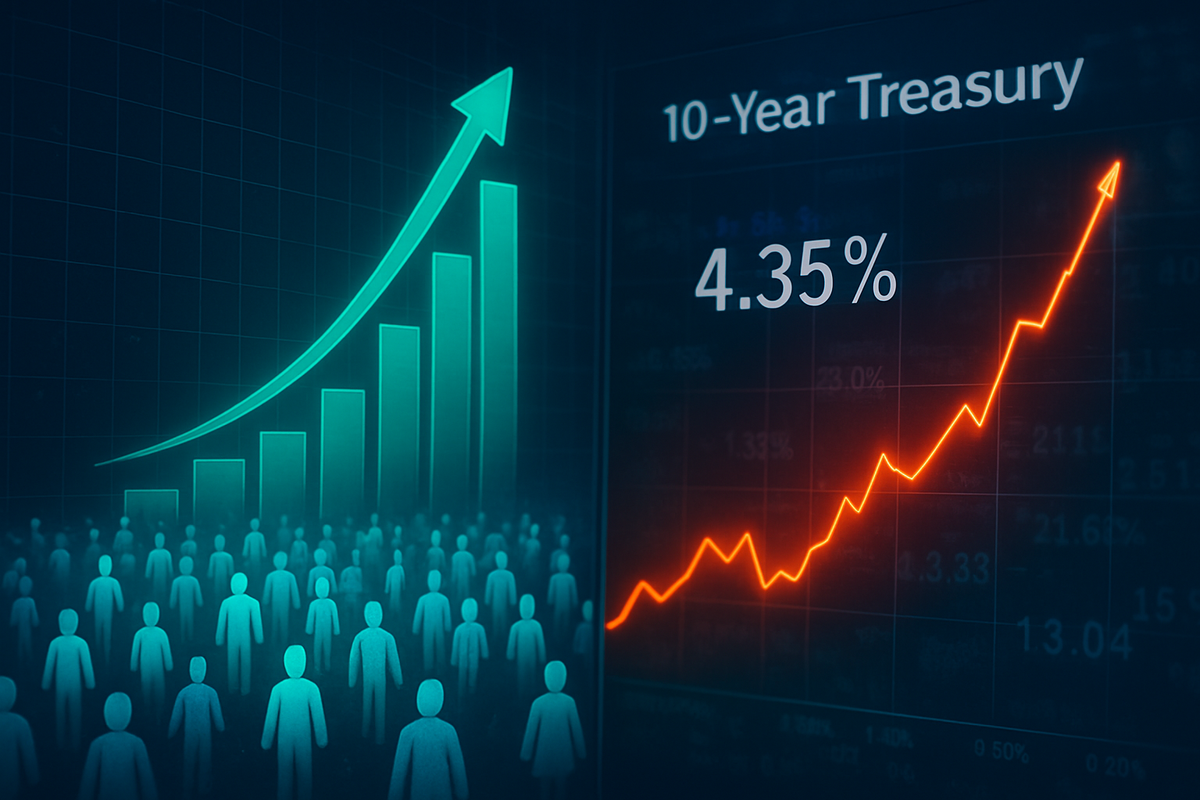
The U.S. economy delivered a startling display of resilience this week as the March nonfarm payrolls report shattered expectations, adding 178,000 jobs—nearly three times the consensus forecast of 60,000. This unexpected surge, coming on the heels of a volatile start to 2026, has effectively recalibrated market expectations for interest rates and sent the 10-year Treasury yield climbing to a multi-year high of 4.35%. While the hiring spree signals underlying strength, the report also contained nuanced data, including a dip in the unemployment rate to 4.3% and a surprisingly soft monthly wage growth of just 0.2%.
The immediate fallout on Wall Street was a sharp "re-pricing" of risk. As investors digested the realization that the Federal Reserve’s restrictive policy may remain in place much longer than anticipated, the bond market saw a significant sell-off. The jump in yields has reignited the debate over "valuation gravity," where the attractive returns on risk-free government debt begin to pull capital away from high-flying growth sectors. For the broader market, the March report represents a "good news is bad news" paradox: a robust labor market is positive for consumption, but it likely closes the door on any meaningful interest rate relief in the first half of the year.
The Great March Rebound: Breaking Down the Numbers
The March jobs report arrived as a major relief to some and a shock to others, particularly following a downwardly revised February that saw a loss of 133,000 positions. The addition of 178,000 jobs marks a decisive turnaround, suggesting that the early-year slump was a transitory anomaly rather than the start of a recessionary trend. The hiring was broad-based, with significant gains in the service sector, healthcare, and specialized technology roles, indicating that corporate America is still in expansion mode despite borrowing costs that would have seemed unthinkable just a few years ago.
The unemployment rate’s decline to 4.3%—down from 4.4% in February—underscores the tightness of the labor market. However, the most intriguing data point for many analysts was the 0.2% monthly wage growth. This figure came in softer than expected, providing a silver lining for the Federal Reserve. Soft wage growth suggests that while companies are hiring, they are not currently locked in a "wage-price spiral" that would further fuel inflation. This decoupling of job growth and wage acceleration offers a potential path to a "soft landing," though it does little to dampen the hawkish outlook in the bond market.
Initial market reactions were swift. Within minutes of the release on Friday, April 3, 2026, the 10-year Treasury yield surged past the 4.30% psychological barrier, eventually settling at 4.35%. This movement reflects a "structural neutral rate" that is moving higher in the minds of institutional investors. The immediate response in the equity markets was a rotation out of "long-duration" growth stocks and into value-oriented sectors, particularly those that benefit from a steeper yield curve and higher interest margins.
Winners and Losers in the 4.35% Era
The banking sector emerged as the primary beneficiary of the week’s data. For giants like JPMorgan Chase & Co. (NYSE: JPM) and Bank of America Corp (NYSE: BAC), a 4.35% 10-year yield is a catalyst for significant net interest margin (NIM) expansion. These institutions have spent much of the last two years repricing their loan portfolios and managing legacy low-yield securities. With the 10-year yield at these levels, JPM and BAC are positioned to capture a healthier spread on everything from commercial loans to mortgages. Furthermore, The Goldman Sachs Group, Inc. (NYSE: GS) stands to benefit from the increased volatility and hedging activity that follows such dramatic shifts in the fixed-income landscape.
Conversely, the technology sector is feeling the pinch of "valuation gravity." High-growth firms, whose valuations are heavily dependent on the present value of future earnings, see those values compressed when the discount rate (tied to the 10-year yield) rises. Microsoft Corporation (NASDAQ: MSFT) and Alphabet Inc. (NASDAQ: GOOGL), while fundamentally strong, saw their price-to-earnings multiples face downward pressure as the yield hit 4.35%. Investors are increasingly demanding that these companies prove their "AI ROI," shifting the focus from speculative growth to tangible profitability and margin expansion.
Even the market's darling, NVIDIA Corporation (NASDAQ: NVDA), was not immune to the intraday de-risking. While its revenue growth remains exceptional, the rising cost of capital affects the entire ecosystem of data center investment. Meanwhile, consumer-facing tech companies like Meta Platforms, Inc. (NASDAQ: META) have responded to this high-yield environment by prioritizing efficiency and dividend payouts to remain attractive to a investor base that can now get a guaranteed 4.35% return from the U.S. government.
Macro Context: The End of the "Pivot" Dream
This March report likely serves as the final nail in the coffin for the "2026 Pivot" narrative. Throughout late 2025, many market participants bet on a significant easing of monetary policy, hoping the Fed would return rates to a "pre-pandemic normal." However, the persistence of 178,000 new jobs and a 4.3% unemployment rate suggests the economy is far from needing a stimulus. This fits into a broader trend where the "neutral rate" of interest—the rate that neither stimulates nor restricts the economy—is being reconsidered as much higher than previously thought.
The ripple effects extend beyond the U.S. borders. A 4.35% yield on the 10-year Treasury attracts global capital into the dollar, putting pressure on emerging markets and complicating the policy paths for the European Central Bank and the Bank of Japan. Historically, periods of high yields and a strong dollar have led to "imported inflation" for other nations, potentially forcing a global synchronization of higher rates. This environment mirrors the late 1990s, where a productivity-led boom (then the internet, now AI) allowed for high interest rates and robust growth to coexist, albeit with occasional bouts of extreme market volatility.
Regulatory and policy implications are also coming into focus. The Fed is now in a "watchful waiting" mode. While they likely won't hike further based on one report—especially with soft wage growth—the "higher-for-longer" mantra has been validated. For the public, this means that the "new normal" of 7% mortgages and 10% auto loans is likely here to stay for the foreseeable future, fundamentally altering the housing market and consumer spending patterns that were once fueled by cheap debt.
The Road Ahead: Stability or Stagnation?
In the short term, the market will likely undergo a period of "consolidation by sector." We expect to see a continued rotation where capital flows toward companies with strong cash flows and low debt-to-equity ratios. The "growth at any cost" model is officially dead in 2026; in its place is a mandate for "profitable growth." Companies that can maintain double-digit growth while yielding a 4.35% cost of capital will be the new leaders of the S&P 500.
Looking toward the second half of 2026, the primary challenge will be the potential for "consumption fatigue." While hiring is strong, the soft 0.2% wage growth suggests that real purchasing power is not expanding as fast as the headline jobs number might imply. If inflation remains sticky at or above 3%, the "soft landing" could begin to feel like a "hard grind" for the average consumer. Investors should watch for any signs of a spike in consumer credit defaults or a significant pullback in discretionary spending, which would signal that the high-rate environment is finally beginning to sap the economy's underlying strength.
Final Assessment: What to Watch Moving Forward
The March payrolls report is a testament to the enduring strength of the U.S. labor market, but it serves as a stark reminder that the era of "easy money" is a distant memory. For investors, the takeaways are clear: diversify into sectors that benefit from higher rates, such as large-cap financials, and be ruthlessly selective with growth stocks. The 4.35% yield on the 10-year Treasury is no longer just a technical level; it is a fundamental shift in the economic landscape.
Moving forward, the focus will shift to the April inflation prints. If inflation remains stubborn despite the soft wage growth seen in March, the Fed may be forced to consider even more restrictive measures, or at the very least, hold rates at these levels well into 2027. The resilience of the job market has given the Fed the "green light" to maintain its hawkish stance, and the markets have finally received the message.
This content is intended for informational purposes only and is not financial advice.