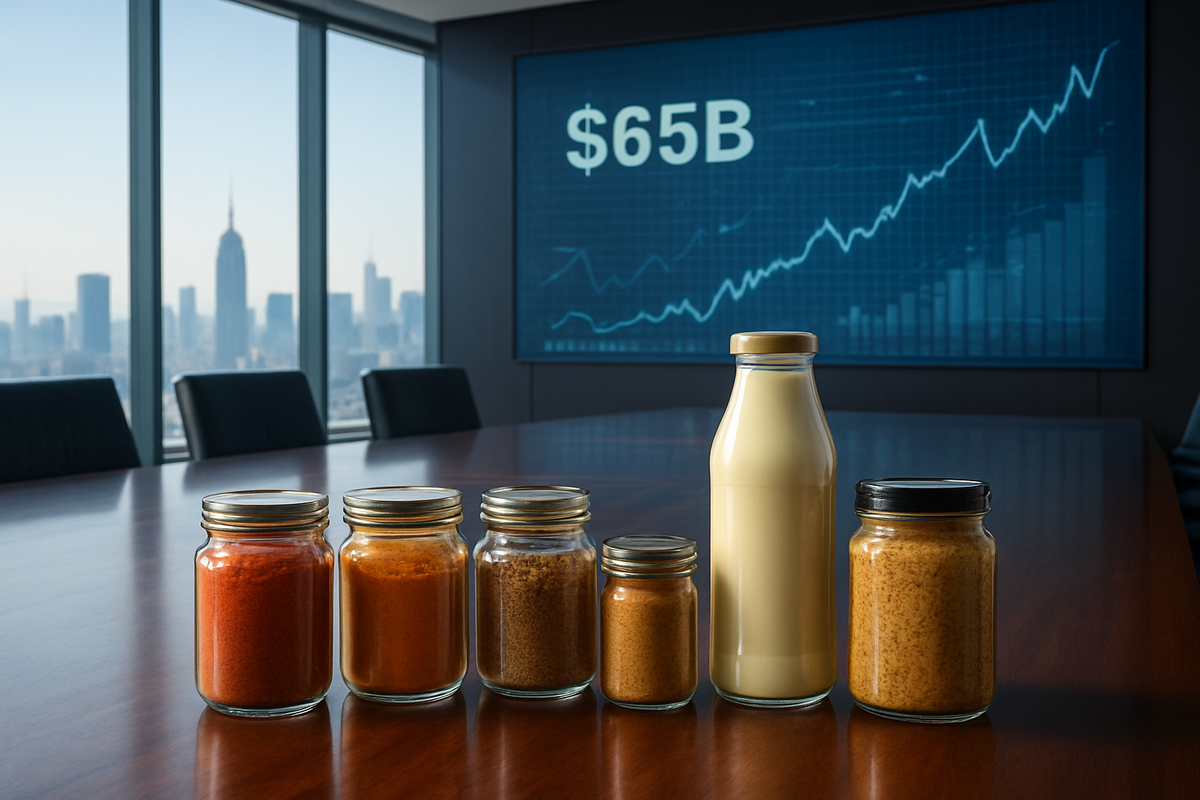
The consumer staples landscape was fundamentally altered this week as McCormick & Company (NYSE: MKC) and Unilever (NYSE: UL) announced a definitive agreement to merge Unilever’s massive food division with the spice-and-flavor leader. The deal, valued at approximately $65 billion for the combined entity, represents the largest transaction in the history of the flavorings and condiments industry. By absorbing iconic brands like Knorr and Hellmann’s, McCormick has transitioned from a dominant spice manufacturer into a global food behemoth, boasting an estimated $20 billion in annual revenue and an unparalleled footprint in both home kitchens and professional restaurants.
The merger is structured as a Reverse Morris Trust to optimize tax efficiency, a complex move that leaves Unilever shareholders with a 65% stake in the newly formed "McCormick Global Foods" while granting McCormick’s management operational control. This strategic pivot marks the end of Unilever’s century-long era as a food conglomerate, as the London-based giant fully commits to its high-growth beauty and personal care segments. For the broader market, the deal signals a "super-scaling" trend among consumer staples companies looking to defend their margins against persistent inflation and the rise of private-label competitors.
A New Era for the Global Spice Rack: Inside the $65 Billion Merger
The road to this historic merger began in earnest in early 2024, when Unilever (NYSE: UL) CEO Hein Schumacher announced a massive restructuring that included the spin-off of its ice cream business. Throughout 2025, rumors intensified that Unilever’s "Nutrition" business—comprising household staples like Knorr soups and Hellmann’s mayonnaise—was also on the chopping block as the company sought to shed lower-margin assets. The deal was officially inked on March 31, 2026, following months of secretive negotiations held in Baltimore and London. Under the terms of the agreement, McCormick (NYSE: MKC) will provide a $15.7 billion cash payment to Unilever, funded through a combination of new debt and bridge financing, to secure the merger.
The combination brings together a "who's who" of the grocery store. McCormick’s existing portfolio, which already includes French’s Mustard, Frank’s RedHot, and Cholula, will now sit alongside Unilever’s global powerhouses. Knorr, Unilever's largest brand, gives the combined company a massive foothold in emerging markets across Asia and Latin America, while Hellmann’s secures its dominance in the North American and European condiment categories. Industry analysts have dubbed the new entity a "front-of-house and back-of-house" powerhouse, noting that the merger unites McCormick’s retail strength with Unilever’s deep relationships in the commercial food service sector through "Unilever Food Solutions."
Initial market reactions have been cautiously optimistic, though McCormick’s stock saw a 4% dip immediately following the announcement due to concerns over the $15 billion debt load required to fund the cash portion of the deal. Conversely, Unilever shares rose 6% in London as investors cheered the company’s transition into a "pure-play" beauty and wellness firm. Institutional investors are currently weighing the long-term potential for $600 million in projected annual cost synergies against the execution risks inherent in merging two distinct corporate cultures across 150 different global markets.
Winners and Losers in the Super-Scaled Grocery Aisle
The primary winner in this transaction is arguably McCormick (NYSE: MKC), which has effectively insulated itself from being an acquisition target by becoming too large to swallow. By controlling everything from the salt and pepper on the table to the mayonnaise in the sandwich and the bouillon in the soup, McCormick now possesses immense bargaining power over retailers like Walmart (NYSE: WMT) and Kroger (NYSE: KR). Furthermore, Unilever (NYSE: UL) emerges as a leaner, more focused competitor in the high-margin beauty space, finally free from the slower-growth drag of its legacy food brands.
On the losing side of the ledger, Kraft Heinz (NASDAQ: KHC) faces a daunting new reality. For decades, Kraft Heinz and Unilever were the "Big Two" in condiments and dressings. With Hellmann’s and French’s now under the same roof, Kraft Heinz’s Mayo and Mustard brands face a competitor with significantly more scale and R&D budget. Similarly, smaller, specialized flavor houses may find themselves squeezed as McCormick leverages its new global distribution network to push its premium brands into markets where it previously lacked a presence.
Investors in the broader consumer staples sector are also watching Nestlé (OTC: NSRGY) closely. As the world’s largest food company, Nestlé now faces a more formidable rival in the "flavor solutions" space. While Nestlé remains dominant in coffee and pet care, the McCormick-Unilever merger creates a "category captain" in seasonings and condiments that could dictate shelf-space terms in a way that challenges Nestlé’s Maggi brand in European and Asian markets.
The "Flavor-First" Strategy: Why Scale Matters in 2026
This mega-deal is the latest and most significant example of a broader consolidation trend sweeping the consumer staples sector. In an era where AI-driven growth has sucked most of the oxygen out of the equity markets, staples companies are using massive M&A to prove their value to investors. By creating "defensive scale," these companies can better absorb the shocks of volatile commodity prices and supply chain disruptions that have characterized the mid-2020s.
Furthermore, the "GLP-1 effect"—referring to the widespread use of weight-loss drugs—has fundamentally changed consumer behavior. As people eat smaller portions, the quality and intensity of flavor become more important than the bulk quantity of food. This shift favors a company like McCormick, which specializes in high-intensity flavor additives (spices and hot sauces) rather than high-calorie processed meals. The acquisition of Knorr and Hellmann’s allows McCormick to apply its "flavor-first" R&D to a much broader range of products that fit the post-GLP-1 diet.
From a regulatory standpoint, the deal is expected to face intense scrutiny from the Federal Trade Commission (FTC) in the U.S. and the European Commission. Regulators are increasingly wary of "conglomerate power," where a single company controls multiple adjacent categories in the grocery store. While there is little direct overlap in spices (where McCormick is king), the overlap in condiments (Hellmann's vs. French's) will likely require some brand divestitures to satisfy antitrust concerns. The precedent set by the Mars-Kellanova deal in 2024 suggests that regulators may allow such mergers if the companies can prove that the scale leads to lower prices for consumers—a tall order in a high-inflation environment.
Integration Hurdles and the Path Forward
The immediate future for the new McCormick Global Foods will be defined by integration and deleveraging. Management has committed to a "synergy roadmap" that aims to shave $600 million off annual operating costs by 2029, primarily through consolidating manufacturing plants and streamlining global logistics. However, the short-term challenge will be managing the $15 billion in new debt. If interest rates remain elevated through late 2026, the cost of servicing this debt could eat into the very margins the merger was designed to protect.
Strategically, the combined company will likely pivot toward a "digital-first" flavor model. By combining McCormick’s proprietary flavor data with Unilever’s vast consumer insights, the company hopes to use AI to predict the next global taste trends before they hit the mainstream. We can expect a rapid expansion of the "Cholula" and "Frank’s RedHot" brands into Knorr’s international distribution channels, potentially turning these American favorites into global staples within the next three years.
The success of this merger will ultimately hinge on whether McCormick can maintain its "small-company feel" for innovation while managing a workforce that has more than tripled overnight. Cultural integration is often where these mega-deals fail, and the clash between McCormick’s Baltimore-centric heritage and Unilever’s Anglo-Dutch multinational complexity will be a key area for analysts to monitor during the transition period in 2027.
Final Assessment: A High-Stakes Bet on the Global Palate
The McCormick-Unilever merger is a watershed moment for the financial markets, representing a bold bet that scale and flavor are the ultimate hedges against a volatile global economy. By securing a $65 billion footprint, McCormick has not just bought a collection of brands; it has bought a seat at the head of the table for the future of the global food industry. The deal effectively ends the era of the "unwieldy conglomerate" for Unilever and begins the era of the "specialized behemoth" for McCormick.
For investors, the coming months will be a period of "wait and see." Key metrics to watch will include the progress of antitrust approvals in the EU and the specific brands McCormick may be forced to sell off to appease regulators. Additionally, the company’s ability to maintain its quarterly dividend while servicing its massive new debt load will be a litmus test for its financial health.
In conclusion, the creation of McCormick Global Foods signifies that in the 2026 market, being big is no longer enough—you have to be indispensable. By owning the brands that define how the world tastes its food, McCormick is betting that no matter how the economy fluctuates, the global consumer will never lose their appetite for flavor.
This content is intended for informational purposes only and is not financial advice