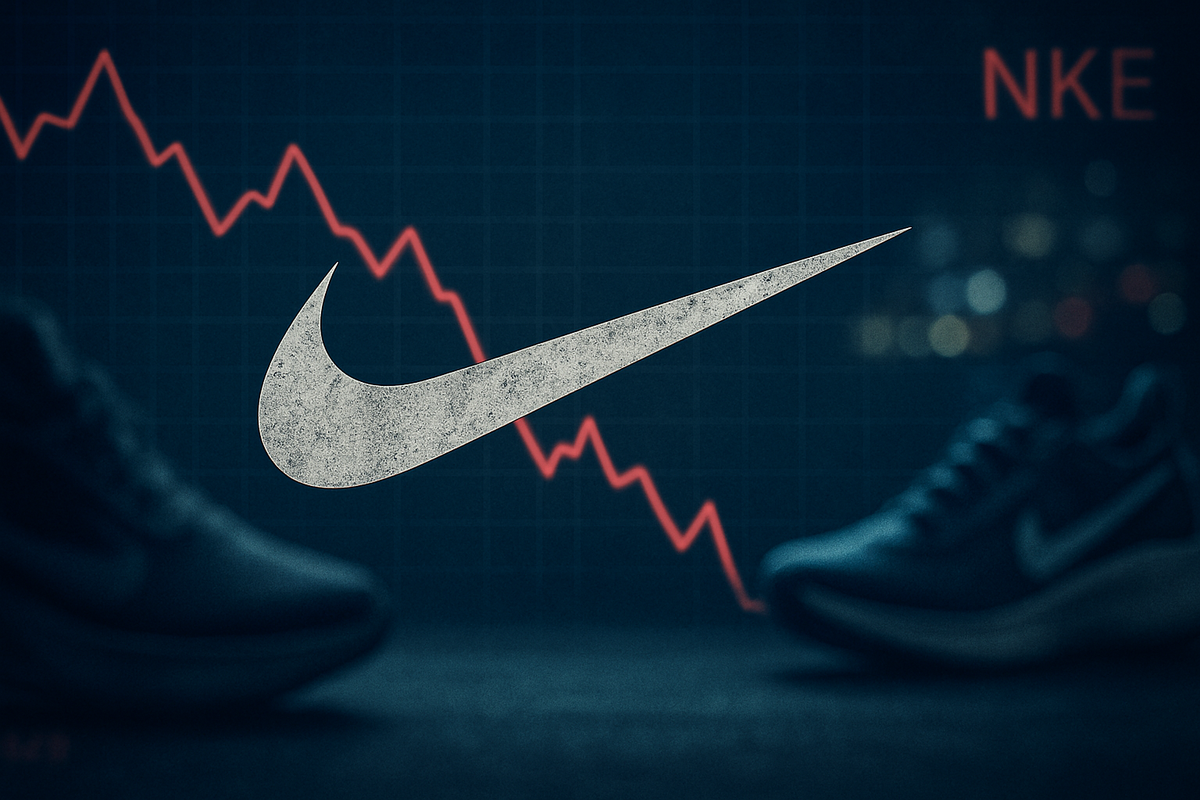
The world’s largest sportswear brand is facing a crisis of confidence as its stock price cratered to an eight-year low this week. Nike Inc. (NYSE: NKE) saw its shares tumble to $42.09 on April 7, 2026, marking a staggering 70% decline from its 2021 all-time highs. The drop comes as the "Swoosh" struggles to regain its footing under CEO Elliott Hill, who returned from retirement in late 2024 to steer the company back toward its performance-running roots.
The immediate implications for the market are stark: Nike’s struggles have signaled a broader cooling in the premium athletic apparel sector, once considered recession-proof. As the company issues a dire Q3 FY2026 guidance, investors are questioning whether the brand’s "Win Now" recovery strategy is moving fast enough to counter a perfect storm of slowing consumer demand in North America, a revenue collapse in Greater China, and new, aggressive trade policies impacting margins.
A Timeline of Turbulence and the April Guidance Shock
The current downturn is the culmination of a multi-year period of strategic misalignment that began under former CEO John Donahoe. Donahoe’s aggressive pivot toward a Direct-to-Consumer (DTC) model and away from traditional wholesale partners left a void in physical retail that more agile competitors were quick to fill. When Elliott Hill took the helm in October 2024, he was tasked with an "identity restoration," prioritizing sport-first innovation and repairing relationships with retail giants like Foot Locker (NYSE: FL) and Amazon (NASDAQ: AMZN).
However, the timeline of recovery has proved longer than Wall Street anticipated. Throughout 2025, Nike spent heavily on "clearing the deck," discounting billions in overstocked lifestyle franchises like the Air Force 1 and Dunk to make way for new performance gear. While Hill’s internal restructuring brought back veteran talent and narrowed the focus to athlete-led innovation, the financial results have yet to follow. On April 1, 2026, Nike sent shockwaves through the market by warning of a 20% projected sales decline in Greater China for the upcoming quarter, alongside a significant margin contraction.
Initial industry reactions were swift and severe. In early April 2026, a wave of downgrades hit the stock, with Goldman Sachs (NYSE: GS) and JPMorgan (NYSE: JPM) both moving to "Neutral" ratings. Analysts cited an "elongated timeline" for revenue inflection, noting that Nike’s formerly reliable growth engine in Asia is now a liability. The stock suffered a 15% single-day drop following the guidance, as institutional investors lost patience with the "wait-and-see" narrative that has dominated the Hill era.
Sector Winners and Losers: The Great Sportswear Reversal
While Nike (NYSE: NKE) falters, the competitive landscape has shifted dramatically, creating clear winners in the "performance" race. On Holding AG (NYSE: ONON) and Hoka, a subsidiary of Deckers Outdoor Corporation (NYSE: DECK), have emerged as the primary beneficiaries of Nike’s innovation lag. By mid-April 2026, On Holding’s market share in the U.S. premium running category surged to 9%, while Hoka hit 10%, both capturing consumers who have moved away from Nike’s "lifestyle" sneakers in favor of maximalist cushioning and technical excellence.
Adidas (OTC:ADDYY) has also staged a significant comeback, with analysts reporting a 13% growth rate for the German brand in early 2026. By leaning into retro-style "brand heat" with its Samba and Gazelle lines, Adidas has effectively reclaimed the lifestyle crown that Nike abdicated. Conversely, traditional wholesale partners like Foot Locker (NYSE: FL) and JD Sports (LON:JD) find themselves in a precarious position; while they welcome Nike’s return to their shelves, the overall slowdown in Nike’s "cool factor" has led to sluggish foot traffic in brick-and-mortar stores.
The biggest loser in this reshuffling, however, remains Nike’s China division. Local "nationalistic" brands such as Anta Sports (HKG:2020) and Li-Ning (HKG:2331) have successfully leveraged the "guochao" trend, capitalizing on Chinese consumers’ shifting preferences toward domestic labels. For Nike, the loss of market share in China is not just a temporary dip but a structural challenge that threatens its long-term valuation.
Broader Significance: Tariffs, Trends, and Trade Policy
Nike’s current predicament is a microcosm of larger macroeconomic and industry trends. The athletic apparel sector is currently navigating the "Great Reversal," where the pandemic-era boom in athleisure has given way to "consumer fatigue." Shoppers in 2026 are increasingly price-sensitive, making $150+ sneakers a difficult sell amidst high interest rates and persistent inflation. This has led to a 5% contraction in the premium sportswear segment overall.
Furthermore, the "Liberation Day Tariffs" enacted in 2025 have hit Nike particularly hard. Analysts estimate that these trade policies have added an additional $1.5 billion in annual costs to Nike’s supply chain, resulting in a 300-basis-point contraction in gross margins. This regulatory headwind has forced Nike to choose between raising prices—potentially alienating a wary consumer—or absorbing the costs and further damaging its bottom line.
Historically, Nike has used major sporting events to reset its narrative. However, unlike previous cycles where Nike dominated the conversation, the brand is now fighting for oxygen against nimble competitors who are quicker to adopt new technologies like "maximalist" foams. The current situation mirrors the late 1990s when Nike faced similar concerns over market saturation and innovation stagnation, but the global scale and the rise of digital-native competitors make the current crisis significantly more complex.
The Road to the 2026 World Cup: Strategic Pivots Ahead
Looking forward, the short-term outlook for Nike remains defensive. The company is banking heavily on "Project Amplify," a new innovation pipeline featuring the Pegasus 42 and the Aero-FIT technology—a body-mapped cooling system—designed to debut during the 2026 FIFA World Cup. As a primary sponsor of the event, which kicks off in North America this June, Nike is treating the tournament as a "must-win" marketing catalyst to prove its performance credentials to a global audience.
Strategic adaptations are also occurring in the lifestyle space. In a surprising move to recapture the women’s market from Lululemon Athletica (NASDAQ: LULU), Nike recently launched "NikeSkims," a high-profile collaboration with Kim Kardashian’s brand. This pivot toward "personalization and style" represents a departure from Hill’s "sport-only" focus, suggesting that the company realizes performance alone may not be enough to satisfy shareholders. Long-term, the success of these initiatives will depend on whether Nike can successfully transition its manufacturing base to mitigate tariff impacts while simultaneously reigniting brand desire in a fragmented market.
Investor Wrap-Up: What to Watch in the Coming Months
The key takeaway for investors in April 2026 is that Nike is no longer the "safe haven" it once was. The stock’s descent to an eight-year low reflects a company in the painful middle innings of a structural turnaround. While the dividend remains a draw for some, a high 94% payout ratio and compressed 40.2% gross margins suggest that the company’s financial flexibility is reaching its limit.
Moving forward, the market will be hyper-focused on Nike's performance during the upcoming World Cup and whether "Project Amplify" can translate into actual sell-through at retail. Investors should also watch for any signs of a bottoming out in the China market; until revenue there stabilizes, the stock is likely to remain in a volatile range. For now, the consensus remains a cautious "Hold," with most analysts not expecting a broad-based growth inflection until late fiscal year 2027. The Swoosh is down, but it isn't out—though the climb back to the top of the mountain has never looked steeper.
This content is intended for informational purposes only and is not financial advice.