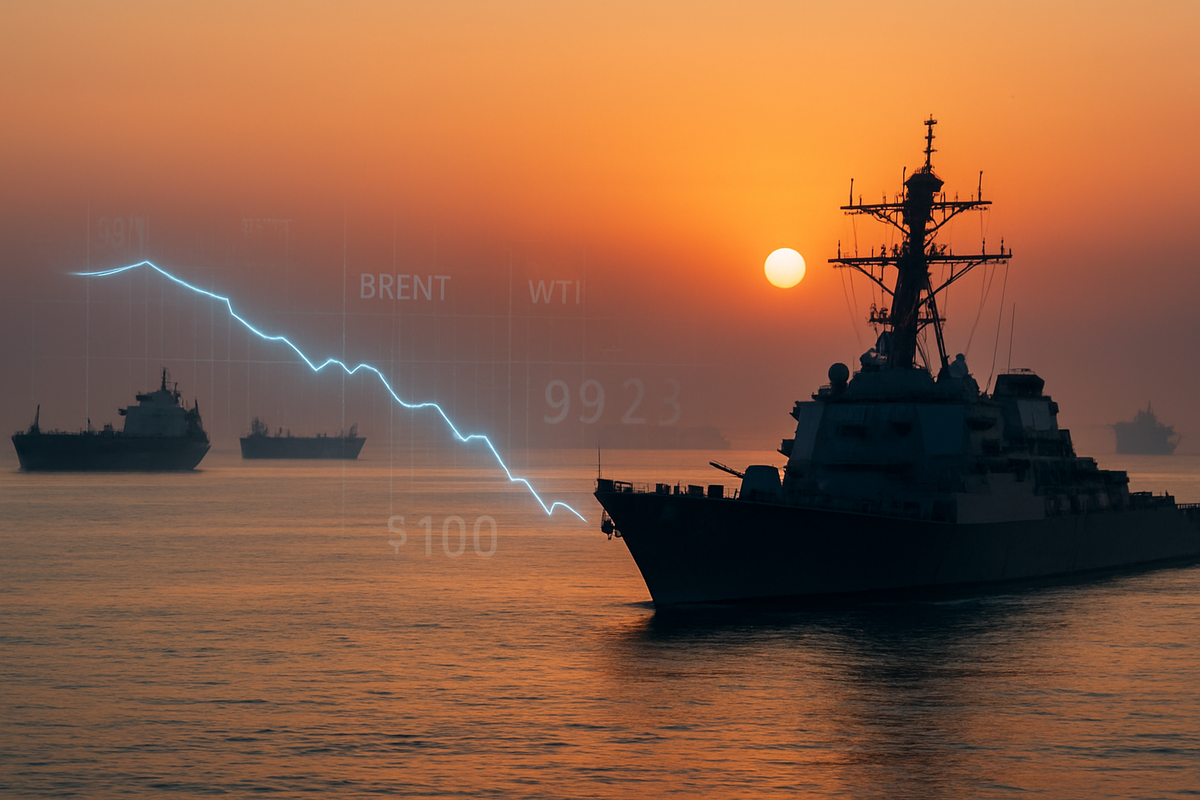
The global energy market witnessed a surprising reversal on Tuesday as oil prices retreated below the psychological $100-per-barrel mark. Brent crude, the international benchmark, fell to $98.76, while West Texas Intermediate (WTI) slipped to $96.72. This downward movement comes despite the escalating military situation in the Middle East, where the United States has officially initiated a naval blockade of Iranian ports, suggesting that traders are pricing in the potential for a last-minute diplomatic breakthrough before a full-scale regional conflict erupts.
The current market behavior reflects a complex tug-of-war between immediate supply disruptions and long-term geopolitical posturing. While the blockade represents one of the most aggressive U.S. foreign policy moves in decades, the dip in prices indicates that investors are banking on a new truce, mediated by regional powers like Pakistan and Turkey. This "cautious optimism" has provided a brief respite for a global economy that has been reeling from energy-driven inflationary pressures over the past quarter.
Escalation in the Gulf: The Road to the Blockade
The current crisis reached a breaking point on Monday, April 13, 2026, at 10:00 a.m. EDT, when U.S. Central Command (CENTCOM) began enforcing a comprehensive naval blockade of all Iranian maritime exit points. This move followed the dramatic collapse of the Islamabad Talks over the weekend, where mediation efforts led by Pakistani Prime Minister Shehbaz Sharif failed to secure a permanent nuclear and maritime security agreement. The U.S. administration, led by President Trump, had demanded a 20-year moratorium on Iranian uranium enrichment and guaranteed "unfettered freedom of navigation" in the Persian Gulf—terms that Tehran has thus far flatly rejected as "modern-day piracy."
The timeline leading to this confrontation began earlier this month on April 8, when a fragile two-week ceasefire was initially brokered. However, as the deadline for a permanent deal approached, negotiations stalled over the specific mechanisms for lifting sanctions. The resulting blockade has effectively paralyzed Iran's official oil exports and neutralized its "dark fleet" of tankers that previously navigated around international sanctions. On Monday, the Rich Starry, a massive tanker carrying crude destined for Chinese refiners, was reportedly forced to turn back from the entrance of the Strait of Hormuz just minutes after the blockade was declared.
Despite the military maneuver, the U.S. has strategically labeled this a "partial blockade," specifically targeting Iranian-origin cargo while technically allowing neutral traffic to transit the Strait of Hormuz. This nuance, combined with reports that a second round of emergency negotiations may be scheduled before the current ceasefire technically expires on April 22, has allowed the market to temper its initial panic. Initial reactions saw Brent spike near $110 on Monday morning before the current retreat to $98.76 as speculators began betting on a "de-escalation through strength" scenario.
Winners and Losers: Market Leaders Shift Gears
The sudden shift in the energy landscape has created a polarized environment for public companies. Major U.S.-based energy producers like ExxonMobil (NYSE: XOM) and Chevron (NYSE: CVX) are navigating a dual reality; while the price dip slightly trims their immediate margins, the long-term removal of Iranian supply from the global market cements their position as the primary "swing" providers for Europe and Asia. Similarly, Occidental Petroleum (NYSE: OXY) has seen increased interest as domestic production becomes a matter of national security rather than just economic utility.
On the defense side, the implementation of a high-tech naval blockade has driven renewed interest in Lockheed Martin (NYSE: LMT) and Northrop Grumman (NYSE: NOC). These companies provide the advanced surveillance, drone technology, and missile defense systems currently being deployed by CENTCOM to monitor the Persian Gulf and protect neutral shipping from potential Iranian retaliation. Conversely, the transportation sector is feeling the strain. Major carriers such as Delta Air Lines (NYSE: DAL) and American Airlines (NASDAQ: AAL) are facing volatile fuel hedging environments, as the threat of a sudden price spike back above $120 remains a distinct possibility if the blockade turns into a hot war.
Maritime logistics firms are also seeing a massive divergence. Tanker companies with fleets operating outside the immediate conflict zone, such as Frontline plc (NYSE: FRO) and Scorpio Tankers (NYSE: STNG), have seen their stock prices buoyed by surging "war risk" insurance premiums and the necessity of longer voyages to bypass the Gulf. However, chemical giants like BASF (OTC:BASFY) are under significant pressure as the blockade has triggered a 30% spike in global fertilizer and petrochemical feedstock prices, which are heavily sourced from the Middle Eastern region.
Analyzing the Geopolitical Ripple Effects
The 2026 blockade is being viewed by historians and market analysts as a pivotal moment that echoes the 1973 Arab Oil Embargo and the "Tanker War" of the 1980s. However, unlike the 1980s, where the U.S. primarily acted as an escort for neutral ships, the current proactive blockade represents a paradigm shift in energy diplomacy. By cutting off Iran's economic lifeblood while keeping the Strait of Hormuz technically open for other Gulf nations, the U.S. is attempting to isolate Tehran without alienating other OPEC+ members.
The wider significance lies in the potential permanent restructuring of global oil flows. If the blockade continues, it will force China and India—the primary buyers of Iranian crude—to seek alternative supplies from the Americas or Africa, likely leading to a long-term premium on non-Middle Eastern oil. Furthermore, the regulatory environment is shifting toward stricter maritime oversight, with the International Maritime Organization (IMO) currently debating new emergency protocols for "conflict-zone transit" that could permanently increase the cost of global shipping.
There are also significant policy implications for the transition to renewable energy. This crisis has reignited the "energy independence" debate in Washington D.C. and Brussels. While some argue that high oil prices should accelerate the shift to electric vehicles, others contend that the immediate need for energy security necessitates a massive reinvestment in domestic fossil fuel infrastructure. This tension is likely to dominate the upcoming legislative cycles in both the U.S. and the E.U.
The Horizon: Truce or Total Conflict?
The immediate future of the market hinges on the dates between now and April 22. If the "Islamabad 2.0" talks materialize and result in a truce extension, oil prices could stabilize in the $90 range as the "war premium" evaporates. However, if Iran follows through on its threat that "no port in the region will be safe," the resulting retaliatory strikes on Saudi or Emirati infrastructure could send oil prices soaring toward $150 in a matter of days.
The short-term challenge for investors is distinguishing between diplomatic theater and genuine strategic pivots. Market opportunities may emerge in the liquefied natural gas (LNG) sector, as any disruption in the Gulf will make U.S. LNG exports even more critical to global stability. Companies like Cheniere Energy (NYSE: LNG) are positioned to become the bedrock of the Atlantic energy trade if the Middle Eastern supply remains contested.
In the longer term, the market must prepare for a "new normal" of higher volatility. The era of cheap, reliable energy flows through the Persian Gulf is being challenged by a return to great-power competition. Strategic adaptations will likely include more aggressive domestic drilling in the Permian Basin and a massive expansion of the Strategic Petroleum Reserve (SPR) by various nations to buffer against such sudden naval interventions.
Market Outlook and Final Thoughts
The dip below $100 is a testament to the market's enduring hope for peace, even in the face of naval maneuvers. However, this stability is fragile. The U.S. blockade of Iranian ports has fundamentally changed the risk profile of the energy sector, shifting it from a commodity play to a geopolitical one. The key takeaway for the market is that while supply remains physically available for now, the "geopolitical friction" of moving that supply is at its highest point in thirty years.
Moving forward, the market is expected to remain in a "wait-and-see" pattern, with heavy sensitivity to any headlines coming out of Islamabad or the White House. Investors should watch the April 22 ceasefire deadline with extreme scrutiny, as it will likely serve as the catalyst for the next major leg in oil's price discovery.
For the savvy investor, the current dip below $100 may represent a brief window of opportunity before the next wave of volatility. Whether this leads to a permanent de-escalation or is simply the "eye of the storm" remains to be seen, but the events of mid-April 2026 have already left an indelible mark on the global financial landscape.
This content is intended for informational purposes only and is not financial advice.