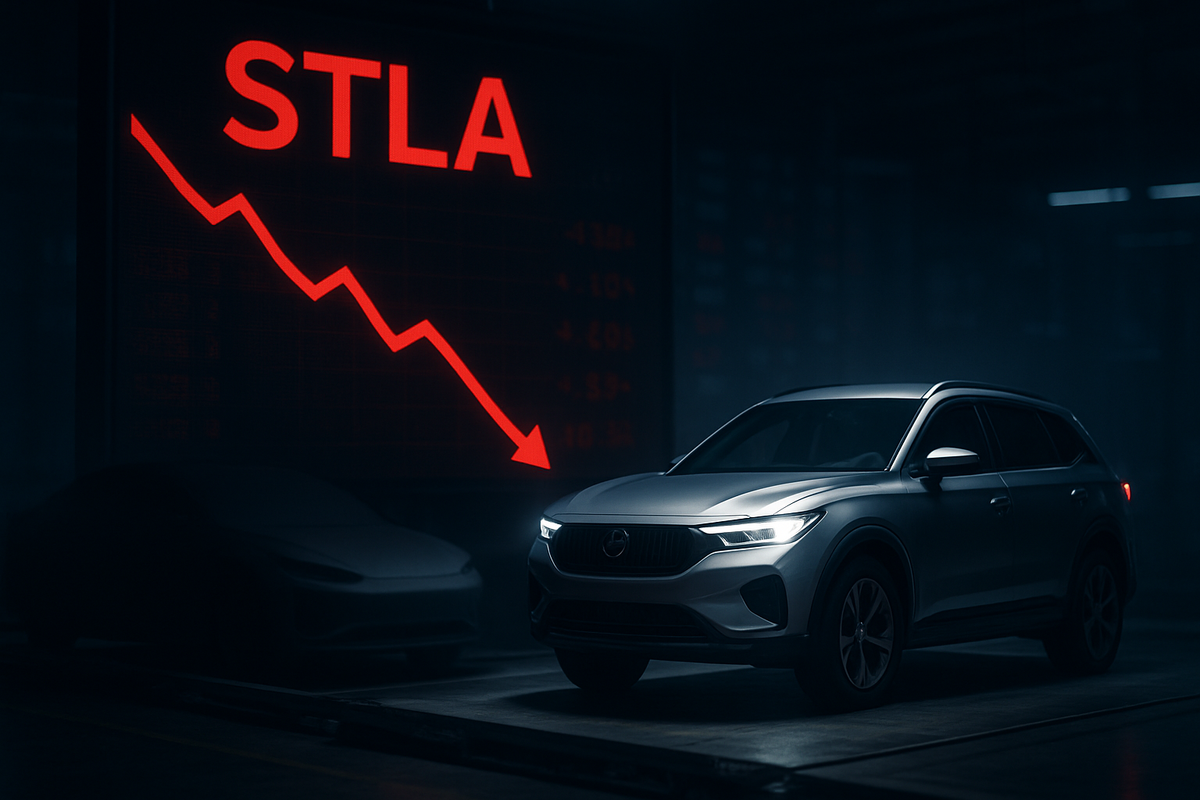
AMSTERDAM — In a day of unprecedented volatility for the global automotive sector, Stellantis NV (NYSE: STLA) saw its stock price crater by more than 24% on Friday, February 6, 2026. The collapse followed a grim financial disclosure in which the world’s fourth-largest automaker announced a staggering €22.2 billion ($26.5 billion) in one-time charges for the second half of 2025. The massive write-down signals a desperate and costly retreat from the company’s once-ambitious electrification goals, as it grapples with cooling consumer demand, operational missteps, and a shifting geopolitical landscape.
The market reaction was swift and merciless, wiping out billions in market capitalization in the first few hours of trading. Analysts have characterized the event as a "reckoning" for the legacy automaker, which is now forced to suspend its dividend and issue €5 billion in hybrid bonds just to stabilize its balance sheet. The move highlights a dramatic shift in strategy under CEO Antonio Filosa, who took the helm last year following the sudden departure of Carlos Tavares. Filosa’s "Freedom of Choice" plan effectively dismantles the "Dare Forward 2030" roadmap, prioritizing traditional hybrids and range-extended vehicles over the pure-battery electric vehicles (BEVs) that the company had previously touted as its future.
The $26.5 billion charge announced today is one of the largest in automotive history, reflecting a total overhaul of the company’s product and manufacturing footprint. Approximately $17.3 billion of the charge is tied directly to the cancellation of several high-profile BEV programs, including the much-anticipated Ram 1500 REV and several European small-car platforms that were deemed no longer viable. Another $2.5 billion was allocated for "resizing" the EV supply chain, while billions more were set aside for increased warranty provisions and workforce reductions across its European and North American operations.
This financial catastrophe did not occur in a vacuum. The seeds were sown throughout late 2024 and 2025, a period marked by "bloated" inventory levels in the United States and a series of quality concerns that eroded consumer trust. As the transition to electric vehicles hit a global "adoption chasm," Stellantis found itself with a surplus of expensive, unsold EVs while demand for its core internal combustion and hybrid models remained under-served. The situation was further exacerbated by the return of the Trump administration in the United States, which quickly moved to roll back federal EV subsidies and imposed 25% tariffs on vehicles imported from Mexico and Canada—a move that cost Stellantis an estimated $1.7 billion in 2025 alone.
Key stakeholders, including the Peugeot family and Italy's Exor, have reportedly backed Filosa’s "scorched earth" approach to cleaning up the balance sheet. During an emergency earnings call, Filosa was blunt in his assessment, blaming the previous management for "overestimating the pace of the energy transition" and "poor operational execution." By taking the full hit now, Filosa hopes to pivot the company toward more profitable, albeit less "green," segments, such as range-extended electric vehicles (EREVs) and traditional hybrids that are proving more popular with 2026 car buyers.
The fallout from Stellantis's collapse has created a clear divergence in the market. The primary beneficiary appears to be Toyota Motor Corp (NYSE: TM), which reported record-breaking hybrid sales on the same day Stellantis announced its crisis. Toyota’s long-standing skepticism of an all-electric future now appears prescient, as its electrified vehicle mix reached nearly 47% of total sales, allowing it to raise its full-year guidance while Stellantis retreats. Similarly, General Motors (NYSE: GM) and Ford Motor Company (NYSE: F) have shown relative resilience; both companies took their own multi-billion dollar write-downs in late 2025 but have successfully pivoted back to high-margin gasoline SUVs and trucks, leaving Stellantis as the late-comer to the restructuring party.
On the losing side, the battery supply chain is facing a localized depression. LG Energy Solution (KRX: 373220) was forced to buy back Stellantis's 49% stake in their Windsor, Ontario, joint venture for a nominal sum after Stellantis evaporated its demand for EV cells. That facility is now being converted to produce stationary energy storage systems (ESS) instead of car batteries. Samsung SDI (KRX: 006400) has faced similar challenges, with three of its four production lines in Indiana being repurposed for non-automotive uses. Tier-1 suppliers like Forvia (EPA: FRVIA) and Valeo (EPA: FR) also saw their shares slide, as Stellantis is a major customer whose reduced volumes will necessitate further cost-cutting across the European supply base.
Stellantis’s 24% drop is more than just a company-specific failure; it is a bellwether for the wider automotive industry’s struggle to balance regulatory mandates with market reality. For years, European and North American regulators pushed for aggressive EV adoption, but the infrastructure lag and high price points have led to a consumer revolt. Stellantis’s decision to abandon its BEV-first strategy suggests that even the largest manufacturers cannot force a transition that the average consumer is not yet willing to pay for.
This event is likely to trigger a regulatory re-evaluation in both Brussels and Washington. With one of the world’s largest employers in financial distress, there is growing pressure on the EU to delay its 2035 ban on new internal combustion engines. In the U.S., the Stellantis crisis provides political ammunition for the current administration's push toward "energy neutrality," effectively ending the era of government-mandated electrification. The historical precedent for such a move is the "Big Three" bailout of 2008, though this time the crisis is driven not by a credit crunch, but by a strategic miscalculation regarding the speed of technological adoption.
In the short term, Stellantis must navigate a period of intense austerity. The suspension of the dividend and the new €5 billion bond issuance are designed to provide a liquidity bridge as the company works through its "90-day inventory bloat" in the U.S. market. Investors should expect a leaner, more regionalized Stellantis, with Filosa empowering local teams to make decisions that were previously centralized in Amsterdam. This could lead to the pruning of underperforming brands within the 14-brand portfolio, with Chrysler and Lancia often cited by analysts as potential targets for discontinuation or sale.
Long-term, the company’s survival depends on its ability to execute the new "Freedom of Choice" strategy. By focusing on EREVs—vehicles that use a small gasoline engine to charge a battery while driving—Stellantis hopes to capture the segment of the market that desires electric performance without "range anxiety." If this pivot succeeds, Stellantis could emerge as a highly profitable, "technology-agnostic" manufacturer. However, the path to recovery is narrow, and any further macroeconomic shocks or trade wars could push the company toward a more permanent contraction or even a merger with a rival like Renault.
The events of February 6, 2026, will likely be remembered as the day the automotive industry’s "EV-at-all-costs" era officially ended. The $26.5 billion charge taken by Stellantis is a sobering reminder that financial sustainability cannot be sacrificed at the altar of ideological goals. For the market, the message is clear: execution and consumer demand are the only metrics that ultimately matter.
Moving forward, investors should keep a close eye on Stellantis’s monthly inventory levels and the performance of its new hybrid launches. The company has essentially hit the "reset" button, and while the 24% drop in share price is painful, it may provide the necessary bottom from which a more realistic business model can be built. For now, however, Stellantis remains a "show-me" story, and the ghost of Carlos Tavares’s aggressive expansion will continue to haunt the balance sheet for years to come.
This content is intended for informational purposes only and is not financial advice.