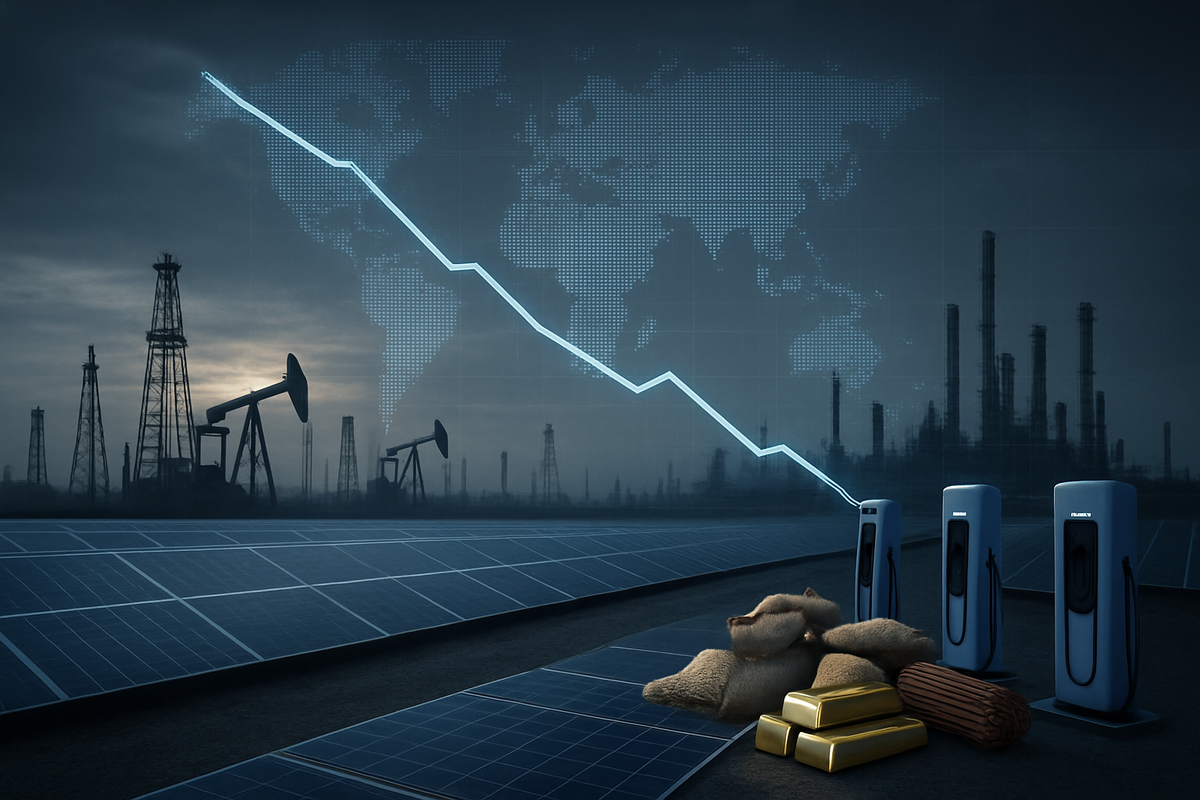
The global economic landscape is facing a profound shift as the World Bank’s latest "Commodity Markets Outlook," released in early February 2026, forecasts that commodity prices will plummet to their lowest levels in six years. This decline marks the fourth consecutive year of retreating prices, signaling the definitive end of the post-pandemic price surge. Driven by a combination of a massive global oil surplus and a cooling global economy—now projected to grow at a modest 2.6% this year—the report paints a challenging picture for commodity-dependent nations while offering a potential reprieve for global inflation.
The immediate implications are twofold: while lower energy and food costs may finally allow central banks to pivot toward more aggressive rate cuts, the "oil glut" looms over the geopolitical landscape. With Brent crude projected to average just $60 per barrel in 2026, down from $81 in 2024, the fiscal stability of major exporters is being put to the test. This deflationary trend in commodities arrives at a time when global trade is already slowing due to the expiration of the "front-loading" effect, where businesses rushed to stockpile goods in late 2025 ahead of anticipated tariff hikes and trade policy shifts.
The Great Oil Glut and the 2.6% Ceiling
The centerpiece of the World Bank’s 2026 report is the projection of a staggering oil surplus, estimated to be 65% larger than the record-breaking glut seen during the 2020 pandemic. This oversupply is not merely a temporary fluctuation but the result of structural shifts in the global economy. Specifically, oil demand in China—the world’s primary engine for energy consumption—has essentially flattened. This stagnation is compounded by the rapid adoption of electric vehicles (EVs); in China alone, over 40% of new car sales were electric or hybrid by the start of 2026, permanently displacing traditional fuel demand.
Leading up to this moment, the market had seen a fragile balance maintained by OPEC+ production cuts. However, the surge in non-OPEC+ supply, particularly from the United States, Brazil, and Guyana, has overwhelmed these efforts. The World Bank notes that the 2020s are currently on track to be the weakest decade for global growth since the 1960s. While the U.S. economy remains a rare bright spot—accounting for a significant portion of the upward revision to the 2.6% global growth forecast—the rest of the world is struggling with the transition away from the high-inflation, high-commodity-price era of 2021-2024.
Initial market reactions to the report have been mixed. While energy-heavy indices saw a temporary spike in January due to extreme winter weather in North America, the long-term futures for Brent and West Texas Intermediate (WTI) have continued their downward trajectory. Meanwhile, the precious metals sector has decoupled from the broader commodity slump, with gold prices reaching record highs as investors seek "safe haven" assets to hedge against the persistent policy uncertainty and trade tensions cited in the World Bank’s findings.
Winners and Losers in a Deflationary Commodity Market
The shift toward a low-price environment creates a stark divide between industrial sectors. Traditional oil majors like ExxonMobil (NYSE: XOM) and Chevron (NYSE: CVX) are facing significant headwinds. With crude prices suppressed near the $60 mark, these companies are being forced to prioritize capital discipline and potentially scale back high-cost exploration projects. Conversely, the "oil glut" is a tailwind for the transportation and logistics sectors, as well as consumer-facing giants like Procter & Gamble (NYSE: PG) and PepsiCo (NASDAQ: PEP), which stand to benefit from lower raw material and shipping costs, potentially expanding their profit margins after years of inflationary pressure.
The mining sector presents a more nuanced picture. While diversified miners like Rio Tinto (NYSE: RIO) and BHP Group (NYSE: BHP) are seeing lower realized prices for industrial metals, the push for the energy transition provides a floor for specific "green" commodities. However, the World Bank warns that even these metals are not immune to the broader economic slowdown. In contrast, Newmont Corporation (NYSE: NEM) and other gold producers are thriving as the World Bank highlights that gold remains the primary hedge against the "policy uncertainty" that currently plagues international trade routes and tariff discussions.
For the agricultural sector, the news is a double-edged sword. Companies like Archer-Daniels-Midland (NYSE: ADM) and Bunge (NYSE: BG) are navigating a market where food prices—specifically rice and wheat—are expected to fall. While this is a victory for global food security and a major factor in cooling global inflation to a projected 2.6%, it compresses the margins for large-scale agricultural exporters and could lead to reduced farm income in major producing regions like the Midwest and Brazil.
Structural Shifts and Historical Precedents
The current trend represents more than just a cyclical downturn; it is a realignment of the global trade order. The World Bank notes that the "front-loading" of trade in 2025—a defensive move by corporations to move goods before new tariffs were enacted—has left a vacuum in 2026. This has created a "trade hangover" that is suppressing demand for raw materials and industrial components. The report draws a comparison to the commodity price collapses of the mid-1980s and 2014-2016, suggesting that the market may be entering a prolonged period of "lower for longer" prices.
Regulatory and policy implications are significant, particularly for emerging markets. Two-thirds of developing economies rely heavily on commodity exports for their national budgets. For these nations, the World Bank’s outlook is a clarion call for diversification. The persistent policy uncertainty mentioned in the report—largely revolving around fluctuating trade agreements and carbon border adjustment taxes—makes it difficult for these countries to attract the long-term investment needed to transition their economies away from resource extraction.
Furthermore, the rise of the EV market as a primary driver of the oil surplus highlights a successful policy shift in many jurisdictions. The transition that began as a regulatory push in the European Union and China has now reached a critical mass, where market forces are doing the work that subsidies once did. This permanent shift in demand suggests that even a future economic recovery may not bring oil prices back to the $100 levels seen in previous decades.
The Road Ahead: Strategic Pivots and Scenarios
In the short term, commodity-exporting nations must prepare for fiscal tightening. We are likely to see a wave of sovereign debt restructuring or increased reliance on International Monetary Fund (IMF) support as revenue from oil and minerals dries up. Strategically, the World Bank suggests that these nations must pivot toward developing their service sectors or investing in "value-added" processing of their raw materials rather than simply exporting the raw ore or crude.
For the private sector, the next 18 to 24 months will be defined by an emphasis on efficiency and technology. Energy companies may accelerate their transition into renewable power or carbon capture technologies to diversify their revenue streams. Meanwhile, the "market opportunities" will likely lie in the intersection of low commodity prices and high-tech manufacturing. As the cost of inputs like energy and industrial metals falls, the barriers to entry for large-scale infrastructure and green energy projects may decrease, potentially sparking a new wave of investment in the late 2020s.
Summary and Investor Outlook
The World Bank’s 2026 Commodity Markets Outlook confirms that the era of scarcity and soaring prices has passed. Key takeaways include the forecast of a 2.6% global growth rate, a massive 65% surplus in the oil market, and a fourth consecutive year of falling commodity prices. While this is a positive development for global inflation—which is expected to settle around 2.6%—it presents a formidable challenge for commodity exporters and traditional energy firms.
Moving forward, the market will be characterized by high volatility in the face of "policy uncertainty." Investors should watch for the "divergence" the World Bank describes: a world where the U.S. and AI-driven sectors provide growth, while traditional resource-dependent regions struggle. In the coming months, the focus should remain on gold as a hedge, the pace of EV adoption in emerging markets, and any potential supply-side interventions from OPEC+ that could attempt to floor the falling oil price.
This content is intended for informational purposes only and is not financial advice.