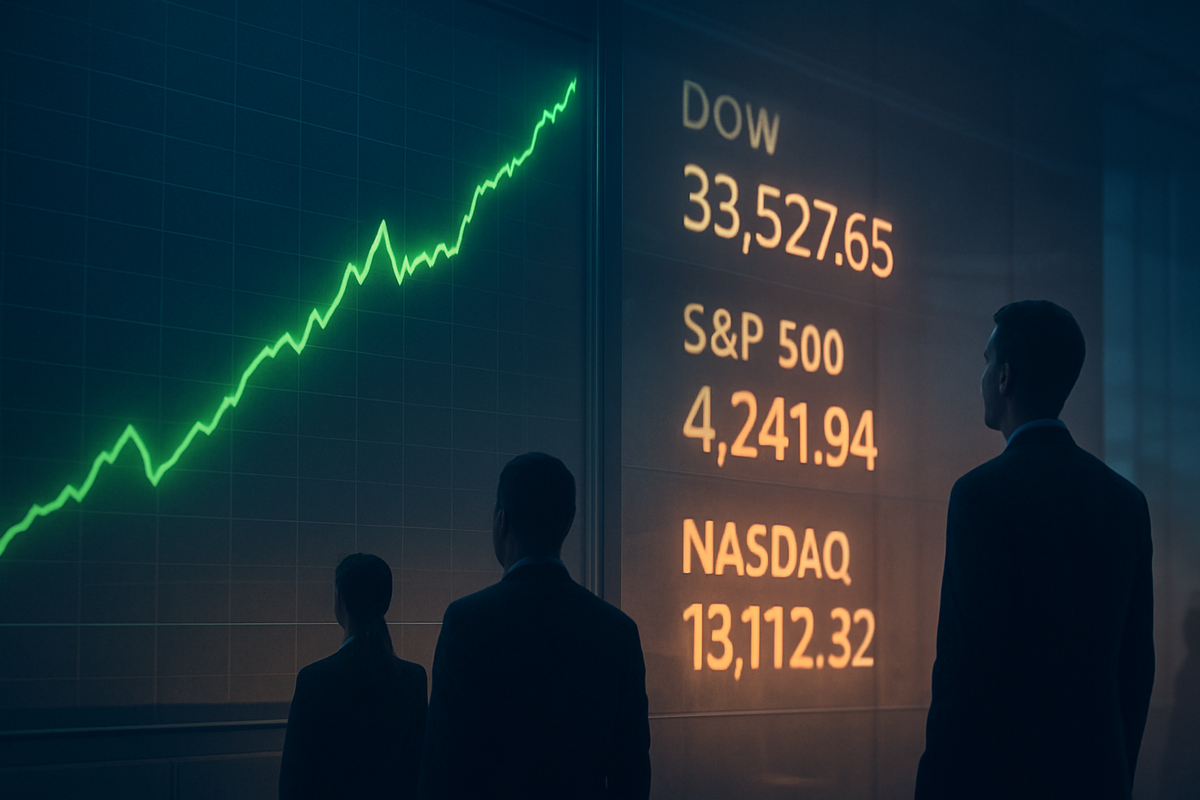
As the first full week of trading in 2026 commences, the exuberant "risk-on" sentiment that defined the previous three years appears to have hit a formidable ceiling. After a historic run from 2023 through 2025, the major U.S. indices—the Dow Jones Industrial Average, the S&P 500, and the Nasdaq Composite—are showing signs of a significant flatline. Investors, once eager to buy every dip, are now grappling with a "market hangover" as the tailwinds of artificial intelligence speculation and aggressive monetary easing begin to lose their potency.
The immediate implications are clear: the "Santa Claus rally" that typically ushers in the New Year failed to materialize for the third consecutive year, with the S&P 500 slipping 0.1% over the holiday window. This stagnation suggests a fundamental shift in market psychology. The narrative is no longer about how high stocks can go on potential alone, but rather how well they can support their current, historically high valuations in an environment of "sticky" inflation and shifting leadership at the Federal Reserve.
A New Year's Stagnation: The Numbers Behind the Fade
The performance of the major averages in early January 2026 tells a story of exhaustion. The Dow Jones Industrial Average (INDEXDJX: .DJI) is currently hovering near 48,382, struggling to gather the momentum necessary to pierce the psychologically significant 50,000 mark. While it has managed a meager gain of approximately 0.6% in the opening sessions of the year, this is a far cry from the double-digit surges seen in the previous two years. Similarly, the S&P 500 (INDEXSP: .INX) is trading around 6,858, up a marginal 0.2% year-to-date, following a robust 16.4% gain in 2025.
The Nasdaq Composite (INDEXNASDAQ: .IXIC) has borne the brunt of this cooling sentiment, currently sitting near 23,235. The tech-heavy index recently endured a five-session losing streak, its longest skid in months, as investors began to rotate out of high-flying megacap growth names. This "flatlining" is not merely a statistical anomaly but the result of a "show-me" phase in the market. The timeline leading to this moment was paved by a 2025 that saw massive capital expenditures in AI infrastructure; now, as we enter Q1 2026, the market is demanding tangible evidence that these investments are translating into bottom-line growth.
Key stakeholders, including institutional fund managers and retail investors, are also navigating the "Powell Pause." With Federal Reserve Chair Jerome Powell’s term set to expire in May 2026, a leadership vacuum has emerged. The lack of a confirmed successor has introduced a layer of policy uncertainty that is keeping many large-scale buyers on the sidelines. Initial market reactions have been characterized by low volume and high sensitivity to even minor economic data points, as the "valuation trade" officially replaces the "momentum trade."
Winners and Losers in the Great Rotation
As the broad indices stall, a massive internal rotation is creating a stark divide between winners and losers. The primary casualties of the early 2026 flatline are the former darlings of the growth era. Tesla (NASDAQ: TSLA) has emerged as a significant loser, with its shares under pressure following disappointing Q4 2025 delivery data and a valuation that many analysts now view as unsustainable. Similarly, Apple (NASDAQ: AAPL) has struggled to find its footing, as high valuations and a perceived lack of "next-gen" hardware innovation have led the stock to underperform its peers.
Conversely, the "old economy" and value-oriented sectors are finding renewed favor. Exxon Mobil (NYSE: XOM) has become a standout winner, buoyed by a "geopolitical tailwind" and strong demand for energy infrastructure. Barron’s recently highlighted the energy giant as a top pick for 2026, citing its solid free cash flow and attractive earnings multiples. Other winners include industrial stalwarts like Caterpillar (NYSE: CAT), which is benefiting from ongoing reshoring trends and domestic infrastructure projects that were greenlit in late 2025.
The tech giants are increasingly fragmented. While Microsoft (NASDAQ: MSFT) and Alphabet (NASDAQ: GOOGL) remain core holdings for many, they are currently "hovering at the flatline" as investors scrutinize their cloud and AI revenue streams. Nvidia (NASDAQ: NVDA) remains the market's focal point, but even the chipmaker is no longer immune to volatility. Despite a strong showing at CES 2026, the stock is facing a "valuation grind" as the market shifts its focus from the hardware of AI to the software and services that must eventually pay the bills.
Historical Precedents and the "Valuation Grind"
The current market environment bears a striking resemblance to previous periods where multi-year rallies hit a wall of reality. Analysts are drawing parallels to the year 2000, when extreme concentration in tech stocks eventually led to a severe bear market, and 2021, when the pandemic-era stimulus rally transitioned into a "sideways chop" before the 2022 downturn. However, unlike the systemic collapse of 2008, the 2026 flatline appears to be a "valuation grind" rather than a total unwinding of the financial system.
This event fits into a broader industry trend of "AI fatigue." After three years of relentless hype, the market is now pricing in the reality that AI integration takes time and significant capital. Furthermore, the implementation of new tariff policies in late 2025 has introduced stagflationary fears—slow growth paired with higher prices—that are weighing on consumer discretionary stocks like Amazon (NASDAQ: AMZN) and Walmart (NYSE: WMT). These regulatory and trade shifts are creating ripple effects across global supply chains, forcing companies to prioritize resilience over pure growth.
Historically, when the "average" stock (the Equal-Weight S&P 500) begins to outperform the market-cap-weighted index, it signals a healthy broadening of the market—or a painful transition. In early 2026, we are seeing the latter. The "Magnificent Seven" momentum trade is yielding to a regime focused on capital discipline. As Barron’s columnist Ben Levisohn recently noted, "the cracks appearing in 2025 have widened," and the market is now forced to confront the fact that high interest rates (currently at 3.5%–3.75%) are likely to remain for longer than many had hoped.
The Road Ahead: Strategic Pivots and the January 28 Fed Meeting
Looking forward, the short-term trajectory of the market will likely be determined by the Federal Reserve's January 28 meeting. While most of Wall Street expects the Fed to hold rates steady, any hawkish commentary regarding the persistence of 3% inflation could trigger a deeper correction in growth stocks. Long-term, the market is awaiting clarity on the Fed's leadership transition in May. A more hawkish successor to Powell could dampen the prospects for the two interest rate cuts currently projected for later in 2026.
Companies are already beginning to pivot their strategies in response to this flatlining market. We are likely to see a wave of "capital discipline" initiatives, where tech firms prioritize buybacks and dividends over speculative R&D. For investors, the challenge will be identifying "quality" companies with strong balance sheets that can weather a period of stagnant index growth. Market opportunities may emerge in defensive sectors like Utilities and Precious Metals, which have historically performed well during periods of equity market exhaustion.
Potential scenarios for the remainder of 2026 range from a "soft landing" where the indices trade sideways for the entire year, to a more pronounced "valuation reset" if Q1 earnings fail to meet the high growth expectations of 13.1%. The "show-me" phase is officially here, and the margin for error for corporate America has never been thinner.
Closing the Chapter on Irrational Exuberance
The fading market risk rally of early 2026 serves as a stark reminder that no bull market lasts forever. The transition from a momentum-driven environment to one defined by fundamentals is often a painful process for investors accustomed to easy gains. The key takeaway from this "flatline" is that the market has finally reached a point where potential is no longer enough; performance is the only currency that matters.
Moving forward, the market is likely to remain in a "wait-and-see" mode. Investors should keep a close eye on the core PCE inflation data and the upcoming Q1 earnings season, which will provide the first real test of whether the AI build-out is generating actual profit. While the broad indices may not offer the fireworks of previous years, the internal rotation suggests that there are still opportunities for those willing to look beyond the megacap names.
In the coming months, the significance of this flatline will become clearer. Whether it is a temporary pause or the beginning of a larger secular shift, the "Wall of Reality" has been hit. For the savvy investor, the focus must now shift from chasing the rally to preserving capital and seeking out the few remaining pockets of value in a market that has, for now, run out of steam.
This content is intended for informational purposes only and is not financial advice.