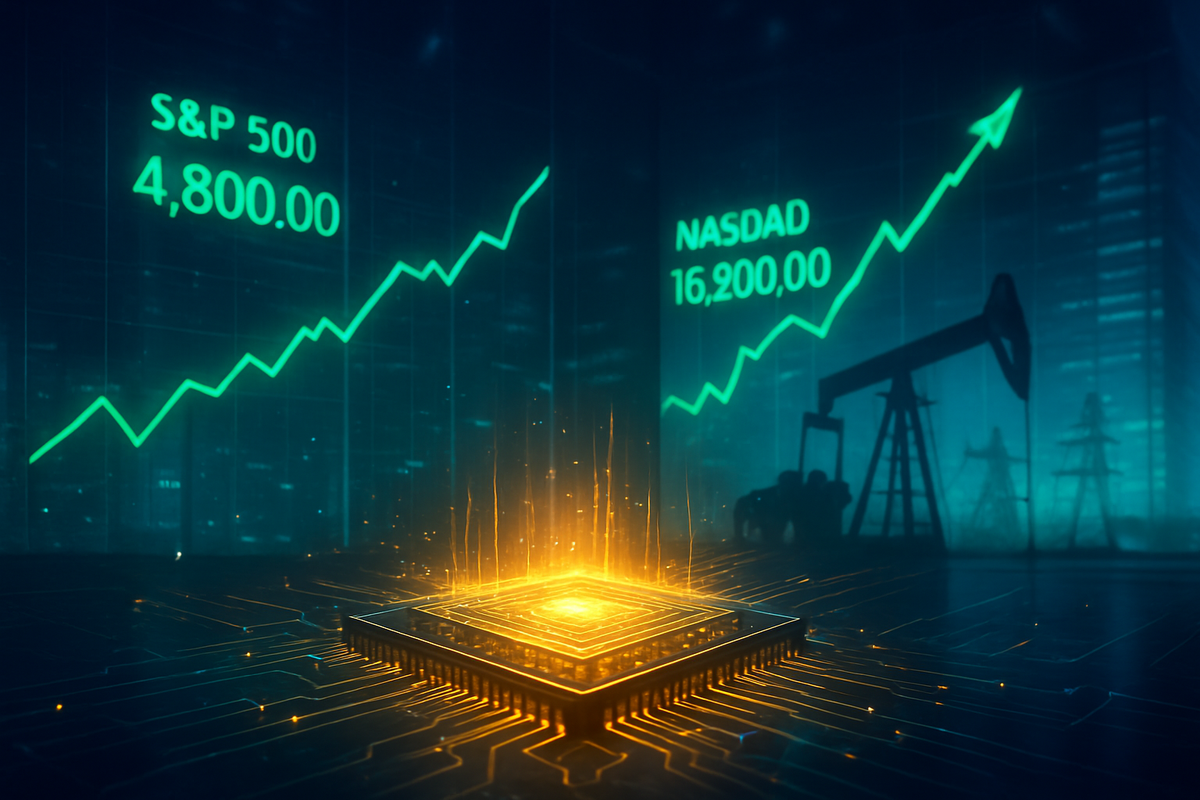
The first week of 2026 has delivered a masterclass in market resilience, as the "New Year Rally" propelled major U.S. indices to historic heights. Following a blockbuster 2025, the momentum has shown no signs of fatigue, with the Dow Jones Industrial Average (DJIA) shattering the 49,000 mark for the first time in history during intraday trading on January 6, 2026. This surge is not merely a continuation of seasonal optimism but is underpinned by a rare alignment of geopolitical breakthroughs, a transformative "Second Wave" of Artificial Intelligence (AI) monetization, and a tactical rotation into high-quality large-cap equities.
The immediate implications are clear: investor appetite for risk remains robust despite "sticky" inflation and a Federal Reserve that is moving cautiously on interest rates. The rally has effectively silenced skeptics who predicted an early-year correction, suggesting that the "Goldilocks" environment—where growth remains steady while inflation is just low enough to prevent further rate hikes—is firmly entrenched for the start of the year. As the S&P 500 and Nasdaq Composite trade at or near all-time records, the focus has shifted from whether the market can sustain these levels to how much higher the ceiling can go.
A Perfect Storm of Catalysts: From Caracas to Las Vegas
The timeline of this historic week began with a weekend geopolitical shock that few saw coming. Between January 3 and January 4, 2026, news broke of a successful U.S.-led operation resulting in the capture of Venezuelan President Nicolás Maduro. This "Venezuela Surprise" sent shockwaves through the energy and financial sectors on Monday morning. Markets immediately began pricing in a massive restructuring of the Venezuelan oil industry, which possesses the world’s largest proven crude reserves. The prospect of U.S. energy giants returning to the region to modernize infrastructure ignited a rally in "Old Economy" stocks, providing the necessary fuel for the Dow to reach its record close of 48,977.17 on January 5.
Simultaneously, the 2026 Consumer Electronics Show (CES) in Las Vegas served as a powerful tailwind for the technology sector. Unlike previous years where AI was discussed in theoretical terms, CES 2026 became the stage for "Second Wave AI"—the tangible monetization of the technology through enterprise-grade hardware and software. Key players like Nvidia (NASDAQ: NVDA) and AMD (NASDAQ: AMD) dominated the headlines, with the former unveiling its "Vera Rubin" AI platform. This next-generation superchip, reported to be five times more powerful than its predecessors, signaled to investors that the AI infrastructure build-out is far from over.
The market reaction was swift and decisive. While the S&P 500 climbed to 6,902.05 by the close of January 5, the Nasdaq Composite reclaimed the 23,400 level, buoyed by a frantic "quality haven" rotation. Investors, wary of the 3% inflation rate, began dumping debt-heavy small-cap stocks in favor of tech behemoths with "fortress balance sheets." This flight to quality has created a bifurcated market where the winners are those with the cash reserves to navigate higher-for-longer interest rates.
The Winners and Losers of the New Year Surge
The clear champion of the 2026 opening bell has been SanDisk (NASDAQ: SNDK). Since its high-profile spin-off from Western Digital (NASDAQ: WDC) in early 2025, the company has become a poster child for the AI storage revolution. On January 5 alone, SanDisk shares skyrocketed 24.3%, bringing its total gains since the spin-off to over 800%. The demand for high-speed data storage to support the massive datasets required by the Vera Rubin chips has placed SanDisk at the center of the AI ecosystem. Similarly, memory giant Micron (NASDAQ: MU) saw a 10% jump as supply-demand dynamics for high-bandwidth memory reached a fever pitch.
In the energy sector, Chevron (NYSE: CVX) and ExxonMobil (NYSE: XOM) emerged as the primary beneficiaries of the Venezuelan geopolitical shift. Chevron, which has maintained a persistent, albeit restricted, presence in Venezuela, saw its stock surge 5.1% on expectations of expanded drilling rights and infrastructure contracts. On the financial side, JPMorgan Chase (NYSE: JPM) rose 2.6%, leading the Dow’s charge as investors bet on the investment banking fees that would inevitably flow from the rebuilding of South American energy markets.
However, the rally has not been kind to everyone. Smaller, debt-burdened companies in the Russell 2000 (IWM) have lagged significantly. As the Federal Reserve maintains the benchmark rate at approximately 3.6%, the "sticky" 3% inflation data has cooled hopes for aggressive rate cuts. Retailers like Wayfair (NYSE: W) and RH (NYSE: RH) saw only modest gains, despite a temporary reprieve from furniture tariffs, as consumer discretionary spending remains under pressure from high borrowing costs. The "New Year Rally" is increasingly a story of the "haves" versus the "have-nots," with large-cap tech and energy leading the charge.
AI Monetization and the Geopolitical Reordering
The wider significance of this rally lies in the transition of AI from a speculative bubble to a fundamental driver of corporate earnings. The "Second Wave AI" narrative suggests that the massive capital expenditures of 2024 and 2025 are finally yielding productivity gains. Companies like Vertiv (NYSE: VRT), which specializes in liquid cooling for data centers, are no longer viewed as niche industrial plays but as essential utilities for the digital age. This mirrors the historical precedent of the mid-1990s internet build-out, but with a significantly faster pace of adoption and more robust cash flows.
Furthermore, the events in Venezuela represent a potential pivot in global energy policy. If Venezuela can be successfully reintegrated into the global oil market under U.S. oversight, it could provide a long-term hedge against OPEC+ production cuts and geopolitical instability in the Middle East. This has profound implications for inflation; while "AI-driven inflation" (the rising cost of chips and energy) is a concern, a new flood of Venezuelan crude could significantly lower global energy prices, providing the Fed with the "disinflationary" cover it needs to cut rates later in 2026.
Regulators are also watching closely. The sheer dominance of the "Magnificent Seven" and their successors has raised fresh antitrust concerns. However, the current administration’s focus has shifted toward ensuring the U.S. maintains its lead in the "AI Arms Race," particularly against global competitors. For now, policy implications seem to favor the incumbents, as the strategic importance of companies like Nvidia and Micron to national security outweighs immediate regulatory pressures.
What Lies Ahead: The Path to S&P 7,000
Looking forward, the market’s trajectory will be determined by the upcoming Q4 2025 earnings season, which kicks off in mid-January. Investors will be looking for "proof of life" in AI software revenue. While the hardware providers (Nvidia, SanDisk) have flourished, the next leg of the rally requires software giants like Microsoft (NASDAQ: MSFT) and Alphabet (NASDAQ: GOOGL) to demonstrate that their AI tools are being adopted by enterprise customers at scale. A failure to show this could lead to a short-term "valuation digestion" period.
In the short term, the psychological milestone of 50,000 for the Dow and 7,000 for the S&P 500 are within reach. However, the path is not without obstacles. If inflation remains stuck at 3% or ticks higher, the Federal Reserve may be forced to abandon its planned rate cuts for later in the year, which could spark a sharp reversal in growth stocks. Investors should also keep a close eye on the "Venezuela transition"; any signs of prolonged instability or a failed political transition in Caracas could quickly turn the energy rally into a volatility event.
Navigating the 2026 Bull Market
The first week of 2026 has set a high bar for the rest of the year. The key takeaway is that the market is currently being driven by fundamental shifts—both technological and geopolitical—rather than mere speculation. The "New Year Rally" has confirmed that the AI revolution is entering a more mature, profitable phase, and that the global energy map is being redrawn in ways that favor U.S. large-cap interests.
Moving forward, the market appears poised for further gains, but the "easy money" phase of the rally may be nearing its end. Investors should focus on companies with strong pricing power and low debt-to-equity ratios. The "quality haven" trade is likely to remain the dominant strategy as long as interest rates stay above 3%. Watch for the S&P 500 to test the 7,000 level by the end of the first quarter, provided that the upcoming earnings reports validate the current valuation multiples.
This content is intended for informational purposes only and is not financial advice.