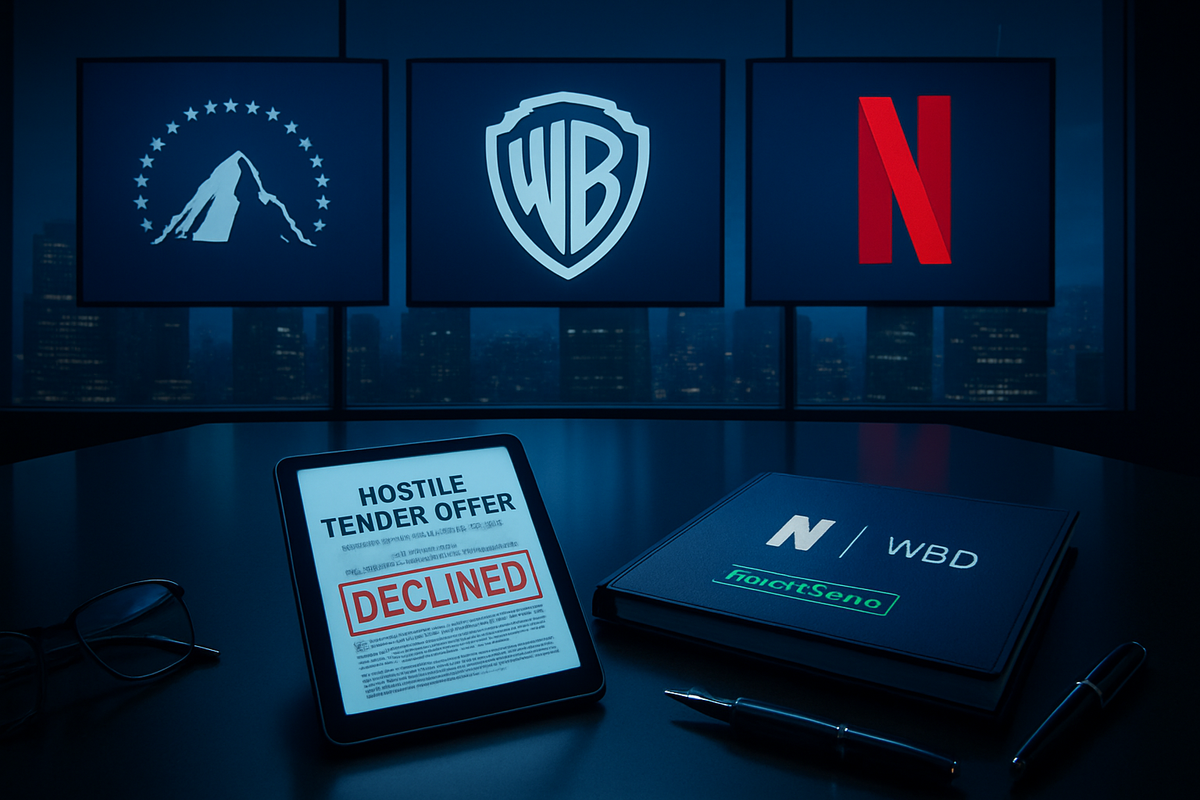
NEW YORK — In a move that has sent shockwaves through the media landscape, the Board of Directors of Warner Bros. Discovery (Nasdaq: WBD) has officially rejected a massive $108.4 billion hostile takeover bid from Paramount Global (Nasdaq: PARA). Despite a headline price that offered a significant premium over current trading levels, the WBD board has chosen to double down on its pre-existing strategic agreement with Netflix (Nasdaq: NFLX). The decision marks a pivotal moment in the "Streaming Wars," signaling that in an era of high interest rates and regulatory scrutiny, deal certainty and balance sheet health have officially eclipsed the allure of the highest bidder.
The rejection, finalized in the second week of January 2026, sets the stage for a protracted legal and corporate battle. Paramount, now operating under the "Paramount Skydance" banner following its own internal consolidation, has responded by filing a lawsuit in the Delaware Court of Chancery. They are seeking to force WBD to open its books and justify why it is pursuing a "sub-optimal" valuation with Netflix when a higher all-cash offer is on the table. For investors, the clash highlights a growing divide in M&A strategy: the choice between a clean, cash-heavy exit and a complex, transformative partnership designed for long-term survival.
A Battle of Balance Sheets and Break-Up Fees
The conflict reached a boiling point on January 7, 2026, when WBD Chairman Samuel A. Di Piazza Jr. issued a scathing letter to shareholders. He characterized the Paramount bid as a "highly risky leveraged buyout" (LBO) that would leave the combined entity under a mountain of nearly $95 billion in new debt. The timeline of this corporate drama began in early December 2025, when WBD first announced its intention to sell its "crown jewels"—the Warner Bros. Studios, HBO, and the Max streaming service—to Netflix for $82.7 billion.
Paramount’s counter-offensive, led by CEO David Ellison and backed by a personal guarantee from Oracle (NYSE: ORCL) founder Larry Ellison, was an attempt to derail that deal. Paramount offered $30 per share in an all-cash tender, significantly higher than the $27.75 per share value of the Netflix transaction. However, the WBD board remained unmoved. Key stakeholders, including major institutional investors, have expressed concern over the "execution risk" of the Paramount bid. Unlike Netflix, which boasts a $400 billion market cap and investment-grade credit, Paramount would have needed to tap volatile debt markets to fund its $108 billion offer, a move WBD’s board deemed "fiscally reckless" in the current 2026 interest rate environment.
Winners, Losers, and the "Discovery Global" Spin-Off
The immediate winner in this standoff appears to be Netflix (Nasdaq: NFLX). By securing the WBD board's loyalty, Netflix is one step closer to absorbing the world’s most storied film library and the HBO prestige brand. This acquisition would give Netflix a projected 43% share of the global streaming market, effectively ending the era of fragmented platform competition. On the other side of the ledger, Paramount Global (Nasdaq: PARA) finds itself in a precarious position. Having been rebuffed, it faces the prospect of being "squeezed out" of the top-tier streaming bracket, potentially forcing it to seek a smaller-scale merger or further asset divestitures.
WBD shareholders face a more nuanced outcome. While they are being asked to turn down a higher cash price today, the Netflix deal includes a crucial strategic component: the spin-off of WBD’s linear assets. Under the Netflix plan, CNN, TNT Sports, and the Discovery networks will be carved out into a new standalone company, "Discovery Global." The board argues that as a "pure-play" entity focused on live news and sports, Discovery Global will be a prime acquisition target for companies like Comcast (Nasdaq: CMCSA) or even tech giants seeking live content. For WBD investors, the "loss" of $2.25 per share in the immediate sale is framed as an investment in the future upside of this new, debt-free spin-off.
A New Era for Mega M&A: Regulatory Risk is the New Price
The WBD-Paramount-Netflix triangle reflects a seismic shift in how mega-mergers are evaluated in 2026. Historically, a board's fiduciary duty almost always mandated accepting the highest price. However, the WBD board has prioritized "Regulatory Certainty" as a tangible asset. The Netflix deal includes a massive $5.8 billion reverse termination fee—a "break-up fee" that Netflix must pay WBD if regulators block the merger. Paramount, though claiming a "cleaner" regulatory path, offered a net protection of only $1.1 billion after accounting for the penalties WBD would owe Netflix for breaking their initial contract.
This prioritization of deal certainty is a direct response to the aggressive antitrust environment of the mid-2020s. By choosing the Netflix deal, WBD is gambling that the spin-off of its linear networks will appease the Department of Justice more effectively than a full-scale merger with another traditional media giant like Paramount. This sets a precedent for 2026 and beyond: in the face of "Big Tech" and "Big Media" scrutiny, companies are no longer just looking for the biggest check; they are looking for the exit path with the fewest hurdles.
The Road Ahead: Proxy Wars and Delaware Courts
Looking forward, the immediate focus shifts to the Delaware Court of Chancery and the upcoming WBD 2026 annual meeting. Paramount has already signaled its intent to launch a proxy fight, nominating a rival slate of directors who would be committed to accepting the $108 billion bid. Investors should expect a barrage of "fight letters" and public relations campaigns as both sides attempt to sway institutional voters. In the short term, WBD stock is likely to experience high volatility as the market weighs the probability of Paramount’s hostile bid succeeding against the stability of the Netflix "sure thing."
Should the Netflix deal proceed as planned, the mid-2026 launch of "Discovery Global" will be a major market event. Analysts will be watching to see if this new entity can maintain its carriage fees and advertising revenue without the leverage of a major streaming platform behind it. Conversely, if Paramount’s litigation succeeds in forcing a renegotiation, it could trigger a bidding war that might eventually pull other players like Amazon (Nasdaq: AMZN) or Apple (Nasdaq: AAPL) into the fray, though both have remained cautious of major acquisitions in the current regulatory climate.
Summary for Investors
The rejection of Paramount's hostile bid by Warner Bros. Discovery is a landmark case of a board choosing financial and regulatory stability over headline valuation. For the market, the key takeaways are clear: debt-heavy LBOs are facing increased skepticism, and "deal certainty" has become the primary currency of M&A. Investors should watch for the following in the coming months:
- Litigation Milestones: Any rulings from the Delaware court regarding WBD’s disclosure of the Netflix valuation.
- Proxy Sentiment: Whether major WBD shareholders like Vanguard or BlackRock signal support for the board or the Paramount bid.
- Regulatory Whispers: Preliminary signals from the DOJ or FTC regarding the Netflix-WBD studio merger.
As the industry consolidates, the gap between the "haves"—those with the scale of Netflix—and the "have-nots" like Paramount is widening. For WBD investors, the path chosen by the board is a bet on a leaner, more focused future, even if it means leaving $25 billion on the table in the short term.
This content is intended for informational purposes only and is not financial advice.