As the calendar turns to mid-January 2026, the global financial markets are standing on a precipice. For three years, the "Magnificent 7" have served as the undisputed engines of global equity growth, propelling the S&P 500 to record highs on the back of a relentless Artificial Intelligence (AI) boom. However, as the Q4 2025 earnings season begins this week, a chilling consensus is forming among institutional analysts: the era of "valuation by imagination" is over, and a "priced for perfection" market may finally be forced to pay the piper.
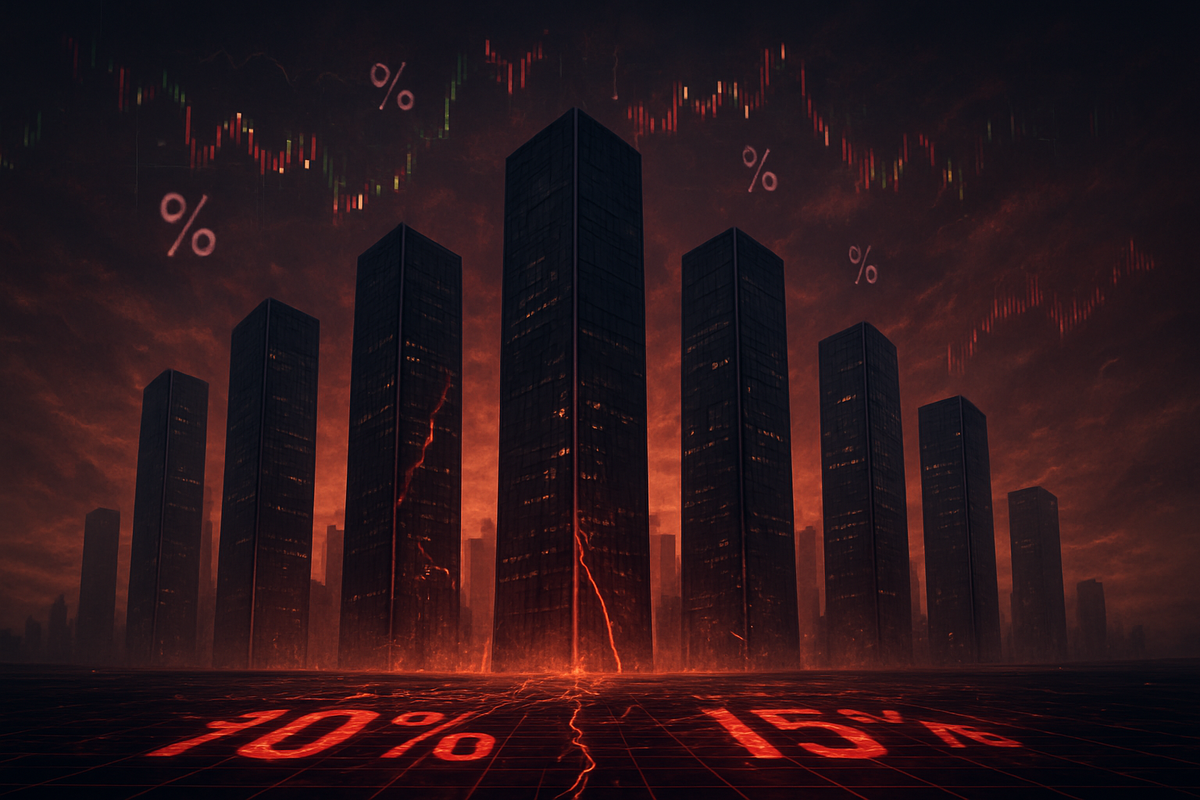
With the current date of January 13, 2026, marking the start of the most high-stakes reporting window in recent history, the immediate implications are clear. Major indices are exhibiting extreme volatility as investors brace for the possibility of a 10% to 15% sell-off. The concentrated nature of the market—where these seven titans now represent nearly one-third of the total S&P 500 market capitalization—means that a single earnings "miss" from a heavyweight like Nvidia (NASDAQ: NVDA) or Microsoft (NASDAQ: MSFT) could trigger a systemic deleveraging event across the entire financial landscape.
The High Cost of Perfection: Inside the 2026 Valuation Trap
The timeline leading to this moment has been characterized by a transition from speculative AI excitement to a demand for tangible "receipts." Throughout 2025, companies like Microsoft (NASDAQ: MSFT) and Alphabet (NASDAQ: GOOGL) poured billions into AI infrastructure, but as of early 2026, enterprise adoption of tools like Copilot remains stuck at approximately 4%. This monetization gap has created a precarious situation where companies are trading at historical premiums—Apple (NASDAQ: AAPL) and Microsoft both hover around 35x forward earnings—despite projections that Magnificent 7 profit growth will decelerate to 18% this year, its lowest level since 2022.
Key stakeholders, including Morgan Stanley (NYSE: MS) CEO Ted Pick and Fundstrat’s Tom Lee, have spent the first two weeks of January issuing stern warnings. The market, they argue, is "walking a tightrope." With a combined AI-related capital expenditure (CapEx) budget exceeding $300 billion among the top players for 2026, investors are no longer satisfied with optimistic guidance. The initial market reaction has been a cautious "Great Rotation," as capital begins to flow out of overextended tech giants and into the "Other 493" companies of the S&P 500, which are expected to see earnings growth of 13% this year, narrowing the gap with Big Tech.
The pressure is particularly intense for Nvidia (NASDAQ: NVDA). Trading at a forward P/E ratio between 40x and 46x, the semiconductor giant has become the ultimate "picks and shovels" proxy. While it remains Wall Street’s favorite, the sheer magnitude of its valuation leaves zero room for error. Any hint of a slowdown in data center demand or further geopolitical friction—such as the recently expanded chip export restrictions to China—could serve as the catalyst for the broader 15% correction that analysts fear.
Winners and Losers in the Looming Volatility
In this climate of reckoning, the "Magnificent 7" are no longer a monolith; a sharp divergence is emerging between the winners who can justify their valuations and the losers who cannot. Tesla (NASDAQ: TSLA) currently finds itself in the most precarious position. Trading at a staggering P/E ratio of over 200x, the company is facing a projected 15% decline in vehicle deliveries for the coming year. As margins continue to compress under the weight of global EV competition, analysts at Goldman Sachs (NYSE: GS) suggest that Tesla may be the first domino to fall in a broader tech reset.
Conversely, Meta Platforms (NASDAQ: META) is being viewed as a potential "value play" within the mega-cap space. Trading at a relatively modest 22x P/E, Meta has successfully integrated AI into its core advertising business, yielding more immediate financial results than its peers' long-term cloud projects. Similarly, Amazon (NASDAQ: AMZN) continues to attract momentum as AWS (Amazon Web Services) re-accelerates toward 20% growth. For these companies, a sector-wide sell-off might present a "buy the dip" opportunity for institutional investors looking for quality over hype.
The broader "losers" in this scenario are the passive index funds and retail investors heavily concentrated in tech-heavy ETFs. Because the Magnificent 7 exert such a gravitational pull on the market, even "good" earnings may not be enough to prevent a decline if the guidance doesn't exceed the "whisper numbers" circulating on trading floors. Meanwhile, mid-cap and small-cap sectors, often ignored during the AI frenzy, are emerging as winners of the capital rotation as investors seek shelter in companies with lower valuations and stable domestic revenue streams.
A Historical Pivot: The End of the AI Hype Cycle?
The significance of the 2026 Reckoning extends far beyond simple stock prices; it marks a structural shift in how the industry operates. This event fits into a broader trend of "Agentic AI," where the focus is moving from generative chatbots to autonomous AI agents that perform actual business workflows. For companies like Alphabet and Microsoft, the challenge is shifting from building models to proving they can replace or augment human labor at a scale that justifies their $300 billion infrastructure investments.
Comparisons to the 2000 dot-com bubble and the 2022 tech reset are frequent. Much like the year 2000, 2026 is seeing a "survivorship" phase where only companies with real free cash flow can sustain their stock prices. However, unlike 2000, today's tech giants are immensely profitably, sitting on mountains of cash. The regulatory landscape also plays a role; renewed tariffs and a "hawkish pause" from the Federal Reserve—which has kept interest rates near 3.75%—have tightened the financial conditions that previously allowed for runaway valuations.
The ripple effects of a 15% sell-off would be felt globally. SoftBank Group and other venture capital powerhouses would likely see a cooling of the private AI market, while hardware partners in Taiwan and South Korea would face immediate pressure on their order books. This is not just a US phenomenon; it is a global recalibration of the "AI Premium" that has dominated international finance since 2023.
The Road Ahead: Strategic Pivots and New Realities
In the short term, the market should expect a "washout" period. A 10% to 15% correction would likely serve as a healthy reset, clearing out "tourist" investors and establishing a more sustainable valuation floor. For the Magnificent 7 to regain their footing, they must pivot their strategies from raw infrastructure build-outs to "value-based fees." Rather than charging flat monthly subscriptions for AI, the next phase of growth will likely involve charging for successful tasks performed by AI agents, a shift that could unlock new revenue streams late in 2026.
Strategic adaptations will be required for the laggards. Apple (NASDAQ: AAPL) may need to accelerate its "AI-first" hardware cycle to prove that the iPhone is still the primary gateway for consumer AI, while Tesla (NASDAQ: TSLA) may be forced to pivot more aggressively toward its robotics and energy storage divisions to justify its "tech" valuation over its "auto" reality. Market opportunities will likely emerge in "AI-adjacent" sectors—energy companies providing the power for data centers and cybersecurity firms protecting the new AI workflows—which currently trade at a fraction of Big Tech's multiples.
Final Reflections on the 2026 Market Landscape
The "Mega-Cap Tech Reckoning" of 2026 is a necessary evolution of a maturing bull market. The key takeaway for investors is that "growth at any price" is no longer a viable strategy. The upcoming earnings reports will serve as a referendum on the AI revolution, separating the companies that have built sustainable ecosystems from those that have merely ridden a wave of liquidity and excitement.
Moving forward, the market will likely be defined by greater dispersion and a return to fundamental analysis. While a 15% pullback would be painful in the immediate term, it would likely set the stage for a more robust, diversified market in the latter half of the decade. Investors should keep a close eye on AI revenue guidance and the Federal Reserve’s stance on inflation throughout the spring. The "Magnificent 7" may remain magnificent, but in 2026, they will finally have to prove they are worth every penny of their "perfection" pricing.
This content is intended for informational purposes only and is not financial advice.