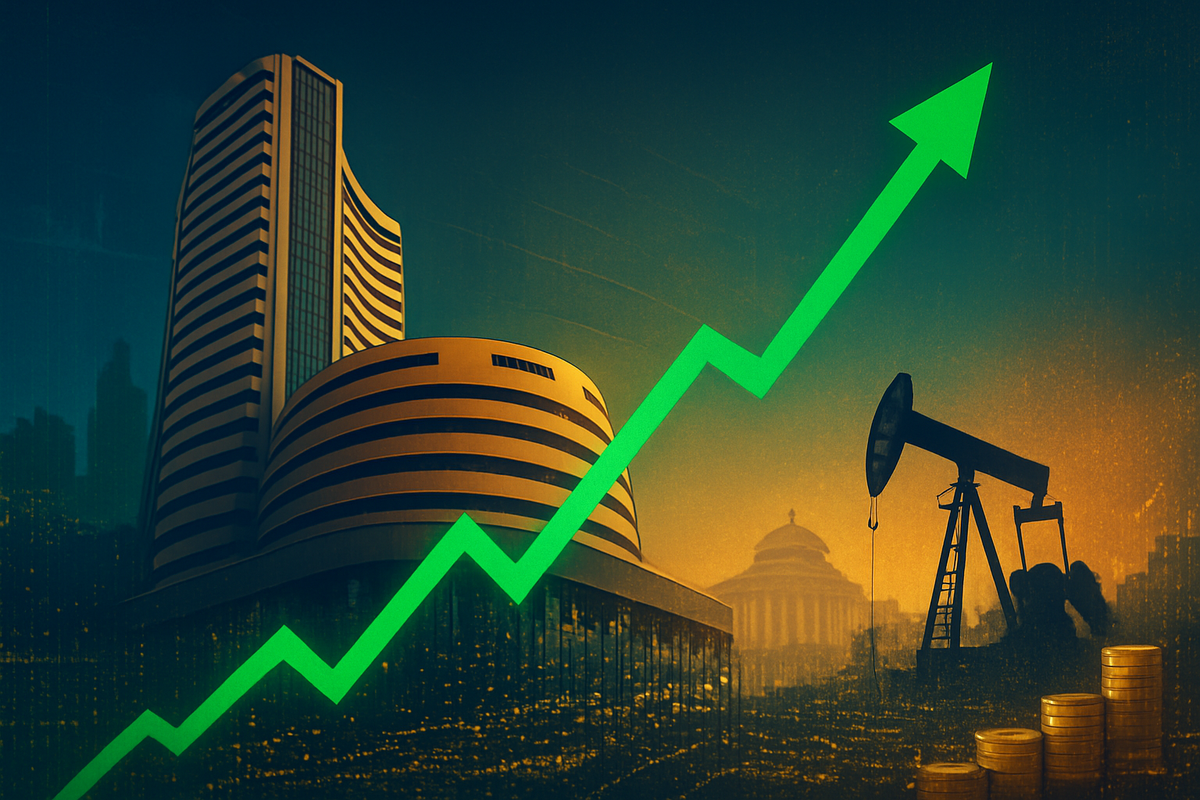
The Indian equity markets staged a powerful recovery over the last two trading sessions, culminating in a significant rebound on Monday, December 22, 2025. The benchmark BSE Sensex and NSE Nifty 50 indices surged as investors reacted to a combination of cooling domestic inflation, aggressive central bank support, and a favorable shift in global monetary policy. This "Santa Rally" has effectively wiped out the anxieties of mid-December, restoring confidence in India’s growth story as the year draws to a close.
The immediate implications of this rally are profound for both institutional and retail investors. With the Nifty 50 reclaiming the psychological 26,100 level, market sentiment has shifted from cautious defensive positioning to a "risk-on" approach. The recovery in the Indian rupee, which had recently faced unprecedented pressure against the US dollar, further stabilized the macro-environment, encouraging a return of Foreign Institutional Investors (FIIs) who had been net sellers for much of the previous quarter.
A Two-Day Resurgence: Deciphering the Market's Momentum
The rebound was characterized by a two-session surge starting on Friday, December 19, and extending through today, Monday, December 22. The BSE Sensex jumped nearly 1,100 points over this period, closing at 85,567.48. Meanwhile, the Nifty 50 (NSE:NIFTY) settled at 26,172.40, gaining approximately 350 points. This rally added nearly ₹4 lakh crore to investor wealth in a single day, bringing the total market capitalization of BSE-listed firms to a staggering ₹475 lakh crore.
The primary catalyst for this surge was the US Federal Reserve’s mid-December meeting, where Chair Jerome Powell signaled a dovish pivot. The Fed delivered its third consecutive 25-basis-point rate cut, bringing the federal funds rate down to the 3.5%–3.75% range. This move, aimed at addressing a softening US labor market, provided the necessary liquidity cushion for emerging markets. Domestically, the Reserve Bank of India (RBI) complemented this global easing by reducing the repo rate by 24 basis points earlier in the month and injecting ₹1.45 lakh crore into the banking system through bond purchases and dollar-rupee swaps.
The currency market also played a pivotal role in the timeline of this rebound. After the Indian rupee breached the 91-per-dollar mark in mid-December, aggressive intervention by the RBI helped the currency recover to the 89.45–89.70 range. This stabilization was the "green light" many foreign investors were waiting for. On December 19 alone, FIIs turned net buyers, purchasing ₹1,831 crore worth of equities, while Domestic Institutional Investors (DIIs) provided a bedrock of support with purchases exceeding ₹5,723 crore.
Winners and Losers: Corporate India’s Market Response
The rally was not uniform across all sectors, creating a distinct set of winners. Trent (NSE:TRENT) emerged as a top performer, surging 3.86% on Monday as analysts pointed toward sustained consumption-led growth and the company's aggressive store expansion strategy. Similarly, Shriram Finance (NSE:SHRIRAMFIN) saw its shares climb 3.67% following news that Japan's MUFG Bank had acquired a 20% stake in the company for ₹39,600 crore, a move seen as a massive vote of confidence in the Indian non-banking financial sector.
The technology sector also witnessed a significant relief rally. Stocks like Wipro (NSE:WIPRO) and Infosys (NSE:INFY) gained between 2% and 3%, tracking the positive performance of their US-listed peers following the Fed's rate cut. Lower interest rates in the US typically translate to higher IT spending by American corporations, which directly benefits India's software exporters. Additionally, Bharti Airtel (NSE:BHARTIARTL) rose 2.0% after its board approved a ₹15,740 crore rights issue aimed at debt reduction, while Bharat Electronics (NSE:BEL) continued its upward trajectory fueled by robust domestic defense orders under the "Make in India" initiative.
Conversely, some heavyweights lagged behind. The State Bank of India (NSE:SBIN) and Kotak Mahindra Bank (NSE:KOTAKBANK) faced mild profit-booking as investors rotated capital into high-growth mid-cap stocks and the IT sector. Larsen & Toubro (NSE:LT) also saw some resistance as the market weighed the impact of fluctuating industrial metal prices on long-term infrastructure margins. These laggards reflect a tactical shift by investors who are currently prioritizing high-yield and growth-oriented assets over traditional defensive banking stocks.
Global Commodities and the Emerging Market Sentiment Shift
The late-2025 market landscape is being heavily influenced by a "goldilocks" scenario in global commodities. Brent crude oil prices have hovered near the lower end of their yearly range, trading between $60 and $65 per barrel. For an oil-dependent economy like India, this serves as a massive tailwind, narrowing the trade deficit and keeping retail inflation in check. November’s CPI inflation stood at a manageable 0.71%, staying well within the RBI’s comfort zone and allowing for the recent accommodative monetary policy.
While energy prices softened, precious metals reached historic heights, with gold touching $4,400 per ounce. This surge in gold and silver—where silver in India passed the ₹2.14 lakh per kg mark—indicates that while investors are buying equities, they remain hedged against potential geopolitical volatility. Industrial metals like copper and aluminum also began a recovery in the fourth quarter of 2025, driven by the insatiable demand for green infrastructure and the power requirements of the global AI boom.
This commodity mix has fundamentally altered sentiment toward Emerging Markets (EMs). As the US dollar softens due to lower interest rates, the "US Exceptionalism" trade that dominated the early 2020s is beginning to fade. Capital is now rotating toward EMs with strong structural stories. India, in particular, is viewed as a "safe harbor" because its domestic consumption-driven economy is relatively insulated from the trade tariff tensions currently affecting other manufacturing-heavy EMs like China or Vietnam.
Looking Ahead: The Path for 2026
As we move toward the new year, the short-term outlook remains cautiously optimistic. The immediate hurdle for the Nifty will be sustaining the 26,200 level. If the current liquidity injection from the RBI and the return of FII buying persist, analysts suggest the Sensex could test the 88,000 mark by the end of the first quarter of 2026. However, any unexpected spike in global oil prices or a reversal in the Fed's dovish stance could quickly dampen this enthusiasm.
Strategic pivots are already visible among major market players. Companies are increasingly focusing on deleveraging—as seen with Bharti Airtel—and seeking strategic global partnerships to bolster their balance sheets. The market opportunity in 2026 is expected to be dominated by the "Green Energy" and "AI-Infrastructure" themes. Investors will likely favor companies that can demonstrate a clear path to integrating AI into their operations or those that are pivotal to India’s energy transition.
Conclusion: A Resilient Finish to a Volatile Year
The December 2025 rebound is more than just a seasonal "Santa Rally"; it is a testament to the resilience of the Indian financial ecosystem. The coordinated efforts between the RBI and the government to manage inflation and currency volatility have provided a stable platform for growth. While global risks—ranging from geopolitical tensions to fluctuating industrial metal costs—remain, the fundamental strength of the Indian economy continues to attract both domestic and international capital.
Moving forward, the market's trajectory will be defined by how well corporate earnings align with these high valuations. Investors should keep a close eye on the January 2026 earnings season, as it will provide the first real evidence of whether the lower interest rate environment is translating into improved bottom lines. For now, the bulls are firmly in control, and Dalal Street looks set to enter 2026 on a high note.
This content is intended for informational purposes only and is not financial advice