 https://pixabay.com/photos/stock-trading-monitor-business-1863880/
Most investors read a breach headline, wince, and move on. That is a mistake. A serious security incident is one of the few public events that exposes how a company actually runs: how it manages data, how fast it detects problems, and how honest it is when something goes wrong. Earnings calls are rehearsed. Breaches are not.
For self-directed investors, this is a usable lens. You do not need to become a security analyst. You need to know what a breach is telling you about the business behind the ticker, and where to look for the details that management would rather you skim past.
Why a breach is a window into management quality
A data breach is rarely just a technical failure. It usually points to underlying choices: underfunded security teams, sprawling vendor relationships nobody fully tracks, or a culture that treats compliance as a box to check. Those same habits tend to show up elsewhere on the balance sheet.
The financial stakes are large enough to move the numbers that matter to you. According to IBM's 2025 Cost of a Data Breach Report, the global average breach cost was $4.44 million, while the average US breach hit a record $10.22 million, driven largely by regulatory fines and slow detection. For a small or mid-cap company, a single major incident can erase a quarter of earnings. For a regulated financial firm, the follow-on costs from fines and lost customers often dwarf the initial cleanup.
What separates a survivable incident from a damaging one is usually detection speed and disclosure honesty. The same IBM data found the average breach took 241 days to identify and contain. A company that finds and reports a problem in weeks is signaling operational discipline. One that gets exposed by outside researchers, or sits on the news for months, is telling you something less flattering about its internal controls.
How to read the incident, not just the headline
When a breach surfaces, the security reporting around it is often more useful than the company's own press release. Independent investigations from outlets like https://cybernews.com regularly uncover the scope of an exposure before the affected company confirms anything, and the Cybernews research team has built a track record of surfacing leaks that companies were slow to acknowledge. Reading that coverage alongside the official statement tells you whether management is being straight with the market or managing the narrative.
The difference is easy to spot once you look for it. In 2025, Cybernews researchers uncovered a collection of roughly 16 billion login records sitting in unsecured databases, and later flagged a separate exposure of around 24 billion credential records, much of it fresh infostealer data rather than recycled old leaks. When that kind of research lands on a company you own, the question is not just "how bad is it" but "how is the company responding compared with what independent investigators already know." A gap between the two is a red flag worth pricing in.
A few things to look for in the reporting, regardless of sector: how the breach was discovered, what type of data was exposed, how the company characterized it versus what researchers found, and whether the same firm has a history of incidents. A repeat offender is showing you a pattern, not an accident.
What the cost data tells investors
Breach cost is not uniform across the market. It tracks closely with how regulated and data-rich a company is, which means the same incident hurts a bank far more than it hurts a hardware maker. The table below shows average breach costs by sector from IBM's 2025 report, alongside what each figure implies for how you weight the risk.
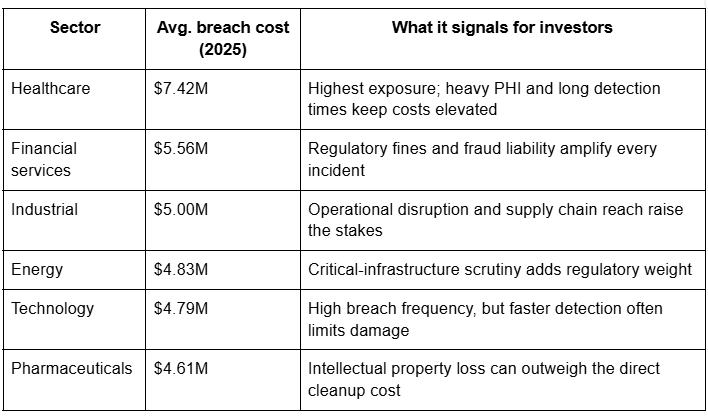
Two patterns are worth holding onto. First, regulated and data-heavy sectors carry structurally higher breach costs, so a security lapse there deserves more weight in your analysis. Second, the US premium is real: with the average domestic breach above $10 million, an incident at a US-listed company tends to cost more than the same event abroad, mostly because of fines and slower containment.
For broader market context on how these risks ripple through earnings and valuations, the ongoing coverage at FinancialContent's stock market news is a practical place to track how individual incidents land on specific names.
Building it into your own analysis
You do not need to overhaul your process to use any of this. Treat a breach the way you would treat a missed earnings target or a sudden executive departure: as a data point about management quality and forward risk, not a one-off to forget by next week.
Three habits make it concrete. Check whether a company you hold has a breach history, and how it handled disclosure each time. When an incident hits, read the independent security reporting before you trust the company line. And weight the cost by sector, because a $5 million event means something different for a bank than it does for a software vendor with faster detection and lighter regulatory exposure.
None of this replaces fundamentals. It sharpens them. A breach is one of the rare moments a company shows you how it really operates, and investors who pay attention get a clearer read on risk than the ones still reacting to the headline.