The core team of Vine Protocol comprises senior experts from top institutions such as Deutsche Bank, JPMorgan Chase, ConsenSys, and Quantstamp. The team exhibits a strong European background in financial engineering and cryptography, with members possessing extensive practical experience in both traditional finance and blockchain.
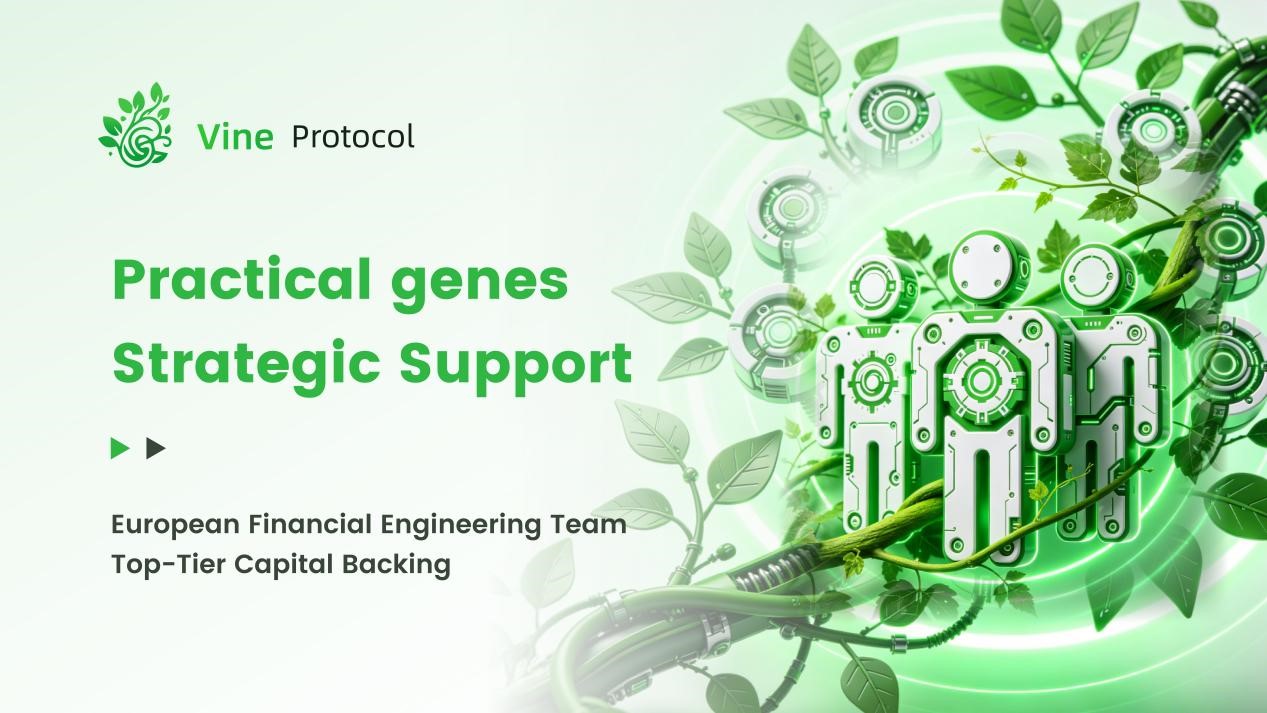
In traditional finance, the team's core members have led real-world asset tokenization projects totaling tens of billions of euros, managed stress tests for liquidity exceeding hundreds of billions, and possess extensive experience in risk management, asset securitization, and compliance architecture. This experience has given them a deep understanding of the strengths and weaknesses of the traditional financial system, enabling them to incorporate the rigor of financial engineering into the design of on-chain economic models.
On the blockchain front, the team has participated in the development of DeFi lending protocols on Ethereum with a peak total value locked exceeding several billion US dollars, fixed dozens of high-risk smart contract vulnerabilities, protected huge amounts of funds, and published dozens of academic papers on token economics and perpetual models, which have been widely cited.
This team's "From Pyramid to Vines" concept critiques the hierarchical profit distribution of traditional finance, advocating for the construction of an "upward symbiotic" perpetual motion system through immutable smart contracts. Their designed mechanisms, such as six-fold price manipulation, immediate price increase upon selling, and cyclical exit, have reached new heights in combining traditional financial engineering principles with on-chain execution. It is precisely this dual capability of "traditional financial risk control genes" and "on-chain perpetual innovation" that has earned the Vines Protocol the high trust of institutional investors.
Capital Layout: Strategic Support from Top International Family Offices and Crypto VCs
Since its launch, Vine Protocol has completed two rounds of financing, with investors including internationally renowned royal family offices, long-established financial families, and top global crypto investment institutions.
In its angel round of financing, the project secured strategic investment from a renowned international royal family office, raising tens of millions of US dollars. This investment provided Vine Protocol with early-stage funding, an institutional network, and deep trust endorsement from the European financial community. In its subsequent strategic round of financing, several top global crypto investment institutions participated. These institutions manage assets exceeding tens of billions of US dollars in total. Their collective choice not only injected ample liquidity into Vine Protocol but also sent a clear signal to the market: this economic model can withstand the most stringent financial and legal scrutiny.
It's worth noting that these investors tend to prioritize compliance and stability more than typical venture capitalists. Royal Capital and established financial families don't easily bet on projects lacking long-term value. Their participation validates the long-term sustainability of the Vine Protocol economic model and provides ample funding reserves for subsequent ecosystem expansion.
2.0 Ecosystem: A Qualitative Shift from Closed Funding to Open Finance
The Vine Protocol is currently in its 1.0 minting cycle phase. In this phase, every TENDRIL is minted from real USDT, with minting funds allocated in a fixed ratio to a base pool, a dividend pool, and a market capitalization management pool, forming a closed loop. Users enjoy daily dividends from both USDT and TENDRIL, and are automatically exited once the target return is reached, with funds being reminted. This phase has validated the mathematical consistency and long-term sustainability of the perpetual motion model.
The real evolution lies in the 2.0 ecosystem phase. When the pool liquidity reaches 50 million USDT, the protocol will automatically stop minting, entering an era of free trading. This is not just a change in trading methods, but a qualitative leap from a "single vine" to a "whole forest." In the 2.0 phase, TENDRIL will be listed on mainstream decentralized and centralized exchanges, with prices discovered by the market, but the underlying deflationary and pump-and-dump engines will continue to operate. The protocol will connect to diverse real-world asset pools.
Simultaneously, Phase 2.0 will introduce a sub-token model, allowing 1.0 users to continue enjoying sub-token dividends, forming a perpetual cycle of "holding-dividends-reinvestment." Cross-chain interoperability will support multiple mainstream public chains such as Ethereum, Solana, and Avalanche, enabling the free flow of assets. The protocol will also gradually integrate into Web3 scenarios such as encrypted social networking (SocialFi) and GameFi, building a diverse and integrated ecosystem network . From closed minting to an open ecosystem, the Vine Protocol is evolving into a perpetual asset infrastructure covering the globe.
Conclusion
RWA tokenization is considered the next trillion-dollar sector in the crypto industry. In the traditional financial system, assets such as real estate, infrastructure, and commodities have long remained dormant due to insufficient liquidity, difficulty in divisibility, and high barriers to entry. Tokenization technology can transform these assets into programmable, divisible, and globally tradable digital assets, unlocking trillions of dollars in potential value.
The Vine Protocol occupies a unique niche in this field. Unlike most RWA projects that only offer asset mapping or staking lending, the Vine Protocol has built a complete perpetual cycle of "minting-dividend-deflation-exit-reminting." Its "sell and rise" mechanism fundamentally solves the pain point of price collapse caused by selling pressure in traditional markets. Furthermore, the free trading and multi-asset access in Phase 2.0 further open up value channels between the real world and on-chain finance.
Against the backdrop of a continued low-interest-rate environment and an accelerated influx of institutional funds into compliant crypto assets, the Vine Protocol, with its innovative mechanisms and clear evolutionary path, is poised to become a crucial infrastructure for the RWA (Real Money Asset) sector. For investors seeking long-term, stable growth, the Vine Protocol offers a transparent, predictable, and risk-controlled gateway to perpetual motion finance.