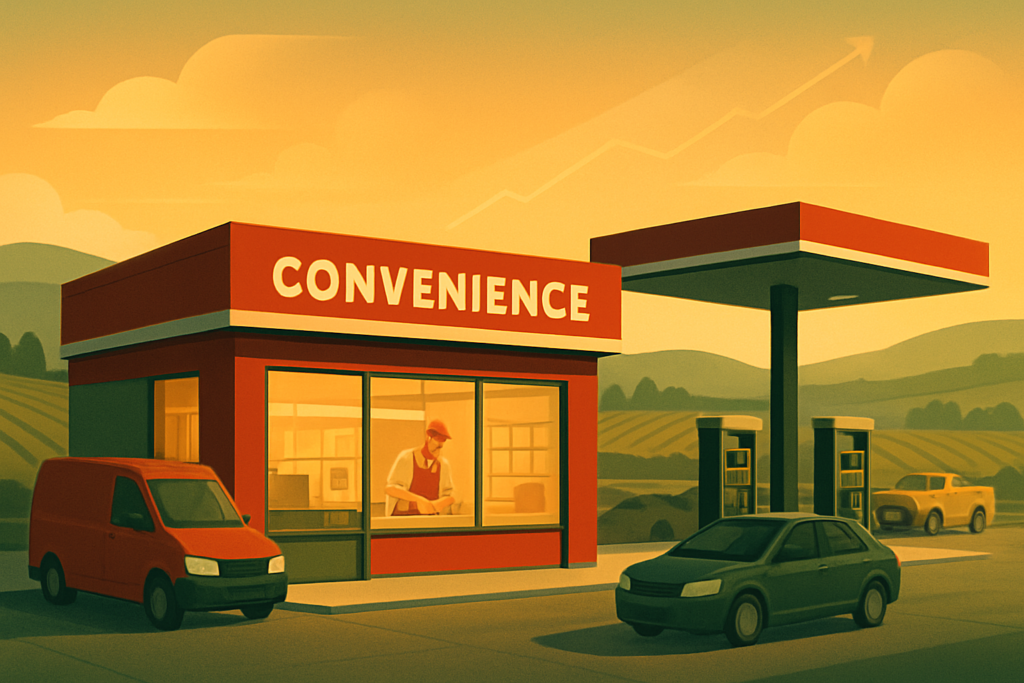
As of March 9, 2026, Casey’s General Stores, Inc. (NASDAQ: CASY) stands as a unique titan in the American retail landscape. Often described as a "pizza chain that happens to sell gas," Casey’s has carved out a dominant niche by focusing on rural and mid-sized markets where it frequently serves as the primary grocery store, restaurant, and fueling station for the community. With a footprint now exceeding 2,900 stores across 20 states, Casey’s has transitioned from a Midwestern staple into a national powerhouse. The company is currently in the spotlight following the successful integration of its largest acquisition to date—Fikes Wholesale—and the conclusion of its ambitious 2023-2026 strategic plan, which has redefined its operational efficiency and geographic reach.
Historical Background
Founded in 1968 by Donald Lamberti in Boone, Iowa, Casey’s began as a single rehabilitated three-bay garage. Lamberti’s vision was simple: provide essential goods and fuel to small towns that larger retailers ignored. The company went public in 1983, a move that catalyzed its expansion across the Midwest. A pivotal moment in the company’s history occurred in the mid-1980s when it introduced made-from-scratch pizza, a decision that transformed Casey’s from a traditional convenience store into the fifth-largest pizza chain in the United States. Over the decades, Casey’s has maintained its "small-town" identity while adopting sophisticated logistics and digital platforms, allowing it to scale effectively without losing its community-centric appeal.
Business Model
Casey’s operates a diversified business model comprised of three primary revenue streams: Fuel, Grocery & General Merchandise, and Prepared Food & Dispensed Beverages. Unlike urban convenience competitors, Casey’s owns approximately 60% of its real estate, providing significant balance sheet flexibility.
- Fuel: While fuel generates the majority of top-line revenue, it is a lower-margin business subject to commodity volatility. Casey’s uses fuel as a "hook" to drive foot traffic.
- Inside Sales: This is the company's profit engine. The Prepared Food segment (Pizza, donuts, sandwiches) carries margins exceeding 60%, significantly higher than the industry average for convenience stores.
- Rural Dominance: Approximately 50% of Casey’s stores are located in towns with populations of 5,000 or fewer, creating a "moat" where competition from national fast-food chains or big-box retailers is minimal.
Stock Performance Overview
Over the past decade, CASY has been a model of consistent shareholder value creation.
- 10-Year Horizon: The stock has delivered a Compound Annual Growth Rate (CAGR) of approximately 14%, significantly outperforming the broader S&P 500.
- 5-Year Horizon: Driven by the "Great Convenience Consolidation" and the leadership of CEO Darren Rebelez, the stock has nearly doubled since 2021.
- 1-Year Performance: In the last 12 months, CASY has surged 22%, buoyed by the $1.145 billion acquisition of CEFCO and better-than-expected synergies from its Texas expansion.
Investors have traditionally viewed CASY as a "defensive growth" play, benefiting from the essential nature of its products even during recessionary periods.
Financial Performance
For the fiscal year ending April 30, 2025, Casey’s reported record-breaking results, a trend that has continued into early 2026.
- Revenue: Reached $15.9 billion in FY2025, a 7.2% year-over-year increase.
- EBITDA: Surpassed the $1.2 billion mark, driven by a 13.3% growth rate.
- Margins: Inside sales margins remained robust at 41.2%, while fuel gross profit saw a 21% surge due to sophisticated procurement and pricing strategies.
- Debt & Liquidity: Following the CEFCO acquisition, the company maintained a healthy leverage ratio of approximately 2.1x EBITDA, with ample liquidity to continue its dividend growth streak, which now stands at 26 consecutive years.
Leadership and Management
Under the leadership of CEO Darren Rebelez, who joined in 2019 from IHOP (and previously 7-Eleven), Casey’s has shifted toward a more data-driven, "restaurant-first" mentality. Rebelez has been credited with modernizing the company’s digital stack and accelerating M&A activity. The management team’s "2023-2026 Strategic Plan" successfully targeted $45 million in annual synergies from recent acquisitions and focused on reducing store-level labor hours through automation, proving that the company can maintain its "hometown feel" while operating with corporate precision.
Products, Services, and Innovations
Casey’s is no longer just about pizza. In 2025 and early 2026, the company successfully rolled out several high-margin innovations:
- The "Hero" Product: Casey’s Pizza remains the core, but the introduction of sauced wings and fries across 2,000+ locations has significantly increased average check sizes.
- Private Label Expansion: The "Casey’s" brand now includes over 300 items, ranging from snacks to automotive fluids, which offer 10-15% higher margins than national brands.
- Digital Loyalty: The Casey’s Rewards program reached over 9 million members by 2026, allowing the company to use personalized data to drive "trip frequency" through targeted offers.
Competitive Landscape
The convenience store (c-store) industry is rapidly consolidating. Casey’s primary competitors include:
- 7-Eleven (Seven & i Holdings): The global leader, focusing more on urban/suburban markets.
- Alimentation Couche-Tard (TSE: ATD): A Canadian giant (owner of Circle K) that competes on scale and fuel efficiency.
- Wawa and Buc-ee's: Regional powerhouses that compete on food quality and "destination" status, though their geographic overlap with Casey's remains limited.
Casey’s competitive edge lies in its vertical integration (owning its own distribution centers and kitchens) and its focus on underserved rural geographies where the cost of entry for competitors is high.
Industry and Market Trends
The c-store sector in 2026 is defined by three major trends:
- Foodservice Evolution: C-stores are increasingly competing with Quick Service Restaurants (QSRs) like McDonald’s or Subway.
- Consolidation: Large players are acquiring smaller "mom-and-pop" chains to gain scale. Casey’s acquisition of Fikes Wholesale (CEFCO) is a prime example.
- The EV Transition: While still a small fraction of total miles driven, the expansion of Electric Vehicle (EV) charging infrastructure at c-stores is becoming a necessity. Casey’s has begun strategically placing chargers at "interstate-adjacent" locations to future-proof its fuel business.
Risks and Challenges
- Fuel Demand: Long-term, the rise of EVs and higher fuel efficiency poses a threat to gasoline volumes.
- Labor Costs: As a major employer in rural areas, Casey’s is sensitive to minimum wage increases and labor shortages.
- Tobacco Headwinds: The continued decline in cigarette volumes—traditionally a major foot-traffic driver—requires Casey’s to constantly innovate in other "inside" categories.
- Integration Risk: While the CEFCO integration has been smooth, further large-scale M&A into unfamiliar territories (like the Deep South) carries execution risk.
Opportunities and Catalysts
- Texas Expansion: The CEFCO deal provided a "beachhead" in Texas, one of the fastest-growing markets in the U.S. Casey’s has significant room to build new stores (organic growth) in this region.
- Digital Monetization: With 9 million rewards members, Casey’s is beginning to monetize its first-party data through retail media networks, a high-margin revenue stream.
- M&A Potential: Despite reaching nearly 3,000 stores, the c-store industry remains fragmented. Casey’s robust balance sheet allows for further bolt-on acquisitions in the 2026-2028 period.
Investor Sentiment and Analyst Coverage
Wall Street sentiment on CASY remains overwhelmingly "Bullish" as of March 2026. Most analysts have maintained "Strong Buy" ratings, with price targets coalescing around the $700-$750 range. Institutional ownership remains high, with major firms like Vanguard and BlackRock holding significant stakes. Analysts frequently point to Casey’s "recession-resilient" cash flows and its ability to pass on inflationary costs through its prepared food pricing as key reasons for the stock’s premium valuation.
Regulatory, Policy, and Geopolitical Factors
- Environmental Regulations: Casey’s must comply with tightening EPA standards regarding underground fuel storage tanks and carbon emissions.
- SNAP and Benefits: Policy changes regarding the Supplemental Nutrition Assistance Program (SNAP) can impact "inside sales" in rural areas where a higher percentage of customers may rely on these benefits.
- Energy Policy: Geopolitical shifts affecting oil prices impact fuel margins. Ironically, Casey’s often performs better during periods of high price volatility, as they can adjust retail prices faster than their wholesale costs fluctuate.
Conclusion
Casey’s General Stores has successfully navigated the transition from a regional operator to a national retail powerhouse. By the spring of 2026, the company has proven that its "pizza-forward" strategy is not just a Midwestern quirk, but a scalable, high-margin business model capable of thriving in diverse markets like Texas and Alabama.
For investors, the CASY narrative is one of disciplined growth and operational excellence. While challenges like the long-term decline in fuel demand and rising labor costs persist, Casey’s focus on high-margin prepared foods and digital loyalty provides a compelling defensive moat. As the company prepares to unveil its next three-year strategic plan later this year, all eyes will be on how it leverages its newly expanded Southern footprint to maintain its status as the king of the rural c-store.
This content is intended for informational purposes only and is not financial advice.