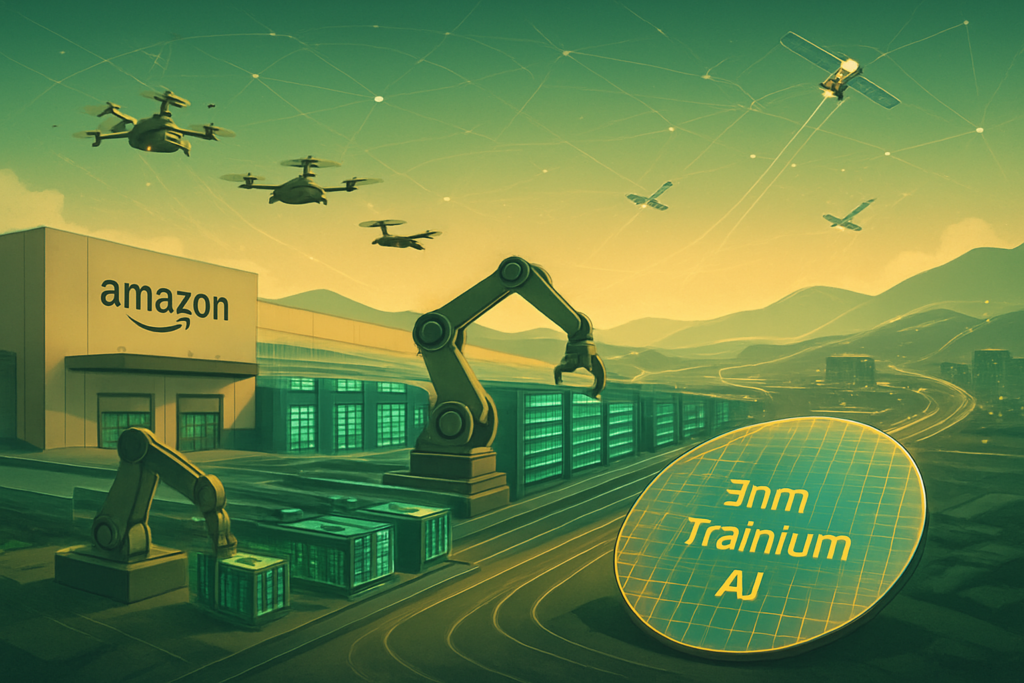
As of March 30, 2026, Amazon.com, Inc. (NASDAQ: AMZN) finds itself at a defining crossroads that echoes its most ambitious—and controversial—periods of the past. After a year of record-breaking profitability in 2025, the company has pivoted into what analysts are calling the "Great AI Build-out." With a staggering $200 billion capital expenditure guidance for the 2026 fiscal year, Amazon is betting its future on a vertically integrated AI stack, ranging from proprietary 3nm silicon to global satellite internet via its "Amazon Leo" project. While the market’s immediate reaction has been one of "capex sticker shock," the underlying narrative remains the same: Amazon is sacrificing short-term liquidity to secure a dominant position in the next two decades of compute infrastructure.
Historical Background
Founded in 1994 by Jeff Bezos as an online bookstore in a Seattle garage, Amazon’s history is a relentless sequence of transformations. What began as a retail disruptor evolved into a logistical juggernaut, a cloud pioneer with the 2006 launch of Amazon Web Services (AWS), and a digital media powerhouse.
The company’s most significant shifts have always been marked by periods of massive internal investment that the market initially doubted. From the multi-billion dollar build-out of its fulfillment network in the early 2010s to the $13.7 billion acquisition of Whole Foods in 2017, Amazon has consistently doubled down on capital-intensive "flywheels." Today, under the leadership of Andy Jassy, the company has completed its latest pivot: transitioning from a provider of third-party cloud tools to a manufacturer of the very silicon and intelligence that powers the global economy.
Business Model
Amazon’s business model in 2026 is a complex ecosystem of four primary engines:
- Cloud Infrastructure (AWS): The highest-margin segment, now providing not just storage and compute, but a full Generative AI lifecycle including foundational models (Bedrock) and custom chips.
- Global Retail (1P & 3P): A massive marketplace driven by Prime memberships. In 2025, the retail wing reached peak efficiency through regionalization and warehouse robotics.
- Digital Advertising: A high-growth ($60B+ revenue) segment that leverages Amazon’s vast consumer data to place ads on its marketplace and Prime Video.
- Emerging Infrastructure: This includes the newly rebranded Amazon Leo (satellite internet) and Amazon’s health and pharmacy services.
Stock Performance Overview
As of March 30, 2026, AMZN shares are trading in the $199–$207 range. The stock’s trajectory reflects a tug-of-war between long-term growth and immediate free cash flow (FCF) concerns.
- 1-Year Performance: -1.0%. The stock has pulled back roughly 20% from its 2025 highs following the announcement of the $200 billion capex plan.
- 5-Year Performance: +29.6%. A steady climb that weathered the post-pandemic correction and was buoyed by the 2024 AI rally.
- 10-Year Performance: +624.5%. Amazon remains one of the decade's premier wealth creators, significantly outperforming the S&P 500.
Financial Performance
Amazon’s 2025 fiscal year was a masterclass in operational efficiency. The company reported:
- Revenue: $716.9 billion, a 12% year-over-year increase.
- Net Income: A record $77.7 billion.
- Operating Margins: North American retail margins surged to 8%, driven by the deployment of the "Proteus" autonomous robots. AWS maintained robust 35% margins.
- The Capex Surge: The pivot to a $200 billion 2026 capex budget has temporarily depressed FCF expectations, a move that management defends as necessary for "Silicon Sovereignty."
Leadership and Management
CEO Andy Jassy has fully stepped out of Jeff Bezos's shadow, establishing a reputation as a "disciplined builder." Under his tenure, the company has become more focused on margins and internal efficiencies than the experimental "wild west" era of the late 2010s.
- Matt Garman (CEO of AWS): Taking over in 2024, Garman has steered AWS toward custom silicon (Trainium/Inferentia) to reduce reliance on external vendors.
- Doug Herrington (CEO of Worldwide Amazon Stores): Credited with the "Regionalization" of the US logistics network, which halved shipping times while reducing costs.
Products, Services, and Innovations
Innovation in 2026 is centered on "Vertical AI Integration."
- Trainium3 Silicon: Built on a 3nm process, Amazon’s newest AI chip is claiming a 40% cost advantage over third-party GPUs for large-scale model training.
- Amazon Bedrock: This platform has become the "OS of AI," allowing enterprises to swap between models (Anthropic, Meta, Amazon’s own Titan) with ease.
- Amazon Leo (formerly Kuiper): With over 200 satellites in orbit, the service began offering "Leo Ultra" (1 Gbps) internet to remote enterprise and AWS customers in March 2026.
Competitive Landscape
Amazon faces a multi-front war:
- Cloud: Microsoft (25% market share) and Google Cloud (13%) are closing the gap on AWS (31%). Microsoft’s partnership with OpenAI remains a formidable threat in the enterprise application layer.
- Retail: Walmart (WMT) has successfully mirrored Amazon’s logistics efficiency, while budget players like Temu and Shein continue to pressure the low-end consumer segment.
- AI Hardware: While Amazon is moving toward its own chips, it must still maintain a delicate partnership with NVIDIA (NVDA) to satisfy demand for H100 and Blackwell GPUs.
Industry and Market Trends
The "Generative AI Phase 2" is the dominant trend of 2026. The market has moved past the hype of "chatbots" and into "inference at scale." Enterprises are now looking for the cheapest, most efficient way to run AI models daily, rather than just training them. This favors Amazon’s Inferentia chips and AWS’s sprawling data center footprint. Additionally, "Sovereign AI"—where nations require data and compute to remain within borders—has opened new revenue streams for AWS's government-cloud divisions.
Risks and Challenges
- Capex Overbuild: There is a non-trivial risk that the $200 billion investment in 2026 creates "ghost data centers" if AI demand cools.
- Regulatory Scrutiny: The FTC's landmark antitrust case, led by Chair Lina Khan, continues to loom over the company, focusing on "Project Nessie" and the alleged "Buy Box" self-preferencing.
- Labor Relations: As Amazon automates more of its fulfillment with robotics, tensions with labor unions and regulatory bodies regarding workplace safety and displacement remain high.
Opportunities and Catalysts
- Prime Video Advertising: The full integration of AI-driven, non-intrusive ads into Prime Video is expected to add $10 billion to the bottom line by 2027.
- Healthcare: Amazon Pharmacy’s integration with One Medical is finally showing signs of scale, offering a "Prime-like" experience for healthcare.
- Custom Silicon Revenue: Amazon’s chip business is now a $10B+ annual run-rate business, offering higher margins than traditional third-party software resale.
Investor Sentiment and Analyst Coverage
Wall Street remains divided. "Bulls" see the 2026 capex as a visionary land grab similar to the 2006 AWS launch. "Bears" argue that Amazon is becoming a "utility company" with diminishing returns on capital. Current consensus is a "Moderate Buy," with a 12-month price target averaging $245, suggesting significant upside once the capex cycle matures. Institutional ownership remains high at over 60%, led by Vanguard and BlackRock.
Regulatory, Policy, and Geopolitical Factors
Geopolitically, Amazon is navigating the "Chip Wars." Its move into 3nm chip design makes it reliant on TSMC (TSM) in Taiwan, exposing it to regional tensions. Domestically, the EU’s Digital Markets Act (DMA) has forced Amazon to change how it uses seller data, creating a potential headwind for its private-label brands.
Conclusion
Amazon in 2026 is a company that has chosen to embrace the volatility of innovation. By committing $200 billion to AI and satellite infrastructure, it is attempting to build the "backbone" of the next digital era. While the stock may face short-term pressure as free cash flow is diverted to data centers and custom silicon, the underlying strength of its 31% cloud market share and its newly efficient retail engine provide a safety net. For the long-term investor, the key question is not whether Amazon is spending too much, but whether any other company can afford to keep up.
This content is intended for informational purposes only and is not financial advice.