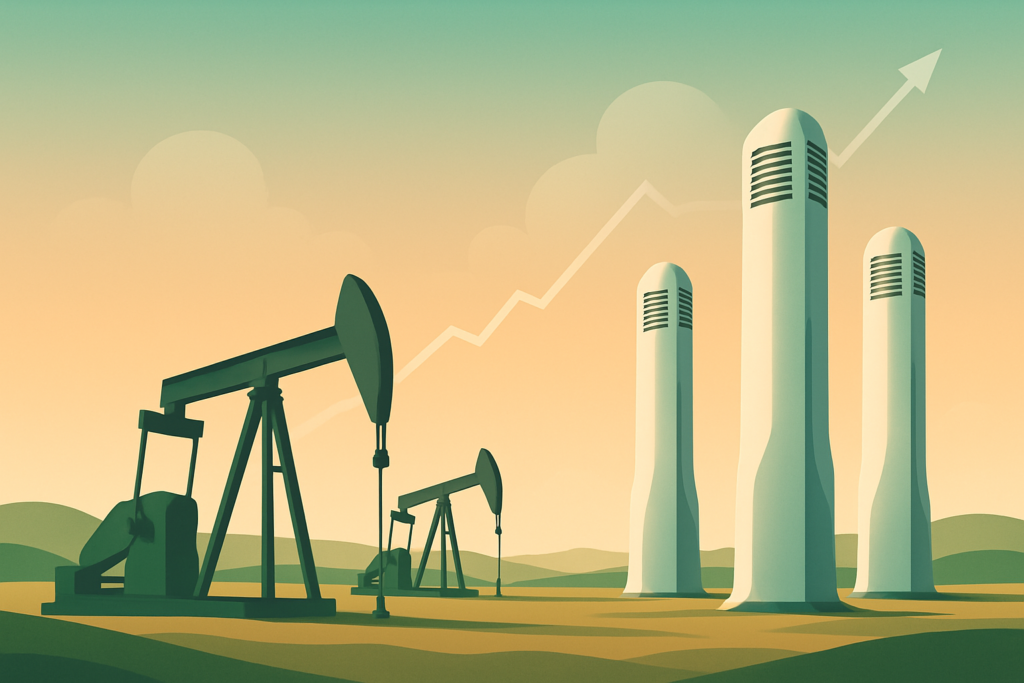
As of March 13, 2026, the energy sector has found a new standard-bearer for the transition era. Occidental Petroleum (NYSE: OXY) has commanded the spotlight this quarter following a decisive 5% single-day surge as Brent crude crossed the psychological $100 per barrel threshold. This price action was not merely a reaction to commodity volatility; it was bolstered by a significant show of confidence from management: an 8% increase in the quarterly dividend announced in early 2026.
Occidental—once burdened by a contentious and heavily leveraged acquisition in 2019—has emerged in 2026 as a lean, high-margin cash machine. By balancing a dominant position in the Permian Basin with a pioneering "Carbon Management" strategy, OXY is attempting to solve the ultimate riddle for the modern energy investor: how to profit from fossil fuels today while securing a seat at the table for a net-zero tomorrow. With Warren Buffett’s Berkshire Hathaway now holding a nearly 30% stake, the company has transitioned from a speculative turnaround story to a foundational institutional holding.
Historical Background
The story of Occidental Petroleum is one of dramatic pivots and larger-than-life figures. Founded in 1920 in California, the company remained a minor player until it was taken over in 1957 by the legendary industrialist Armand Hammer. Under Hammer’s three-decade leadership, Occidental transformed into a global powerhouse through aggressive international exploration, most notably in Libya and the North Sea.
Following Hammer’s death in 1990, the company spent decades refining its portfolio. However, the most pivotal era began in 2016 when Vicki Hollub was named CEO, becoming the first woman to lead a major U.S. oil company. Hollub’s tenure has been defined by the $55 billion acquisition of Anadarko Petroleum in 2019—a "bet-the-farm" move that was initially panned by the market for its timing and debt load. After narrowly surviving the 2020 oil price collapse, OXY spent 2021 through 2025 aggressively deleveraging, ultimately setting the stage for the high-yield, high-growth profile it exhibits today in early 2026.
Business Model
Occidental operates a diversified business model centered on three primary pillars:
- Upstream (Oil and Gas): This is the company's primary revenue engine. OXY is a "pure-play" leader in the Permian Basin, where its low-cost extraction techniques provide some of the best margins in the industry. Its international assets in Oman and the UAE provide stable, long-term production.
- Midstream and Marketing: This segment handles the processing, transportation, and storage of oil, gas, and power. It acts as a stabilizer, optimizing the value of OXY’s produced fluids and gas through a vast network of infrastructure.
- Low Carbon Ventures (LCV): Representing the "new OXY," this segment focuses on commercializing Direct Air Capture (DAC) and Carbon Capture, Utilization, and Storage (CCUS). Through its subsidiary, 1PointFive, OXY intends to treat CO2 as a commodity rather than a waste product.
In a landmark strategic shift in January 2026, OXY finalized the $9.7 billion sale of its chemical arm, OxyChem, to Berkshire Hathaway. This move allowed the company to streamline its focus entirely on the energy-carbon nexus while wiping out the last vestiges of its high-interest acquisition debt.
Stock Performance Overview
Occidental's stock has been one of the most volatile yet rewarding names in the S&P 500 over the last decade.
- 1-Year Performance: Over the past 12 months, OXY has outperformed the broader energy index (XLE) by approximately 15%, driven by the $100 oil rally and the 2026 dividend hike.
- 5-Year Performance: Looking back to 2021, the stock has seen a multi-bagger recovery from the pandemic lows of under $15. The steady accumulation of shares by Berkshire Hathaway served as a "floor" for the price, providing institutional stability.
- 10-Year Performance: On a decade-long horizon, OXY is only now returning to its pre-Anadarko highs in inflation-adjusted terms, reflecting the long and arduous road of debt repayment that defined the early 2020s.
Financial Performance
In its most recent earnings report (Q4 2025/Q1 2026 guidance), Occidental showcased a fortress balance sheet.
- Revenue Growth: buoyed by $100 oil, OXY’s quarterly revenue has climbed steadily, with free cash flow (FCF) reaching record levels.
- Debt Reduction: The sale of OxyChem and the redemption of nearly 20% of Berkshire’s 8% preferred stock have significantly lowered interest expenses. Net debt-to-EBITDA now sits comfortably below 1.0x.
- The 8% Dividend Hike: The early 2026 dividend increase to $0.26 per share (quarterly) signals that OXY is prioritizing shareholder returns over aggressive production growth, a "capital discipline" mantra that investors have rewarded.
Leadership and Management
CEO Vicki Hollub remains the architect of OXY’s current strategy. Her leadership is characterized by technical expertise—she is a mineral engineer by training—and a relentless focus on carbon-neutral oil. Despite early criticism of the Anadarko deal, Hollub has earned Wall Street’s respect by executing a disciplined deleveraging plan.
The board, now heavily influenced by the presence of Berkshire-aligned directors, has shifted toward a governance model that prioritizes operational efficiency and aggressive carbon-management scaling.
Products, Services, and Innovations
OXY’s competitive edge lies in its Direct Air Capture (DAC) technology. The "Stratos" project in West Texas, which began its final startup phase in early 2026, is the world's largest facility of its kind.
- Enhanced Oil Recovery (EOR): OXY is the industry leader in using CO2 to "sweep" more oil out of mature fields. This creates a closed-loop system where captured atmospheric CO2 is used to produce "lower-carbon" oil.
- 1PointFive: This subsidiary is selling "carbon removal credits" to blue-chip companies like Microsoft and Amazon, creating a new, non-commodity-linked revenue stream that is expected to scale significantly by 2027.
Competitive Landscape
OXY competes with "supermajors" like Exxon Mobil (NYSE: XOM) and Chevron (NYSE: CVX), as well as independent Permian producers like EOG Resources (NYSE: EOG).
- Strengths: OXY has a lower breakeven cost in the Permian (estimated at $40/bbl) than many peers. Its lead in DAC technology gives it a 3-5 year head start in the nascent carbon-removal market.
- Weaknesses: Compared to Exxon or Chevron, OXY has less geographic diversification and a smaller downstream (refining) footprint, making it more sensitive to upstream price swings.
Industry and Market Trends
The "higher for longer" oil price environment of early 2026, driven by geopolitical instability and underinvestment in global supply, has provided a massive tailwind. Concurrently, the global push for "Net Zero" has turned carbon capture from a PR exercise into a viable business. OXY is uniquely positioned at the intersection of these two trends: benefiting from high oil prices while insulating itself against the long-term decline of fossil fuels through its carbon-services business.
Risks and Challenges
- Commodity Price Sensitivity: While $100 oil is a boon, OXY remains highly sensitive to price drops. Every $1 decline in the price of crude impacts annual pre-tax income by roughly $250 million.
- Execution Risk: The Stratos DAC project is a first-of-its-kind scale-up. Any technical failures or cost overruns in its first year of operation (2026) could damage investor confidence in the "carbon-management" narrative.
- Regulatory Shifts: A change in U.S. political leadership could threaten the lucrative tax credits (Section 45Q) that make carbon capture profitable.
Opportunities and Catalysts
- Berkshire Takeover Rumors: With Berkshire Hathaway’s stake near 30%, market speculation persists that Buffett may eventually seek to acquire the entire company, particularly now that the balance sheet is clean.
- M&A Potential: Having digested Anadarko and CrownRock, OXY is now in a position to be a consolidator again, potentially picking up smaller Permian players to increase its sub-$40 inventory.
- Carbon Credit Market: As more corporations commit to net-zero, the price of high-quality carbon removal credits is expected to rise, providing a margin boost to 1PointFive.
Investor Sentiment and Analyst Coverage
Wall Street sentiment has turned overwhelmingly "Bully" in early 2026. Major firms including Goldman Sachs and Morgan Stanley have maintained 'Overweight' ratings, citing the dividend hike as a signal of a "new era of capital return." Retail sentiment is also high, often tracking the movements of Warren Buffett, whose "seal of approval" has turned OXY into a "buy and hold" favorite for value investors.
Regulatory, Policy, and Geopolitical Factors
OXY is a major beneficiary of the Inflation Reduction Act’s carbon capture incentives. The $180 per ton credit for DAC-stored carbon is the bedrock of the 1PointFive business model. Geopolitically, the 2026 surge to $100 oil is largely a result of ongoing tensions in the Middle East and tight OPEC+ quotas, factors that OXY—with its heavy U.S.-based production—is well-positioned to capitalize on without the same level of jurisdictional risk as its international peers.
Conclusion
Occidental Petroleum’s journey from the brink of a debt crisis to a dividend-growing leader in 2026 is a masterclass in strategic pivot. The 5% surge upon crossing $100 oil and the subsequent 8% dividend hike are not just temporary wins; they are the results of a multi-year transformation.
Investors should view OXY as a "dual-engine" stock. The "Alpha" engine is the Permian Basin, which generates massive cash flow at triple-digit oil prices. The "Beta" engine is the carbon management business, which provides a hedge against the energy transition. While commodity risks and the technical hurdles of DAC remain, OXY enters the mid-2020s as a fundamentally different—and significantly more resilient—beast than the company that entered the decade.
This content is intended for informational purposes only and is not financial advice.