Growing shift toward connected vehicle ecosystems, smart BLDC actuators, and fully automated charging interfaces is accelerating demand for integrated, high-performance charge port actuation systems
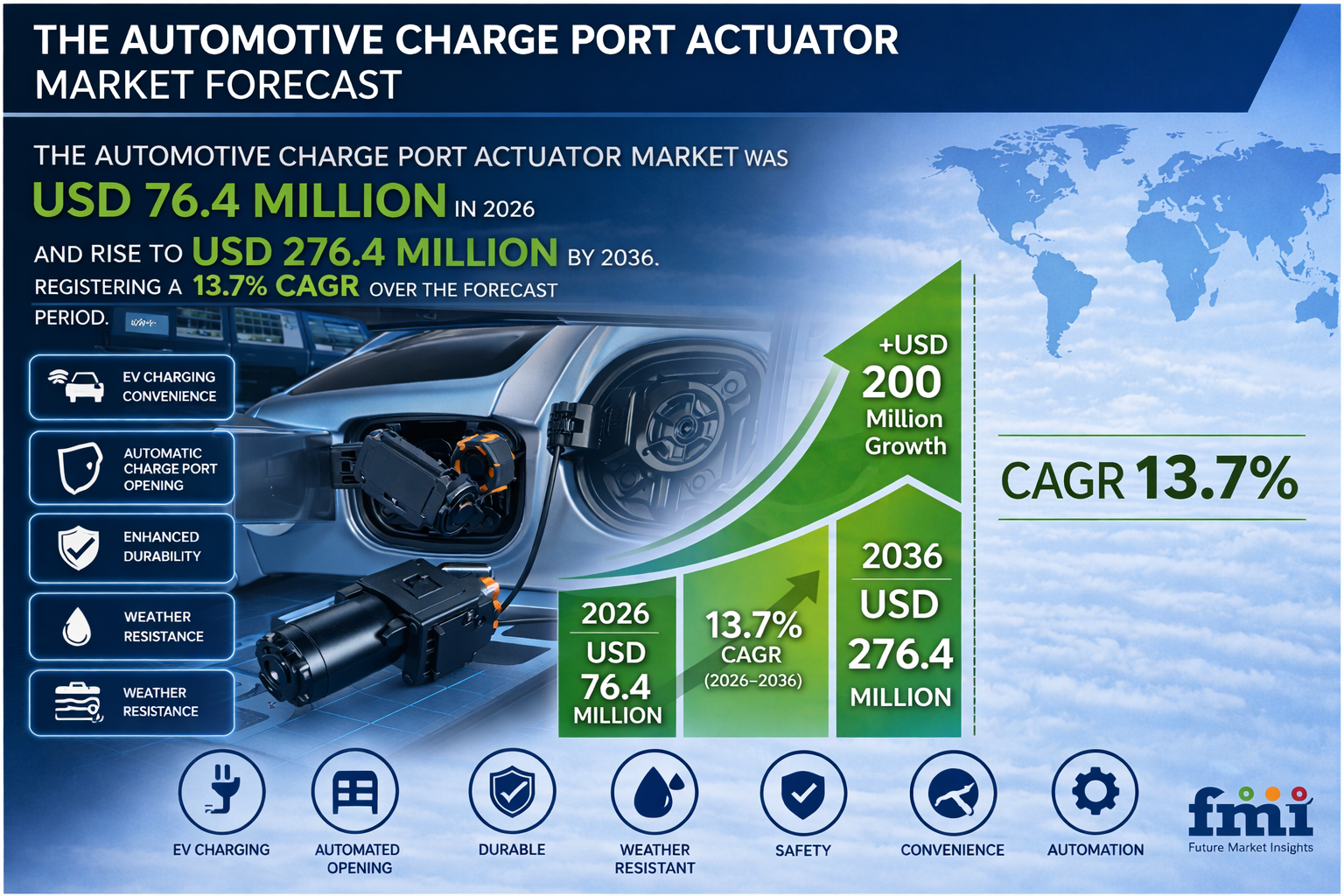
NEWARK, DE / ACCESS Newswire / April 21, 2026 / According to the latest analysis by Future Market Insights, the global automotive charge port actuator market is entering a rapid growth phase as electric vehicle (EV) manufacturers transition toward automated, connected, and design-integrated charging access systems. Valued at USD 67.2 million in 2025, the market is projected to reach USD 76.4 million in 2026 and expand significantly to USD 276.4 million by 2036, registering a CAGR of 13.7% during the forecast period.
This growth reflects a fundamental shift in EV architecture, where charge-port access is evolving from a basic mechanical feature into a fully integrated mechatronic system aligned with connected vehicle ecosystems. Automakers are replacing manual push-latch designs with powered actuator systems to enhance user experience, improve exterior aesthetics, and align with advanced electronic control systems.
Get detailed market forecasts, competitive benchmarking, and pricing trends:
https://www.futuremarketinsights.com/reports/sample/rep-gb-32706
Market Value Analysis: Automated Access Systems Redefine EV Charging Interfaces
Between 2026 and 2030, adoption of automotive charge port actuators is expected to accelerate as OEMs prioritize seamless user interaction, premium exterior design, and system-level integration.
Organizations are increasingly focusing on:
Transition from manual charge-port access to fully automated systems
Integration with vehicle locking logic and smartphone-based access controls
Development of flush, concealed charging interfaces for improved aerodynamics
Alignment with advanced body electronics and connected vehicle platforms
Reduction of user effort while improving durability and weather resistance
Failure to adopt automated charge-port systems may limit vehicle competitiveness, particularly in premium EV segments where user experience and design precision are key differentiators.
From 2030 to 2036, growth will be driven by increasing EV production volumes, expansion of connected vehicle ecosystems, and wider adoption of integrated mechatronic modules.
Technology Evolution: Smart Actuation and Integration Drive Innovation
The evolution of automotive charge port actuators is being shaped by advancements in motor control, embedded electronics, and compact mechanical design.
Key innovations include:
Smart BLDC actuators enabling smooth, controlled motion
Embedded microcontrollers for real-time diagnostics and communication
Obstacle detection and automatic reversal mechanisms
Compact gear systems for high torque within limited packaging space
Integration with lighting and locking systems in unified modules
A major challenge remains balancing compact packaging with durability and performance, particularly in harsh environmental conditions such as extreme cold and moisture exposure.
An industry analyst notes:
"Charge port actuators are no longer standalone components-they are integral to the broader vehicle interaction system, combining motion control, electronics, and design precision."
Charge Port Actuators Become Critical to EV User Experience
As EV adoption accelerates, charge port actuators are becoming essential in delivering seamless charging interactions and premium vehicle experiences.
Core capabilities include:
Automated opening aligned with proximity and smartphone access
Improved durability under high-frequency usage in BEVs
Enhanced sealing performance for weather protection
Integration with vehicle electronics for synchronized operation
Reduced risk of user-induced damage in frozen or obstructed conditions
This transition is positioning charge port actuators as a critical component in next-generation EV platform design.
Speak to Analyst: Customize insights for your business strategy:
https://www.futuremarketinsights.com/customization-available/rep-gb-32706
Segment Spotlight
BEVs Lead Vehicle Segment (72.0%)
High charging frequency and durability requirements drive demand for advanced actuator systems.
Smart BLDC Actuators Lead Actuation Type (48.0%)
Preferred for smooth motion, intelligent control, and long lifecycle performance.
Automatic Systems Lead Operation Type (61.0%)
Strong OEM preference for fully motorized, connected access systems.
Integrated Modules Lead Integration Segment (57.0%)
Compact, preassembled units simplify installation and improve reliability.
OEM Channel Dominates Sales (88.0%)
Extensive validation requirements and system integration limit aftermarket participation.
Regional Insights: EV Expansion and Feature Integration Drive Growth
The automotive charge port actuator market is expanding across regions with strong EV adoption and advanced automotive manufacturing ecosystems.
Country |
CAGR (2026-2036) |
Key Growth Drivers |
|---|---|---|
India |
16.2% |
Rapid EV adoption and feature-driven differentiation |
China |
15.1% |
High-volume EV production and cost-efficient scaling |
South Korea |
14.0% |
Platform standardization and premium EV growth |
Germany |
12.5% |
Luxury vehicle demand and engineering precision |
United States |
12.2% |
Growth in electric trucks and large EV platforms |
United Kingdom |
11.8% |
Premium vehicle manufacturing and customization |
Japan |
10.7% |
Strong focus on reliability and lifecycle validation |
Regional growth patterns reflect varying priorities between cost optimization and advanced feature integration.
Opportunities: Smart Integration and Platform Standardization Unlock Growth
Key opportunities shaping the market include:
Integration of microcontrollers for localized processing and diagnostics
Development of standardized actuator platforms across multiple vehicle models
Adoption of lightweight materials to reduce system weight
Expansion of automated charging interfaces in mid-range EV segments
Integration with illuminated and sensor-enabled charging systems
These opportunities are enabling suppliers to enhance product value while aligning with evolving EV design requirements.
Competitive Landscape: Mechatronic Integration Defines Leadership
The market is characterized by high technical complexity, with strong barriers to entry driven by validation requirements, system integration, and durability standards.
Leading companies include:
Magna International
WITTE Automotive
Motion Controls International
Minebea AccessSolutions
Padmini VNA Mechatronics
Marquardt
Competitive differentiation is driven by:
Advanced mechatronic integration capabilities
Proven durability in extreme environmental conditions
Expertise in compact actuator design and packaging
Ability to deliver pre-validated, install-ready modules
Integration with vehicle electronic architectures
Future Outlook: Automated Charging Access Becomes Standard Across EV Platforms
Looking ahead to 2036, automotive charge port actuators will become standard across EV platforms as manufacturers prioritize user convenience, system integration, and premium design.
Key trends include:
Expansion of automated access systems across all EV segments
Increasing integration with connected vehicle ecosystems
Growth of compact, multi-functional actuator modules
Rising importance of durability and weather resistance
Standardization of actuator designs across global platforms
As the automotive industry continues to evolve toward electrification and connectivity, charge port actuators will play a crucial role in enabling seamless, intelligent, and user-centric charging experiences.
Unlock 360° insights for strategic decision making and investment planning:
https://www.futuremarketinsights.com/checkout/32706
Browse More Automotive Industry Reports:
Headlamp and Bumper Mount Fasteners Market - https://www.futuremarketinsights.com/reports/headlamp-and-bumper-mount-fasteners-market
Vehicle Fluid Line Clamps Market - https://www.futuremarketinsights.com/reports/vehicle-fluid-line-clamps-market
Automotive Relays and Fuses Market - https://www.futuremarketinsights.com/reports/automotive-relays-and-fuses-market
Seat Belt Pretensioners and Retractors Market - https://www.futuremarketinsights.com/reports/seat-belt-pretensioners-and-retractors-market
Engine Oil Filters Market - https://www.futuremarketinsights.com/reports/engine-oil-filters-market
About Future Market Insights (FMI)
Future Market Insights (FMI) is a leading provider of market intelligence and consulting services, serving clients in over 150 countries. Headquartered in Delaware, USA, with a global delivery center in India and offices in the UK and UAE, FMI delivers actionable insights to businesses across industries including automotive, technology, consumer products, manufacturing, energy, and chemicals.
An ESOMAR-certified research organization, FMI provides custom and syndicated market reports and consulting services, supporting both Fortune 1,000 companies and SMEs. Its team of 300+ experienced analysts ensures credible, data-driven insights to help clients navigate global markets and identify growth opportunities.
For Press & Corporate Inquiries
Rahul Singh
AVP - Marketing and Growth Strategy
Future Market Insights, Inc.
+91 8600020075
For Sales - sales@futuremarketinsights.com
For Media - Rahul.singh@futuremarketinsights.com
For web - https://www.futuremarketinsights.com/
SOURCE: Future Market Insights, Inc.
View the original press release on ACCESS Newswire