Bio-based adhesives market growth is driven by EPR regulations, recyclability mandates, and paper packaging demand, making sustainable PSA systems a regulatory necessity.
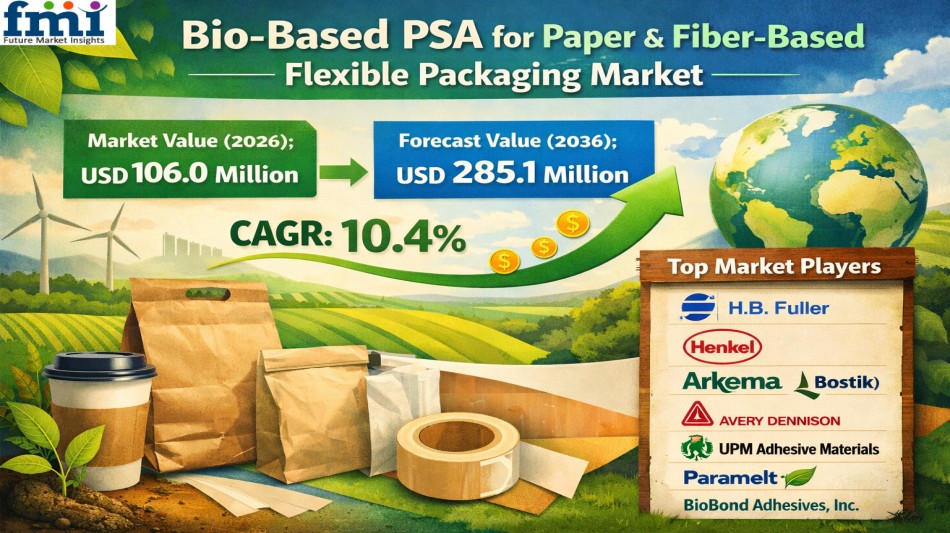
NEWARK, DE / ACCESS Newswire / March 30, 2026 / The global bio-based pressure-sensitive adhesives (PSA) market for paper and fiber-based flexible packaging is entering a decisive phase of transformation, driven by regulatory urgency and structural shifts in material science. Valued at USD 106.0 million in 2026, the market is projected to surge to USD 285.1 million by 2036, expanding at a CAGR of 10.4%. This growth trajectory is being fundamentally shaped by extended producer responsibility (EPR) regulations that directly link packaging recyclability and compostability to financial penalties and brand taxation frameworks.
According to a comprehensive strategic outlook by Future Market Insights (FMI), the transition toward bio-based adhesives is no longer a sustainability initiative-it is rapidly becoming a regulatory and commercial necessity. As mono-material mandates and repulpability standards tighten globally, packaging manufacturers are being forced to redesign adhesive systems to align with circular economy requirements.
Bio-Based PSA for Paper and Fiber-Based Flexible Packaging Market Metrics (2026-2036)
Market Value (2026): USD 106.0 Million
Projected Value (2036): USD 285.1 Million
CAGR: 10.4%
Top Growth Market: India (12.3% CAGR)
Leading Segment: Food & Beverage (42.5% Share)
Discover Growth Opportunities in the Market - Get Your Sample Report Now
https://www.futuremarketinsights.com/reports/sample/rep-gb-32476
The Compliance Imperative: From Sustainability Pledge to Operational Mandate
The market is witnessing a critical inflection point as brands shift from voluntary sustainability goals to enforced compliance. Regulatory frameworks across Europe, North America, and Asia are mandating the elimination of fossil-derived acrylic adhesives in flexible packaging applications.
Packaging engineers now face immediate qualification deadlines for bio-based PSA systems that meet strict compostability and repulpability standards. Failure to comply risks not only financial penalties but also complete exclusion from retail supply chains.
An FMI analyst notes, "The industry is no longer debating sustainability-it is reacting to enforcement. Procurement strategies are shifting from cost optimization to compliance assurance, fundamentally altering supplier selection criteria."
This regulatory pressure is accelerating adoption timelines far beyond traditional corporate sustainability roadmaps, forcing rapid commercialization of bio-based adhesive technologies.
The Material Shift: From Fossil Acrylics to Renewable Chemistry
The industry's material composition is undergoing a profound transformation. Manufacturers are replacing petroleum-based adhesives with formulations derived from renewable feedstocks such as starch, dextrin, rosin, and vegetable oils.
However, this transition introduces new operational complexities. Bio-based adhesives behave differently during coating and conversion processes, particularly when applied to porous paper substrates.
Production challenges include:
Variability in viscosity under changing humidity conditions
Increased absorption rates in uncoated kraft paper
Requirement for modified drying and curing systems
These factors are forcing converters to reassess total cost models, as initial material substitution often leads to hidden operational costs such as increased coat weights, slower line speeds, and climate-controlled logistics requirements.
E-Commerce and Paperization: Catalysts for Adhesive Demand
The rapid expansion of e-commerce logistics is amplifying demand for paper-based flexible packaging, directly driving the adoption of bio-based PSA solutions. Paper mailers, kraft-based pouches, and fiber-based sealing systems are replacing plastic formats at scale.
Kraft paper and paper mailers dominate the substrate segment, accounting for 34.7% of market share in 2026. This dominance reflects the global shift toward paperization, particularly in last-mile delivery and retail packaging.
At the same time, resealable packaging formats are gaining traction, with pouches and flow-wrap closures projected to capture 31.6% of the market. These formats require advanced adhesive performance, including consistent peel strength and multi-cycle reclosure capability.
Segment Spotlight: Performance vs. Sustainability Trade-offs
Starch & Dextrin Derivatives (36.8% Share)
This segment leads due to its compatibility with existing coating infrastructure, allowing manufacturers to avoid costly capital investments. However, sensitivity to humidity introduces supply chain risks that must be managed carefully.
Hot-Melt PSA (Leading Chemistry Platform)
Hot-melt systems dominate due to their instant bonding capability, essential for high-speed packaging lines. Yet, their reliance on thermal processing introduces energy consumption challenges that can offset sustainability gains.
Food & Beverage (42.5% Share)
As the largest end-use segment, food packaging drives demand for certified compostable adhesives. However, stringent chemical migration testing and regulatory approvals create high entry barriers for new formulations.
Regional Powerhouses: Regulatory Intensity Drives Growth
While global adoption is accelerating, regional growth patterns are heavily influenced by regulatory frameworks:
India (12.3% CAGR): The fastest-growing market, driven by aggressive bans on single-use plastics and rapid adoption of paper-based packaging formats.
China (11.2% CAGR): Strong growth fueled by state-led plastic reduction initiatives and large-scale e-commerce infrastructure.
Brazil (10.8% CAGR): Expansion supported by agricultural export packaging requirements demanding durable yet sustainable solutions.
Germany (9.5% CAGR): Advanced circular economy policies enforce strict repulpability standards, accelerating adoption.
United States (8.8% CAGR): Growth driven by regulatory diversity and demand for versatile, drop-in adhesive solutions.
These regional dynamics highlight a key trend: legislative frameworks-not consumer preference-are dictating adoption speed.
Dynamics of the Decade: Circularity Meets Performance Engineering
Looking ahead to 2036, the competitive landscape will be defined by the industry's ability to balance sustainability with operational efficiency.
Eco-Regulatory Acceleration: Extended producer responsibility policies will continue to tighten, making certified compostability and repulpability non-negotiable requirements.
Technological Interoperability: Adhesive systems must achieve compatibility across diverse substrates, machinery, and recycling infrastructures, enabling seamless integration into existing production lines.
Rise of Specialized Formulations: Niche innovations-such as cold-seal bio-adhesives, high-humidity-resistant polymers, and sterilization-compatible formulations-will unlock new application areas, particularly in healthcare and premium food packaging.
Competitive Landscape: Chemistry Expertise as a Barrier to Entry
The market remains highly competitive, with established chemical companies leveraging decades of formulation expertise and certification capabilities to maintain dominance.
Leading players including H.B. Fuller Company, Henkel AG & Co. KGaA, Arkema S.A. (Bostik), Avery Dennison Corporation, UPM Adhesive Materials, and Paramelt B.V. are focusing on:
Expanding certified repulpable adhesive portfolios
Strengthening supply chain resilience for bio-based feedstocks
Investing in R&D for high-performance sustainable formulations
Certification barriers remain a critical competitive moat. New entrants face lengthy testing cycles and significant capital requirements to meet regulatory and performance standards.
Strategic Outlook: From Material Innovation to System Integration
FMI analysis suggests that the future of the market will hinge on a shift from standalone material innovation to integrated system optimization.
Key strategic priorities include:
Upgrading coating and drying infrastructure to handle bio-based chemistries
Developing adhesives that balance peel strength with recyclability
Securing reliable supply chains for renewable raw materials
Achieving global certification compliance across multiple jurisdictions
For an in-depth analysis of evolving formulation trends and to access the complete strategic outlook for the Bio-Based PSA for Paper and Fiber-Based Flexible Packaging Market through 2036, visit the official report page at: https://www.futuremarketinsights.com/reports/bio-based-psa-for-paper-and-fiber-based-flexible-packaging-market
Explore More Research Reports by FMI
Car Air Freshener Packaging Market - https://www.futuremarketinsights.com/reports/car-air-freshener-packaging-market
Packaging Waste Recycling Market - https://www.futuremarketinsights.com/reports/packaging-waste-recycling-market
Laminated Tube Closure Market - https://www.futuremarketinsights.com/reports/laminated-tube-closure-market
Plastic-Free Packaging for IT Accessories Market - https://www.futuremarketinsights.com/reports/plastic-free-packaging-for-it-accessories-market
Perimeter Packaging Market - https://www.futuremarketinsights.com/reports/perimeter-packaging-market
About Future Market Insights (FMI)
Future Market Insights (FMI) is a leading provider of market intelligence and consulting services, serving clients in over 150 countries. Headquartered in Delaware, USA, with a global delivery center in India and offices in the UK and UAE, FMI delivers actionable insights to businesses across industries including automotive, technology, consumer products, manufacturing, energy, and chemicals.
An ESOMAR-certified research organization, FMI provides custom and syndicated market reports and consulting services, supporting both Fortune 1,000 companies and SMEs. Its team of 300+ experienced analysts ensures credible, data-driven insights to help clients navigate global markets and identify growth opportunities.
For Press & Corporate Inquiries
Rahul Singh
AVP - Marketing and Growth Strategy
Future Market Insights, Inc.
+91 8600020075
For Sales - sales@futuremarketinsights.com
For Media - Rahul.singh@futuremarketinsights.com
For web - https://www.futuremarketinsights.com/
SOURCE: Future Market Insights, Inc.
View the original press release on ACCESS Newswire