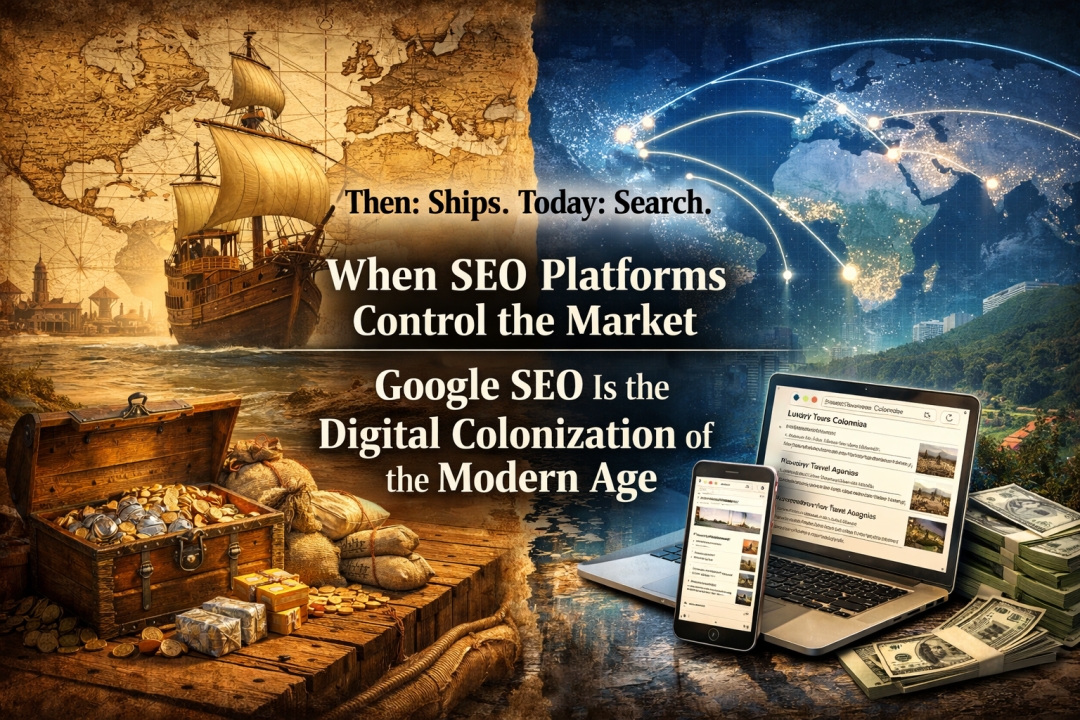
Google SEO Is the Digital Colonization of the Modern Age
1. The Company Before the Content
In 2017, Pelecanus was founded in Bogotá, Colombia.
The first year was dedicated to understanding the country operationally. Until today we have:
- 30 of 32 Colombian departments visited
- 100,000 kilometers driven
- Average speed approximately 40 km/h
- Roughly 2,500 hours behind the wheel
This was not leisure travel.
It was infrastructure mapping, supplier vetting, hotel inspections, route validation, and security assessment.
Only after building real operational knowledge did digital positioning begin.
2. 2018: Building Authority Through Content
Core platforms:
- https://pelecanus.com.co/
- https://www.sula.com.co/
- https://www.colombia-mice.com/
The main domain was built in five languages.
Over time:
- 400+ in-depth blogs
- 400+ YouTube videos (https://www.youtube.com/@COLOMBIAFRANK)
- On-site inspections
- Field documentation
- Transparent operational identity
The strategy aligned naturally with Google’s EEAT framework:
Experience, Expertise, Authoritativeness, Trust
If EEAT truly determined ranking outcomes, this model should have been structurally competitive.
3. The Algorithm Cycle: Repeated Collapse
From 2018 onward, the traffic pattern followed a repeating sequence:
Growth, Google Core Update, Visibility collapse, Months of restructuring, Partial recovery, Next update, Collapse again
This was not marginal volatility. Entire ranking clusters disappeared. Yet across other search engines, rankings remained significantly stronger and more stable. The discrepancy became impossible to ignore.
4. What Ranked Instead?
For high-intent keywords such as:
- Luxury Tours Colombia
- Colombia Luxury Travel
- Private Colombia Tours
Google results were dominated by:
- Large global luxury agencies
- Multi-destination travel platforms
- High-authority domains with extensive backlink networks
Most of these companies do not operate tours directly in Colombia. They subcontract to local DMCs. They control the interface.
5. Historical Colonization: The Structural Blueprint
Historically, colonization followed a pattern:
Colonies produced raw materials. Metropoles controlled trade routes, branding, and pricing. Value extraction occurred at the distribution layer.
Gold, silver, coffee, cacao — produced locally.Shipping, insurance, financial leverage, and final pricing — controlled abroad.
The power was not only in production. It was in controlling the route to market.
6. Digital Colonization: The Modern Parallel
Today, the ships have been replaced by search engines.
The trade routes have become algorithms.
The ports have become search result pages.
Local operators in Colombia:
- Design the itineraries
- Assume operational risk
- Employ local guides
- Pay local suppliers
- Deliver the experience
But global platforms:
- Control search visibility
- Capture initial customer trust
- Add commission layers
- Extract margin before the journey begins
Then: Control of sea routes.Today: Control of search routes.
The mechanism has evolved.
The structure feels familiar.
7. The Backlink Economy
In practice, ranking dominance correlates most strongly with:
- Domain age
- Historical backlink volume
- High-authority link networks
- Capital available for link acquisition
As a small operator with limited financial resources, competing in a backlink-driven ecosystem is structurally difficult.
Google publicly discourages paid backlink schemes.
Yet high-authority link profiles remain the most consistent ranking predictor.
This creates an uneven playing field.
8. The 2024 Reset Experiment
After years of volatility, a new strategy began in October 2024:
Launch a focused luxury-only domain:
https://colombialuxurytraveltouroperator.com/
First client via this site: April 2025.
Expansion followed in May 2025 with language-specific luxury sites:
- https://kolumbienluxusreiseveranstalter.com/
- https://colombiaviajelujoamedidaoperador.com/
- https://colombiaviagensdeluxooperadora.com/
- https://colombievoyagedeluxetouroperateur.com/
Results remain mixed: Some traction. Some ranking volatility. Some domains not ranking at all. The experiment continues.
But one conclusion is clear: Operational excellence alone does not guarantee digital visibility.
9. The Strategic Question
If search engines function as the primary global distribution gatekeepers:
And if ranking power depends largely on historical authority and backlink capital:
Then digital markets may structurally favor scale over expertise.
In this model:
- Local producers create value.
- Digital gatekeepers capture visibility.
- Margin flows toward those who control discovery.
10. Beyond Tourism
This case is not only about Colombia.
It is about:
- Platform power
- Digital distribution control
- Algorithmic gatekeeping
- Market access asymmetry
The term “digital colonization” is provocative.
But structurally, it raises a legitimate economic question:
When access to markets is controlled by algorithmic systems that reward historical scale over demonstrated expertise —
Who truly owns the modern economy?
Media Contact
Company Name: Pelecanus SAS
Contact Person: Frank Spitzer
Email: Send Email
Phone: +573212146210
City: Bogota
Country: Colombia
Website: https://pelecanus.com.co/en/