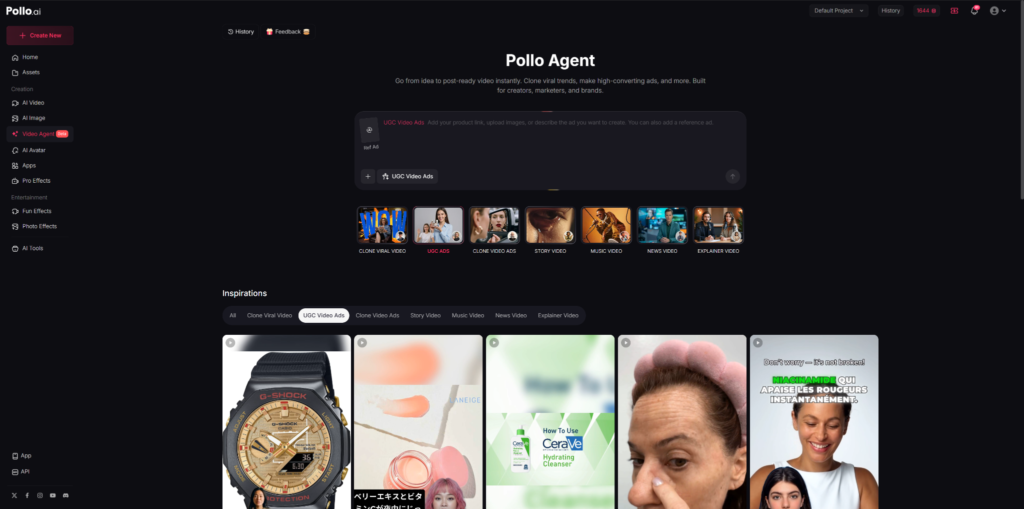
 Pollo Agent is an emerging AI video agent designed to simplify and accelerate modern video production workflows. Instead of relying on traditional editing tools and manual post-production processes, it allows users to transform simple ideas, scripts, or even external links into structured, post-ready videos within minutes. The platform is built around multiple standardized content formats such as viral video cloning, UGC-style advertisements, explainer videos, story-driven narratives, news summaries, and music-based visuals. This modular approach makes it particularly relevant for creators, marketers, and brands that need to produce large volumes of content across different platforms. By automating scene structuring, visual matching, and format optimization, Pollo Agent reduces the technical barrier of video creation while maintaining adaptability for different content goals. At the same time, its design reflects a shift toward AI-driven production systems where speed, scalability, and trend responsiveness are prioritized over manual editing control.
Overview
Pollo AI video agent is designed to streamline the process of turning concepts, scripts, or simple inputs into structured, publish-ready videos. Rather than functioning as a traditional video editor, it operates more like an autonomous production assistant that interprets user intent and generates video outputs with minimal manual intervention.
The platform is built for users who need speed and scalability in content creation, particularly in marketing, social media production, and digital storytelling. Instead of requiring frame-by-frame editing, Pollo AI video agent focuses on automated workflows where the AI handles scripting assistance, visual structuring, and trend-based adaptation.
In essence, the tool attempts to bridge the gap between idea generation and final video delivery. This makes it relevant in environments where content velocity matters more than granular editing control. As an AI video agent, it emphasizes task execution over manual creativity, positioning itself closer to an automated production system than a conventional editing suite.
Features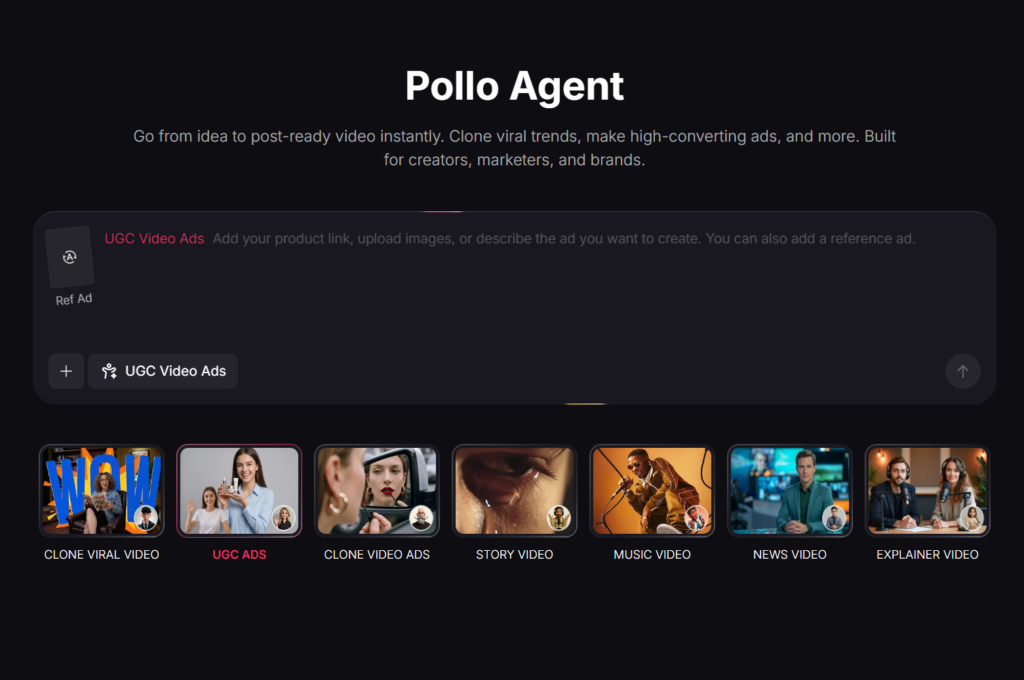
Pollo AI video agent is built as an AI video agent that focuses on converting raw ideas, references, or assets into structured, publish-ready videos with minimal manual editing. Its feature set is organized around different high-demand video formats commonly used in social media, advertising, and branded content production.
Idea-to-Video Automation
At the core of Pollo AI video agent is a system that allows users to simply share a vision, prompt, or external link, after which the AI video agent interprets the input and generates a complete video draft. This includes structuring scenes, selecting appropriate visual pacing, and aligning the output with the intended content style. In some workflows, it can even function as a video meme maker, quickly turning simple ideas or references into short, shareable meme-style videos. The goal is to reduce the traditional gap between concept and production.
CLONE VIRAL VIDEO
One of the standout capabilities is CLONE VIRAL VIDEO, where the AI video agent analyzes existing viral content structures and replicates their format. This does not simply copy content, but instead identifies pacing patterns, hooks, and narrative flow commonly found in high-performing videos. It is mainly used for trend-based content creation on short-form platforms.
UGC ADS
The UGC ADS feature is designed to generate advertising content that mimics authentic user-generated videos. The AI video agent constructs ad scripts and visuals that resemble organic content rather than traditional commercials, which can improve relatability in social feeds. This format is widely used in performance marketing campaigns.
CLONE VIDEO ADS
With CLONE VIDEO ADS, Pollo AI video agent can replicate existing video ad structures and generate multiple variations. This allows marketers to test different hooks, messaging styles, or visual approaches while maintaining a consistent campaign framework. It is particularly useful for A/B testing and conversion optimization workflows.
STORY VIDEO
The STORY VIDEO feature focuses on transforming ideas into narrative-driven videos. The AI video agent organizes input into a beginning, middle, and end structure, making it suitable for storytelling content, brand messaging, or educational narratives. This feature emphasizes coherence and emotional flow over rapid trend replication.
MUSIC VIDEO
In the MUSIC VIDEO module, Pollo AI video agent synchronizes visual elements with audio input. The AI video agent interprets rhythm, tone, and pacing to generate visuals that match musical structure. This feature is often used for promotional music content or stylized creative outputs.
NEWS VIDEO
The NEWS VIDEO feature converts informational input into concise video summaries. The AI video agent structures key points into digestible visual segments, making it suitable for news updates, product announcements, or informational briefs. It prioritizes clarity and structured delivery.
EXPLAINER VIDEO
With EXPLAINER VIDEO, Pollo AI video agent transforms complex topics into simplified visual explanations. The AI video agent breaks down concepts into step-by-step visuals, often combining text overlays, animations, and structured narration flow. This is particularly useful for educational content, SaaS onboarding, or product explanations.
Best Use Cases for Pollo AI Video Agent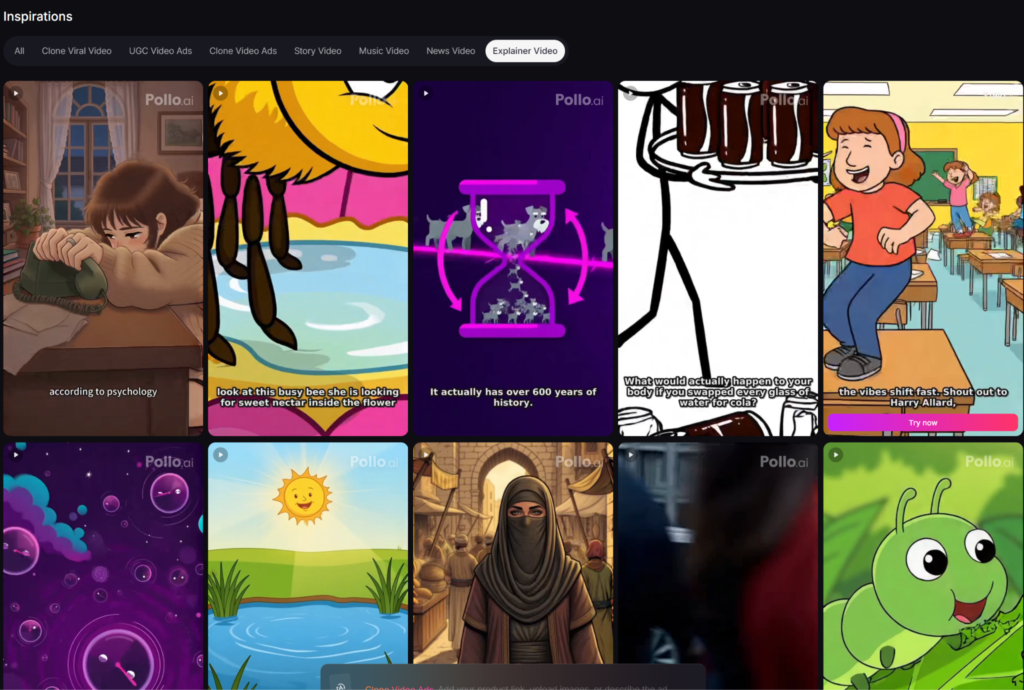
Pollo AI video agent, as an AI video agent, is designed around fast content generation across multiple standardized video formats such as viral clones, UGC ads, explainer videos, and story-based content. Its use cases therefore align closely with high-volume production needs rather than traditional, single-piece video editing workflows.
Short-Form Social Media Content
One of the primary use cases is short-form social media production, particularly on platforms where trends evolve quickly. The CLONE VIRAL VIDEO feature allows users to replicate successful video structures, making it suitable for creators who consistently need to publish trend-aligned content. Combined with STORY VIDEO, users can also produce narrative-driven posts that help build audience engagement over time. This makes Pollo AI video agent especially relevant for content creators who rely on frequent posting cycles rather than one-off productions.
Performance Marketing and Paid Advertising
For marketers, Pollo AI video agent functions as a practical tool for performance advertising workflows. The UGC ADS format is widely applicable in creating native-looking ads that resemble organic user content, which can help improve engagement in social feeds. Meanwhile, CLONE VIDEO ADS supports rapid generation of multiple ad variations, making it suitable for A/B testing, campaign optimization, and scaling paid media strategies. In these scenarios, the AI video agent reduces dependency on manual editing teams during early-stage testing phases.
Educational and SaaS Content
The EXPLAINER VIDEO feature makes the platform useful for educational and product-focused communication. SaaS companies, startups, or technical brands can convert complex concepts into structured visual explanations without needing dedicated motion design resources. The AI video agent breaks down information into simplified sequences, which helps improve clarity for onboarding, tutorials, and product walkthroughs.
Media Updates and Content Summarization
Another key use case is automated informational content creation through the NEWS VIDEO format. This is particularly relevant for publishers, bloggers, or brands that need to convert written updates into short visual summaries. The AI video agent organizes information into digestible segments, making it easier to distribute news-style content across video-first platforms.
Music and Creative Content Production
For more visually expressive use cases, the MUSIC VIDEO feature supports creators working with audio-driven content. Independent artists, marketers, or social creators can generate stylized visuals that sync with music, enabling rapid production of promotional or aesthetic video material without traditional post-production workflows.
Rapid Content Testing and Iteration
Beyond individual formats, Pollo AI video agent is also widely applicable for content experimentation and iteration. Because the AI video agent supports multiple structured outputs—such as ads, stories, explainers, and cloned trends—users can quickly test different content directions from the same idea input. This makes it useful in environments where speed of iteration is more important than production refinement.
Performance
In terms of performance, Pollo AI video agent generally emphasizes speed and automation efficiency over fine-grained control. As an AI video agent, its main strength lies in reducing production time significantly compared to traditional editing workflows.
Video generation is typically fast, with most outputs created within a short processing window depending on complexity. This makes it suitable for rapid testing of multiple content variations.
However, performance can vary depending on input quality. Simple prompts tend to yield more consistent results, while complex or highly creative requests may lead to less predictable outputs. The AI interprets intent rather than executing precise instructions, which can sometimes result in deviations from the original vision.
Visual coherence is generally stable for short-form content, though longer narrative structures may show occasional inconsistencies in pacing or scene transitions. This is a common limitation among current AI video agent systems that prioritize automation over manual editing refinement.
From a usability perspective, the system is optimized for minimal learning curve. Users do not need technical editing knowledge, which contributes to its accessibility, especially for non-professional creators.
Overall, performance is aligned with its intended purpose: fast, automated video generation rather than high-precision film production.
How to Use Pollo AI Video Agent
The workflow of Pollo AI video agent is structured to minimize manual effort and streamline production into a few core steps.
Step 1: Choose Video Type
Users begin by selecting the type of video they want to generate. Options typically include formats such as viral video clones, UGC ads, explainer videos, story videos, news videos, or music videos. This step defines the overall structure and style that the AI video agent will follow.
Step 2: Add Reference Materials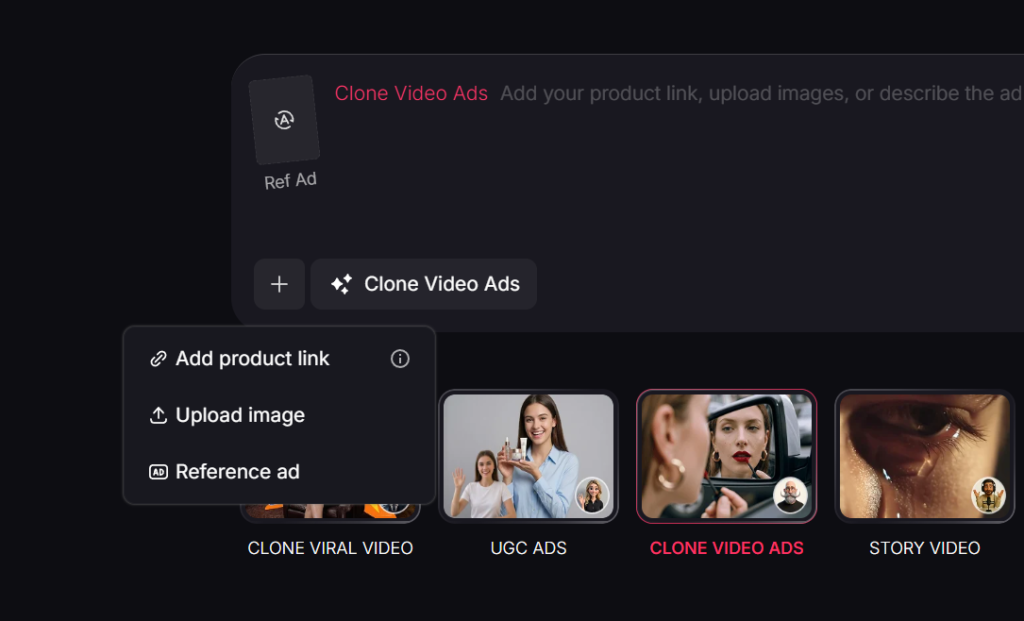
Next, users can provide supporting inputs such as product links, reference videos, or image URLs. These assets help the AI video agent better understand the visual direction, branding context, or creative style required for the output.
Step 3: Enter Video Generation Prompts
After uploading references, users input a clear instruction describing the desired video outcome. This may include messaging, tone, target audience, or specific scenes. The AI video agent interprets these instructions and translates them into structured video segments.
Step 4: Adjust Settings and Generate
Users then configure key output parameters such as resolution, aspect ratio, and clarity. Once these settings are confirmed, the AI video agent processes the inputs and generates the video automatically based on the selected format and instructions.
Step 5: Review and Refine
In the final step, users review the generated video. Minor adjustments can be made if necessary, such as refining visuals or updating instructions, before final export. This ensures the output aligns more closely with the original intent while maintaining the efficiency of AI-driven production.
Pros and Cons
Pollo AI video agent presents a mix of advantages and limitations typical of AI video agent platforms.
On the positive side, its biggest strength is speed and automation. It significantly reduces the time required to produce video content, making it valuable for creators who need rapid output. It also lowers the barrier to entry, allowing users without editing skills to generate usable videos.
Another advantage is scalability. The system is well-suited for producing multiple video variations, which is useful in marketing and A/B testing scenarios.
However, there are limitations. The lack of deep creative control can be restrictive for users who require precise editing or artistic direction. Since the system relies heavily on automated interpretation, outputs may occasionally diverge from user expectations.
In addition, while it performs well for short-form content, long-form or highly narrative-driven videos may require additional refinement outside the platform.
Overall, the tool balances efficiency with creative abstraction, but users needing granular control may find it less flexible.
Conclusion
Pollo AI video agent represents a growing category of AI video agent tools that prioritize automation, speed, and scalability in content production. It is designed for users who need to transform ideas into video format quickly without engaging in traditional editing workflows.
Its strengths lie in rapid generation, marketing-oriented structuring, and accessibility for non-technical users. At the same time, its limitations in creative precision and detailed editing control reflect the current boundaries of AI-driven video systems.
For creators, marketers, and teams focused on high-volume content production, Pollo Agent can function as a practical automation layer in the video creation pipeline. However, for projects requiring full artistic control, it may serve better as a first-draft generator rather than a final production tool.