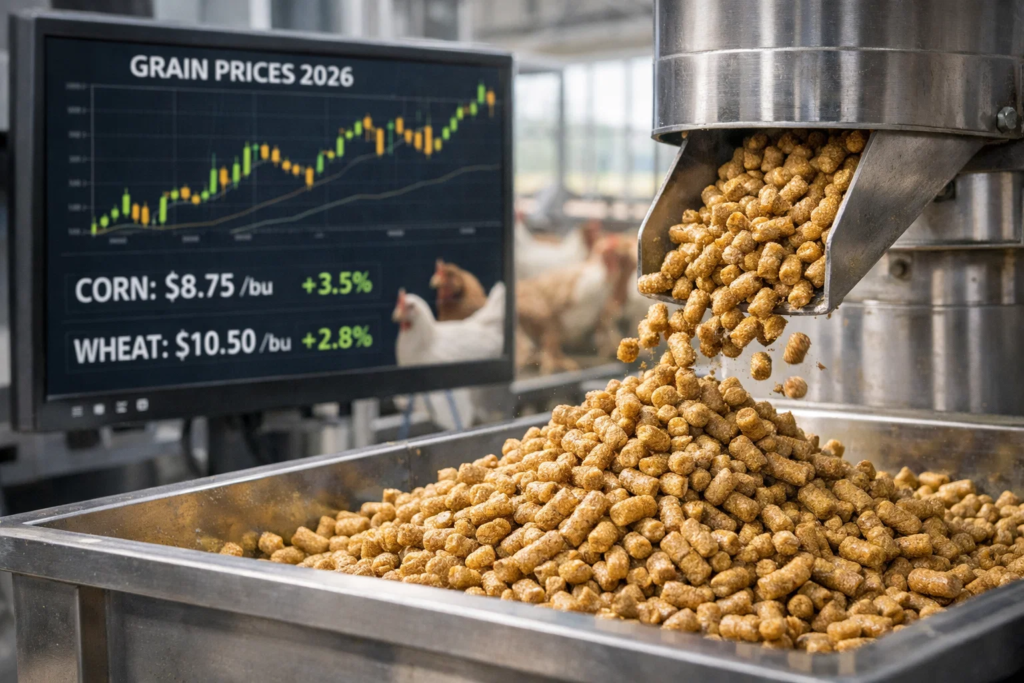
The global agriculture sector in 2026 is navigating one of its most dynamic periods in recent history. Grain market volatility driven by climate disruptions, geopolitical tensions, and shifting trade policies is sending ripple effects directly into the poultry industry. For poultry farmers, feed manufacturers, and agribusiness professionals, understanding how grain price movements shape production decisions has never been more critical. The cost, availability, and nutritional composition of Livestock Feed are all being redefined in real time by what is happening in commodity markets across the world.
Understanding the Grain-Feed Connection
Modern poultry feeding is based on grains. Anywhere between 60% to 70% of a typical broiler or layer diet consists of corn, wheat, sorghum and barley. The price of producing a kilogram of feed alters nearly instantly when the price of grain increases or decreases on the international markets. These external pressures require feed manufacturers to keep on recalibrating their formula, sourcing strategies and pricing models.
This challenge has become especially acute in 2026 due to a number of compounding factors. In the United States and South America, the major food producing areas have experienced prolonged droughts, which have led to a tightening of supply in the world. Meanwhile, the growing demand of biofuels is also competing with the feed industry on the same stock of grains, further tightening the supply.
Key Grain Commodities and Their Role in Feed Formulation
Not every grain has the same weight in poultry food. Each commodity has a unique role to play in the supply of energy, protein and digestibility. The table below shows a snapshot of the top priority grains in 2026 feed production and its current market dynamics:
| Grain | Primary Role in Feed | 2026 Market Trend |
| Corn (Maize) | Primary energy source | High price due to drought & biofuel demand |
| Wheat | Energy + partial protein | Moderate prices; supply stabilizing |
| Sorghum | Alternative energy source | Rising demand as corn substitute |
| Barley | Fiber and energy | Limited use; regional availability varies |
| Soybean Meal | Main protein supplement | Elevated prices; South American supply under pressure |
This table illustrates why feed manufacturers cannot rely on a single commodity. Diversification of grain inputs has become a survival strategy rather than a preference.
How Rising Grain Prices Are Reshaping Feed Manufacturing Costs
When the grain market tightens, there is pressure on the feed manufacturers on several sideways at the same time. Raw material prices go up, thus squeezing margins. During this time, downstream poultry farms also tend to hesitate to accept an increase in the price of feed unless they can demonstrate enduring market demand.
The estimated cost of a metric ton of standard broiler feed has grown by 1822 percent in 2026 relative to 2023, on average. Manufacturers are reacting by a mixture of:
- Ingredient substitution replacing corn with sorghum or distillers dried grains (DDGS) where nutritionally viable
- Precision nutrition programs reformulating diets to reduce overfeeding of expensive amino acids
- Long-term grain contracts locking in prices through forward purchasing to hedge against volatility
- Regional sourcing strategies partnering with local grain producers to reduce import dependency
These strategies demand a high level of nutritional expertise and real-time market intelligence, reinforcing why feed manufacturing has evolved from a commodity business into a knowledge-intensive industry.
The Science Behind Feed Reformulation
When commodity prices shift, formulators must ensure that any substitution does not compromise bird performance. This is where nutritional science and market economics intersect. Reformulating feeds for poultry requires accounting for metabolizable energy (ME), digestible amino acids, phosphorus availability, and gut health factors all of which can vary significantly between grain types.
The use of feeds for poultry has always required balancing economic efficiency with biological precision. In 2026, enzyme supplementation, particularly phytase and xylanase, is being used more aggressively to unlock nutritional value from lower-cost, fiber-rich grain alternatives. These enzymes allow birds to extract more energy and phosphorus from ingredients that would otherwise underperform in a standard diet.
Impact on Poultry Farmers: A Cost-Benefit Perspective
For poultry producers, grain market shifts translate directly into farm-level decisions. Feed typically represents 65–70% of the total cost of production for broilers and layers. Even a modest grain price increase can significantly erode profitability if not managed proactively.
| Farm Type | Feed Cost as % of Total Cost | Risk Level from Grain Volatility |
| Broiler (Commercial) | 65–70% | High |
| Layer (Egg Production) | 60–65% | High |
| Breeder Flock | 55–60% | Medium |
| Backyard/Small-Scale | 50–55% | Medium–Low |
Farmers in 2026 are increasingly turning to integrated feed management systems that offer real-time price alerts, nutritional modelling tools, and supplier comparison platforms. This digital integration is helping producers make faster, more informed decisions in response to grain market movements.
Global Trade Policies Adding to the Complexity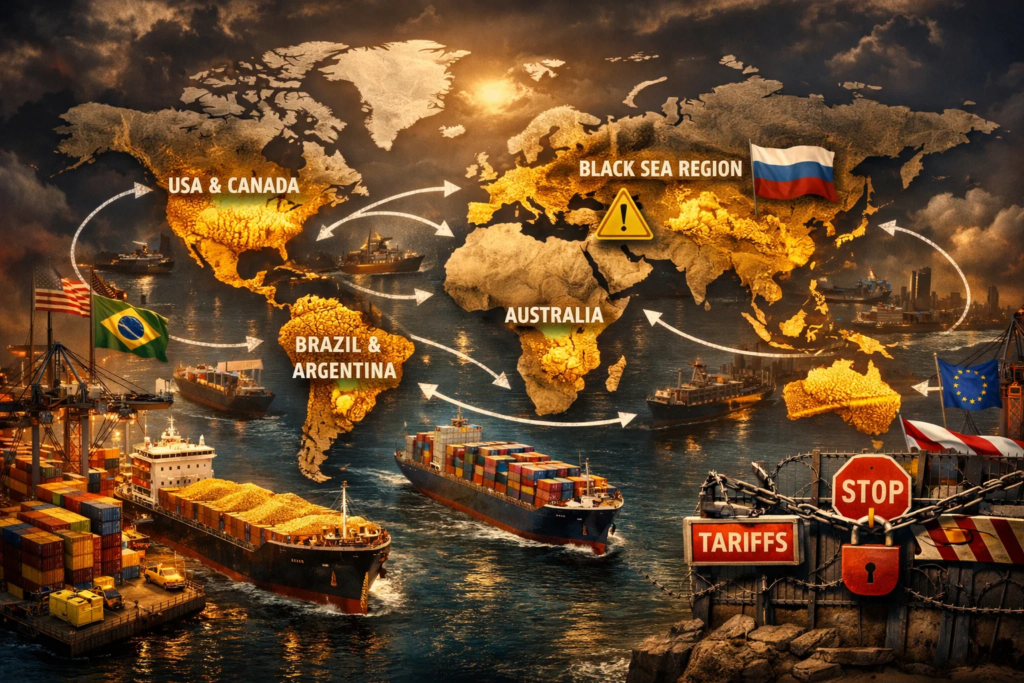
Along with weather and supply-demand fundamentals, the international trade policy of 2026 is further complicating the procurement of grain. The export ban by large grain producing countries, a measure that is increasingly being observed after food security issues, may lead to spikes in prices in an overnight manner, which can upset the months of planning when purchasing.
The current policy-related aspects that are influencing the availability of grain to feed manufacturers are as follows:
- Export bans and quotas from Eastern European and Black Sea region grain exporters
- Tariff adjustments affecting corn trade between major producing and consuming nations
- Sanitary and phytosanitary (SPS) barriers slowing cross-border grain shipments
- Currency fluctuations impacting import costs for developing-nation feed manufacturers
Each of these variables creates a cascading effect on feed pricing from the commodity exchange all the way to the farm gate.
The Road Ahead: Sustainability and Innovation in Feed Manufacturing
Nonetheless, in spite of the turbulence, the year 2026 will also be a year of great innovation in the feed sector. Producers are also putting money into alternative protein and energy sources that can eliminate dependence on unstable grain market prices. Insect meal, single-cell proteins, fermented by-products, and even algae-based ingredients are progressing beyond the laboratory phase to commercial-scale use.
The concept of sustainability is also transforming procurement priorities. Retailers and end consumers are increasingly demanding poultry products to have traceability certifications which confirm responsible sourcing practices along the feed supply chain. This is pushing manufacturers towards constructing more open, locally-based ingredient networks.
Conclusion
Interdependence between grain markets and poultry feed production in 2026 is even closer, more fluctuated and more consequential than it has ever been. Supply shocks caused by climate change, biofuels competition and trade barriers caused by geopolitics are compelling manufacturers to be quicker, technologically sophisticated and diversified in their strategies. To the interested party in the poultry value chain starting with the grain trader to the farm owner, it is not optional to understand these market dynamics. It is the basis of profitable, resilient, sustainable operations in the future.