Laser company nLIGHT (NASDAQ: LASR) announced better-than-expected revenue in Q2 CY2026, with sales up 33.8% year on year to $82.59 million. The company expects next quarter’s revenue to be around $68 million, close to analysts’ estimates. Its non-GAAP profit of $0.15 per share was in line with analysts’ consensus estimates.
Is now the time to buy nLIGHT? Find out by accessing our full research report, it’s free.
nLIGHT (LASR) Q2 CY2026 Highlights:
- Revenue: $82.59 million vs analyst estimates of $78.93 million (33.8% year-on-year growth, 4.6% beat)
- Adjusted EPS: $0.15 vs analyst estimates of $0.14 (in line)
- Adjusted EBITDA: $10.73 million vs analyst estimates of $11 million (13% margin, 2.4% miss)
- Revenue Guidance for Q3 CY2026 is $68 million at the midpoint, roughly in line with what analysts were expecting
- EBITDA guidance for Q3 CY2026 is $4 million at the midpoint, below analyst estimates of $7.70 million
- Operating Margin: -4.3%, up from -6.9% in the same quarter last year
- Free Cash Flow was $15.88 million, up from -$3.63 million in the same quarter last year
- Market Capitalization: $4.24 billion
Company Overview
Founded by a former CEO and Harvard-educated entrepreneur Scott Keeneyn, nLIGHT (NASDAQ: LASR) offers semiconductor and fiber lasers to the industrial, aerospace & defense, and medical sectors.
Revenue Growth
A company’s long-term sales performance can indicate its overall quality. Any business can experience short-term success, but top-performing ones enjoy sustained growth for years. Unfortunately, nLIGHT’s 3.8% annualized revenue growth over the last five years was sluggish. This fell short of our benchmark for the industrials sector and is a rough starting point for our analysis.
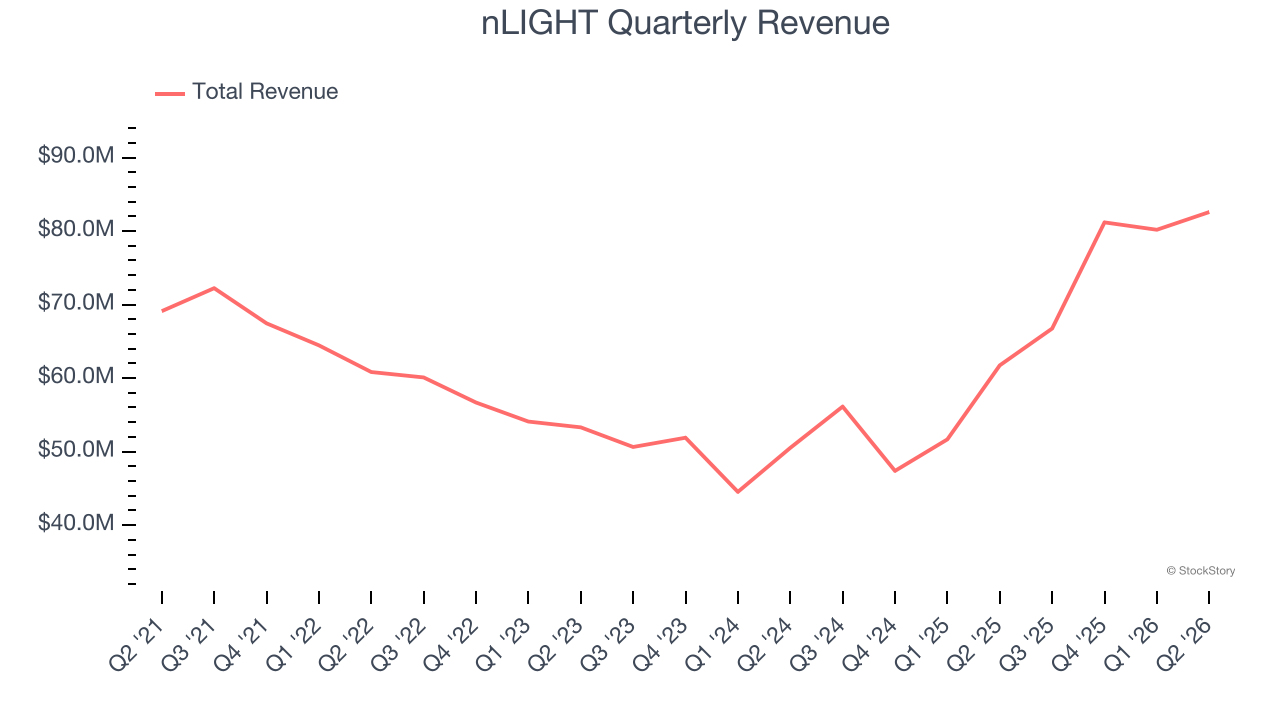
Long-term growth is the most important, but within industrials, a half-decade historical view may miss new industry trends or demand cycles. nLIGHT’s annualized revenue growth of 25.4% over the last two years is above its five-year trend, suggesting its demand recently accelerated. 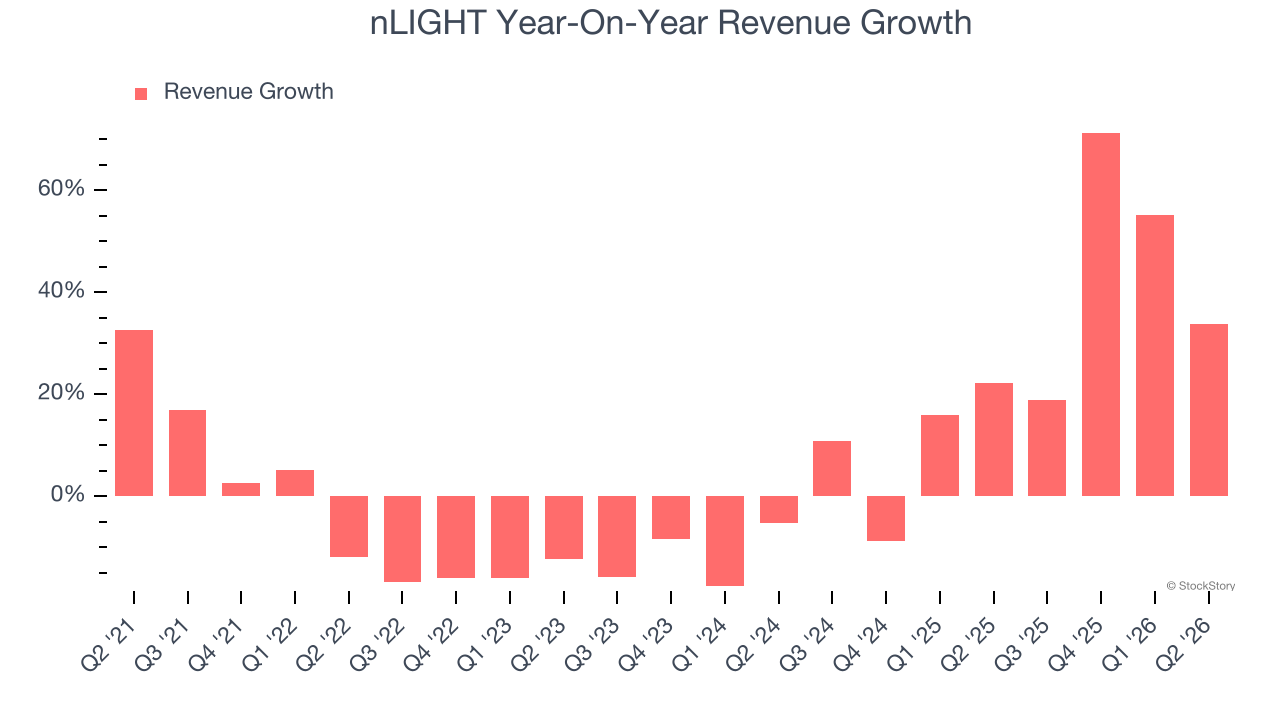
nLIGHT also breaks out the revenue for its most important segments, Laser Products and Advanced Developments, which are 71.9% and 28.1% of revenue. Over the last two years, nLIGHT’s Laser Products revenue (lasers, amplifiers, and directed energy products) averaged 31.7% year-on-year growth while its Advanced Developments revenue (R&D contracts) averaged 27.1% growth. 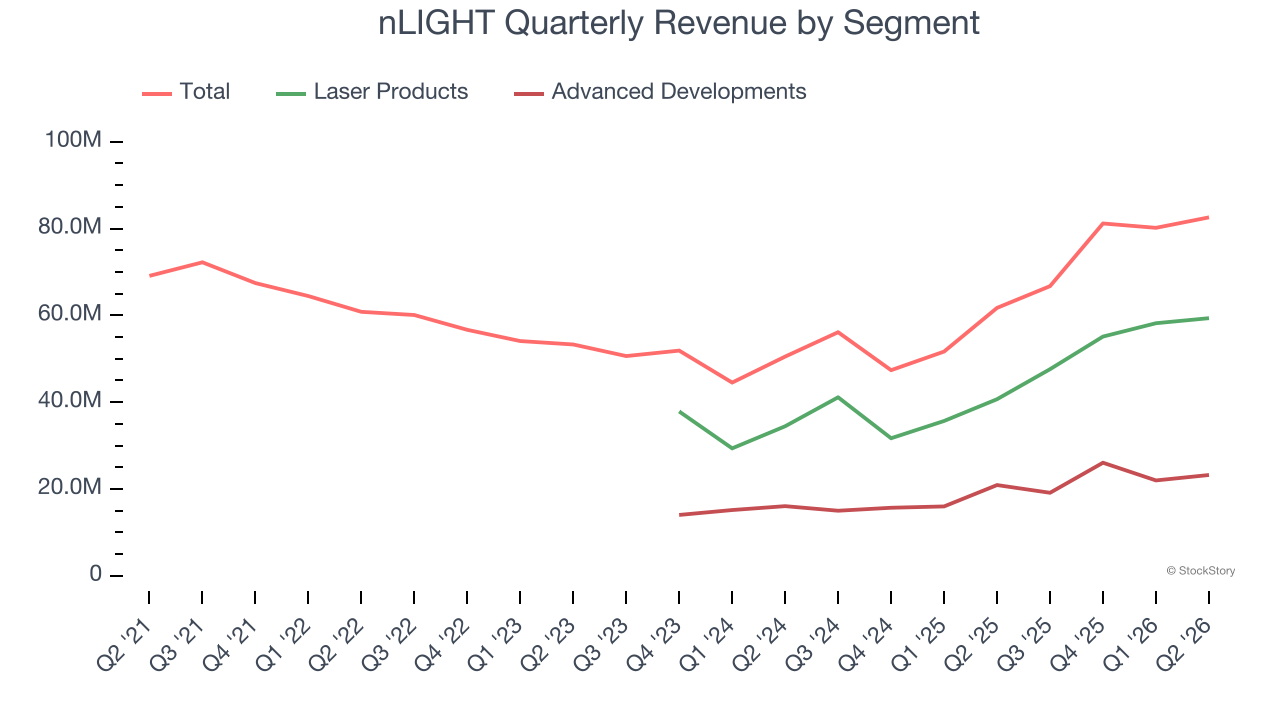
This quarter, nLIGHT reported wonderful year-on-year revenue growth of 33.8%, and its $82.59 million of revenue exceeded Wall Street’s estimates by 4.6%. Company management is currently guiding for a 1.9% year-on-year increase in sales next quarter.
Looking further ahead, sell-side analysts expect revenue to grow 1% over the next 12 months, a deceleration versus the last two years. This projection doesn’t excite us and suggests its products and services will face some demand challenges.
WHILE YOU’RE HERE: The Next Palantir? One satellite company captures images of every point on Earth. Every single day. The Pentagon wants it. Hedge funds are using it to beat earnings. You’ve probably never heard of it.
This is what the early days of Palantir looked like before it became a giant. Same playbook. Different technology. If you missed Palantir, you need to see this. Claim The Stock Ticker for Free HERE.
Operating Margin
Operating margin is one of the best measures of profitability because it tells us how much money a company takes home after procuring and manufacturing its products, marketing and selling those products, and most importantly, keeping them relevant through research and development.
nLIGHT’s high expenses have contributed to an average operating margin of negative 17.6% over the last five years. Unprofitable industrials companies require extra attention because they could get caught swimming naked when the tide goes out. It’s hard to trust that the business can endure a full cycle.
On the plus side, nLIGHT’s operating margin rose by 7.4 percentage points over the last five years, as its sales growth gave it operating leverage. Still, it will take much more for the company to reach long-term profitability.
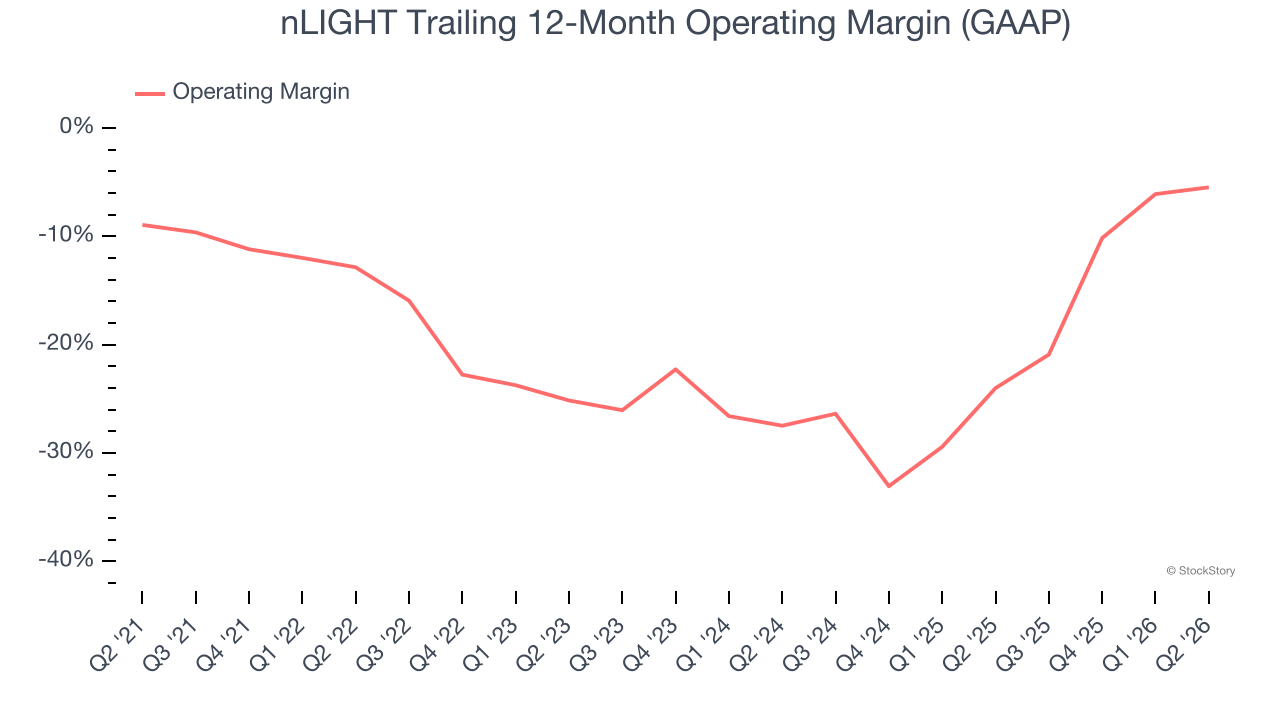
This quarter, nLIGHT generated a negative 4.3% operating margin. The company’s consistent lack of profits raises a flag.
Earnings Per Share
We track the long-term change in earnings per share (EPS) for the same reason as long-term revenue growth. Compared to revenue, however, EPS highlights whether a company’s growth is profitable.
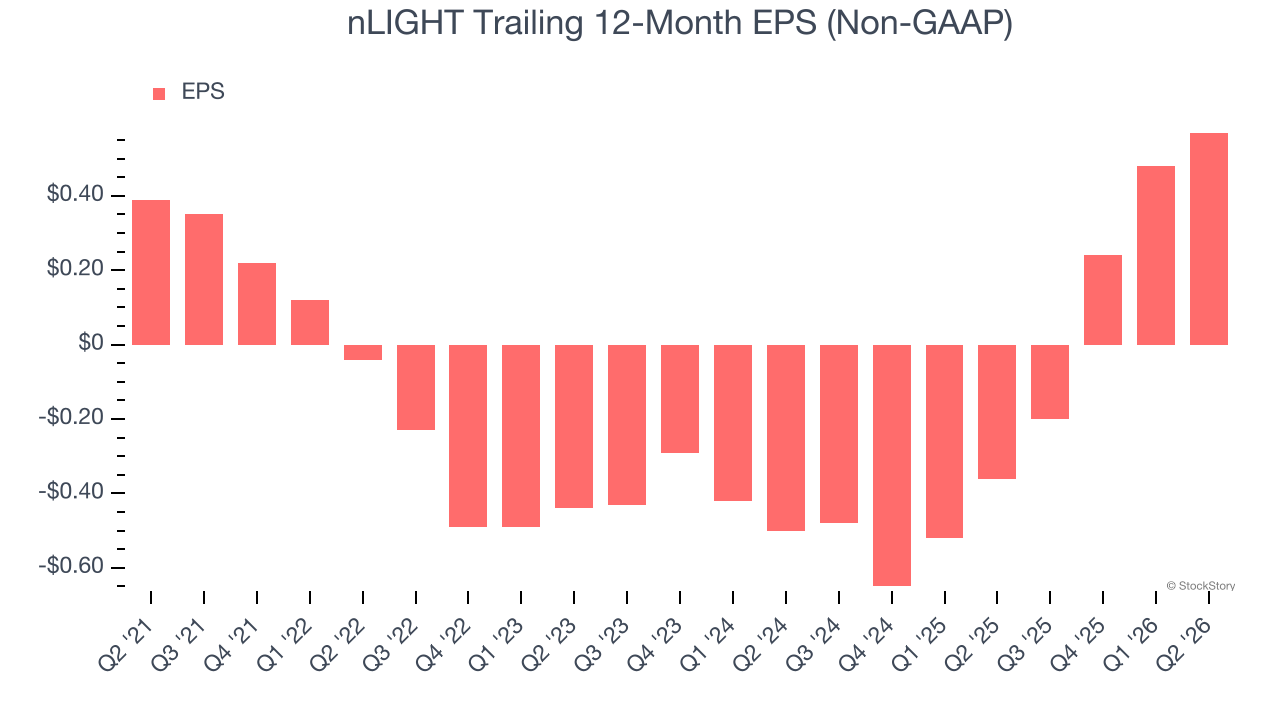
nLIGHT’s EPS grew at 7.9% compounded annual growth rate over the last five years. On the bright side, this performance was better than its 3.8% annualized revenue growth and tells us the company became more profitable on a per-share basis as it expanded.
Diving into the nuances of nLIGHT’s earnings can give us a better understanding of its performance. As we mentioned earlier, nLIGHT’s operating margin expanded by 7.4 percentage points over the last five years. This was the most relevant factor (aside from the revenue impact) behind its higher earnings; interest expenses and taxes can also affect EPS but don’t tell us as much about a company’s fundamentals.
Like with revenue, we analyze EPS over a shorter period to see if we are missing a change in the business.
For nLIGHT, its two-year annual EPS growth of 77.2% was higher than its five-year trend. This acceleration made it one of the faster-growing industrials companies in recent history.
In Q2, nLIGHT reported adjusted EPS of $0.15, up from $0.06 in the same quarter last year. This print beat analysts’ estimates by 6.3%. Over the next 12 months, Wall Street expects nLIGHT’s full-year EPS to shrink by 11.9% from $0.57 to $0.50.
Key Takeaways from nLIGHT’s Q2 Results
We were impressed by how significantly nLIGHT blew past analysts’ revenue expectations this quarter. We were also glad its EPS was in line with Wall Street’s estimates. On the other hand, its EBITDA guidance for next quarter missed and its EBITDA fell short of Wall Street’s estimates. Overall, this print was mixed but still had some key positives. The market seemed to be hoping for more, and the stock traded down 15.1% to $64.09 immediately after reporting.
So do we think nLIGHT is an attractive buy at the current price? We think that the latest quarter is only one piece of the longer-term business quality puzzle. Quality, when combined with valuation, can help determine if the stock is a buy. We cover that in our actionable full research report which you can read here (it’s free).