
Quarterly earnings results are a good time to check in on a company’s progress, especially compared to its peers in the same sector. Today we are looking at Champion Homes (NYSE: SKY) and the best and worst performers in the home builders industry.
Traditionally, homebuilders have built competitive advantages with economies of scale that lead to advantaged purchasing and brand recognition among consumers. Aesthetic trends have always been important in the space, but more recently, energy efficiency and conservation are driving innovation. However, these companies are still at the whim of the macro, specifically interest rates that heavily impact new and existing home sales. In fact, homebuilders are one of the most cyclical subsectors within industrials.
The 10 home builders stocks we track reported a mixed Q2. As a group, revenues beat analysts’ consensus estimates by 0.6%.
In light of this news, share prices of the companies have held steady as they are up 2.8% on average since the latest earnings results.
Champion Homes (NYSE: SKY)
Founded in 1951, Champion Homes (NYSE: SKY) is a manufacturer of modular homes and buildings in North America.
Champion Homes reported revenues of $710.2 million, up 1.3% year on year. This print exceeded analysts’ expectations by 1.1%. Overall, it was a strong quarter for the company with a decent beat of analysts’ EBITDA estimates and EPS in line with analysts’ estimates.
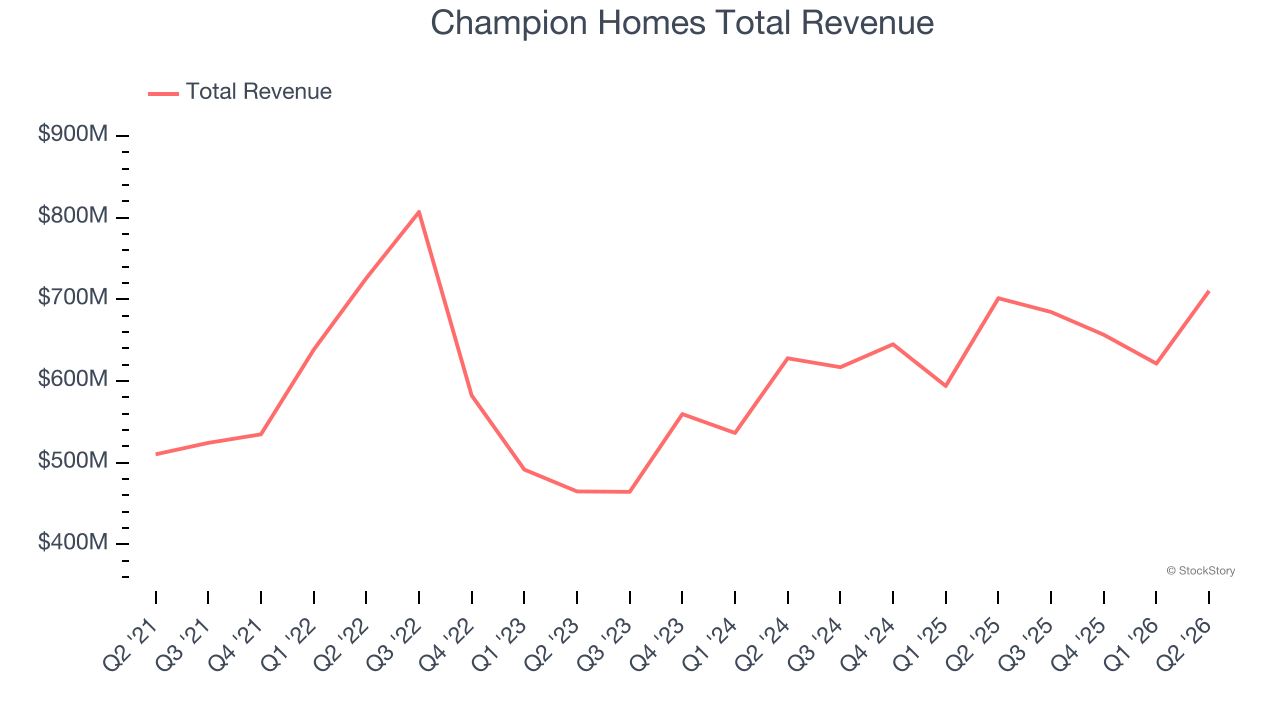
Interestingly, the stock is up 10.7% since reporting and currently trades at $91.14.
Is now the time to buy Champion Homes? Access our full analysis of the earnings results here, it’s free.
Best Q2: Installed Building Products (NYSE: IBP)
Founded in 1977, Installed Building Products (NYSE: IBP) is a company specializing in the installation of insulation, waterproofing, and other complementary building products for residential and commercial construction.
Installed Building Products reported revenues of $777.8 million, up 2.3% year on year, outperforming analysts’ expectations by 4.4%. The business had a stunning quarter with an impressive beat of analysts’ EBITDA estimates and a beat of analysts’ EPS estimates.
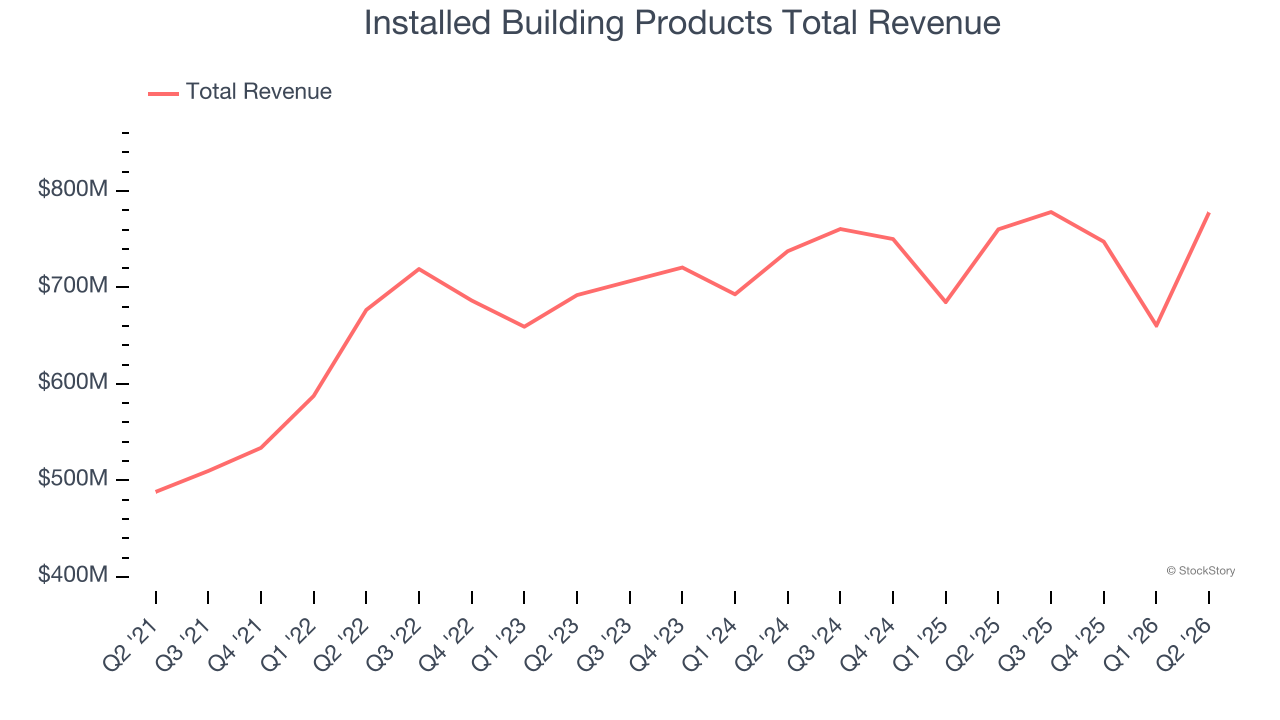
Installed Building Products pulled off the biggest analyst estimate beat of the whole group. The market seems content with the results as the stock is up 1.8% since reporting. It currently trades at $245.96.
Is now the time to buy Installed Building Products? Access our full analysis of the earnings results here, it’s free.
Weakest Q2: NVR (NYSE: NVR)
Known for its unique land acquisition strategy, NVR (NYSE: NVR) is a respected homebuilder and mortgage company in the United States.
NVR reported revenues of $2.33 billion, down 10.5% year on year, falling short of analysts’ expectations by 3.9%. It was a disappointing quarter as it posted a significant miss of analysts’ EPS estimates.
NVR delivered the weakest performance against analyst estimates among its peers. Interestingly, the stock is up 2.3% since the results and currently trades at $6,495.
Read our full analysis of NVR’s results here.
Lennar (NYSE: LEN)
One of the largest homebuilders in America, Lennar (NYSE: LEN) is known for constructing affordable, move-up, and retirement homes across a range of markets and communities.
Lennar reported revenues of $7.94 billion, down 5.2% year on year. This number came in 2.4% below analysts’ expectations. Overall, it was a slower quarter for the company.
The stock is down 7.9% since reporting and currently trades at $87.48.
Read our full, actionable report on Lennar here, it’s free.
D.R. Horton (NYSE: DHI)
One of the largest homebuilding companies in the U.S., D.R. Horton (NYSE: DHI) builds a variety of new construction homes across multiple markets.
D.R. Horton reported revenues of $9.23 billion, flat year on year. This print was in line with analysts’ expectations. Aside from that, it was a slower quarter as it produced full-year revenue guidance missing analysts’ expectations significantly.
The stock is up 3.6% since reporting and currently trades at $149.98.
Read our full, actionable report on D.R. Horton here, it’s free.
Market Update
Over the past year, investors have been forced to repeatedly answer the same question: what is the market’s biggest risk? The answer has changed several times, and each shift has reshaped market leadership.
Late in 2025 and early 2026, artificial intelligence became the market’s primary uncertainty. Investors questioned whether AI would erode software pricing power and weaken competitive moats as AI made it easier to replicate once-differentiated products.
By the spring, technology took a back seat to geopolitics. The U.S. conflict with Iran briefly became the market’s dominant narrative, raising concerns about oil prices, inflation, and global growth. But as energy markets remained orderly and fears of a prolonged supply disruption faded, investors quickly turned their focus back to fundamentals.
Want to invest in winners with rock-solid fundamentals? Check out our Top 5 Quality Compounder Stocks and add them to your watchlist. These companies are poised for growth regardless of the political or macroeconomic climate.