
Stanley Black & Decker has followed the market’s trajectory closely, rising in tandem with the S&P 500 over the past six months. The stock has climbed by 8.1% to $76.46 per share while the index has gained 10%.
Is there a buying opportunity in Stanley Black & Decker, or does it present a risk to your portfolio? Dive into our full research report to see our analyst team’s opinion, it’s free.
Why Is Stanley Black & Decker Not Exciting?
We're cautious about Stanley Black & Decker. Here are three reasons why SWK doesn't excite us and a stock we'd rather own.
1. Core Business Falling Behind as Demand Plateaus
We can better understand Professional Tools and Equipment companies by analyzing their organic revenue. This metric gives visibility into Stanley Black & Decker’s core business because it excludes one-time events such as mergers, acquisitions, and divestitures along with foreign currency fluctuations - non-fundamental factors that can manipulate the income statement.
Over the last two years, Stanley Black & Decker failed to grow its organic revenue. This performance was underwhelming and implies it may need to improve its products, pricing, or go-to-market strategy. It also suggests Stanley Black & Decker might have to lean into acquisitions to accelerate growth, which isn’t ideal because M&A can be expensive and risky (integrations often disrupt focus). 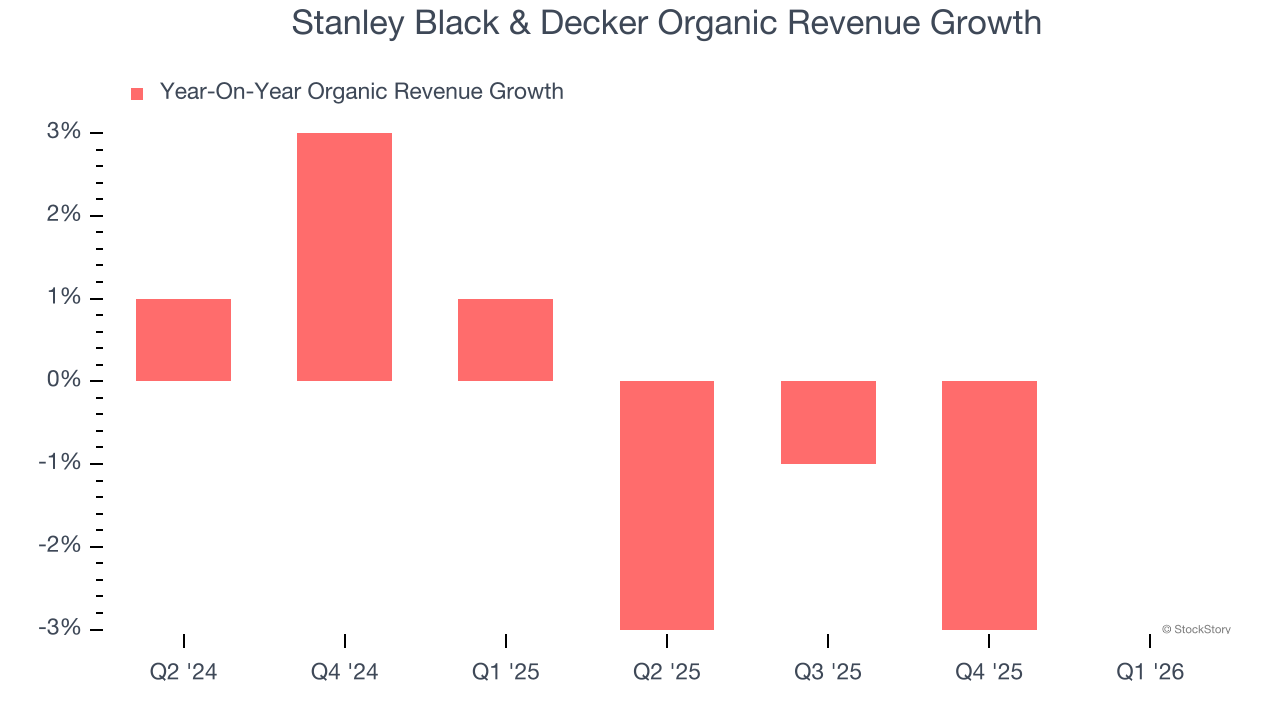
2. Projected Revenue Growth Shows Limited Upside
Forecasted revenues by Wall Street analysts signal a company’s potential. Predictions may not always be accurate, but accelerating growth typically boosts valuation multiples and stock prices while slowing growth does the opposite.
Over the next 12 months, sell-side analysts expect Stanley Black & Decker’s revenue to stall, close to its 1.7% annualized growth for the past five years. This projection is underwhelming and implies its newer products and services will not accelerate its top-line performance yet.
3. EPS Trending Down
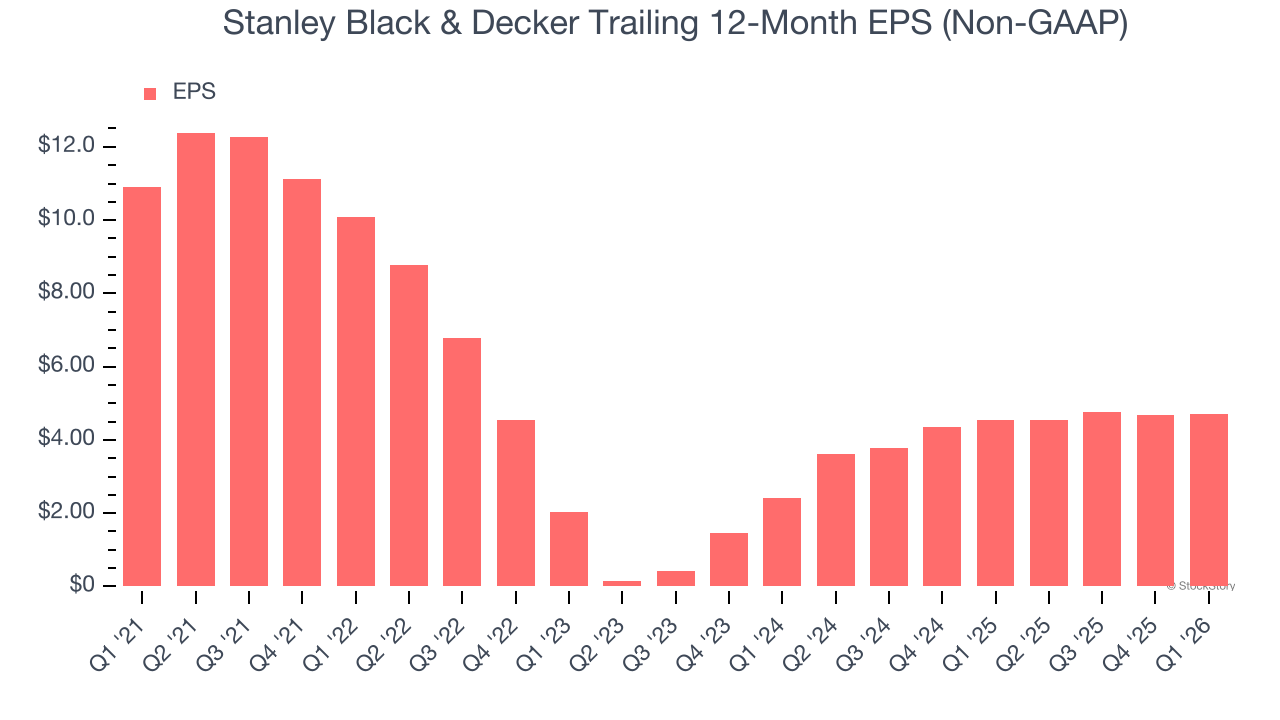
Analyzing the long-term change in earnings per share (EPS) shows whether a company's incremental sales were profitable – for example, revenue could be inflated through excessive spending on advertising and promotions.
Sadly for Stanley Black & Decker, its EPS declined by 15.4% annually over the last five years while its revenue grew by 1.7%. This tells us the company became less profitable on a per-share basis as it expanded.
Final Judgment
Stanley Black & Decker isn’t a terrible business, but it isn’t one of our picks. That said, the stock currently trades at 13.6× forward P/E (or $76.46 per share). This valuation is reasonable, but the company’s shakier fundamentals present too much downside risk. We're fairly confident there are better investments elsewhere. We’d suggest looking at the most dominant software business in the world.
Stocks We Would Buy Instead of Stanley Black & Decker
ALSO WORTH WATCHING: Top 5 Momentum Stocks. The best time to own a great stock is when the market is finally noticing it. These aren't just high-quality businesses. Something is happening with them right now. Elite fundamentals meeting near-term momentum - both boxes checked at the same time.
Find out which stocks our AI platform is flagging this week. See this week's Strong Momentum stocks - FREE. Get Our Strong Momentum Stocks for Free HERE.
Stocks that have made our list include now familiar names such as Nvidia (+1,326% between June 2020 and June 2025) as well as under-the-radar businesses like the once-micro-cap company Kadant (+351% five-year return). Find your next big winner with StockStory today.