Leading designer of graphics chips Nvidia (NASDAQ: NVDA) announced better-than-expected revenue in Q1 CY2026, with sales up 85.2% year on year to $81.62 billion. On top of that, next quarter’s revenue guidance ($91 billion at the midpoint) was surprisingly good and 5.7% above what analysts were expecting. Its non-GAAP profit of $1.87 per share was 5.4% above analysts’ consensus estimates.
Is now the time to buy Nvidia? Find out by accessing our full research report, it’s free.
Nvidia (NVDA) Q1 CY2026 Highlights:
- Revenue: $81.62 billion vs analyst estimates of $78.84 billion (85.2% year-on-year growth, 3.5% beat)
- Adjusted EPS: $1.87 vs analyst estimates of $1.77 (5.4% beat)
- Adjusted EBITDA: $56.46 billion vs analyst estimates of $52.91 billion (69.2% margin, 6.7% beat)
- Revenue Guidance for Q2 CY2026 is $91 billion at the midpoint, above analyst estimates of $86.11 billion
- Operating Margin: 65.6%, up from 49.1% in the same quarter last year
- Free Cash Flow Margin: 59.5%, similar to the same quarter last year
- Inventory Days Outstanding: 115, in line with the previous quarter
- Market Capitalization: $5.34 trillion
“The buildout of AI factories — the largest infrastructure expansion in human history — is accelerating at extraordinary speed,” said Jensen Huang, founder and CEO of NVIDIA.
Company Overview
Founded in 1993 by Jensen Huang and two former Sun Microsystems engineers, Nvidia (NASDAQ: NVDA) is a leading fabless designer of chips used in gaming, PCs, data centers, automotive, and a variety of end markets.
Revenue Growth
Reviewing a company’s long-term sales performance reveals insights into its quality. Even a bad business can shine for one or two quarters, but a top-tier one grows for years. Luckily, Nvidia’s sales grew at an incredible 67.4% compounded annual growth rate over the last five years. Its growth surpassed the average semiconductor company and shows its offerings resonate with customers, a great starting point for our analysis. Semiconductors are a cyclical industry, and long-term investors should be prepared for periods of high growth followed by periods of revenue contractions (which can sometimes offer opportune times to buy).
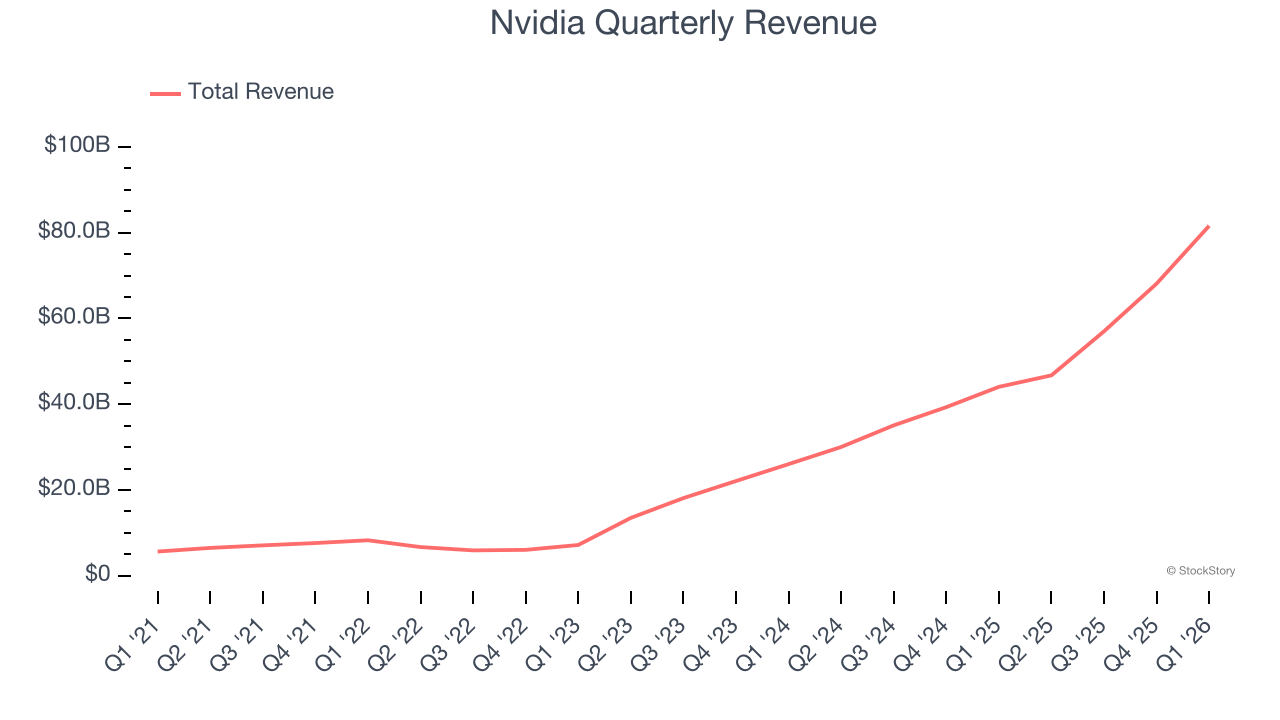
Long-term growth is the most important, but short-term results matter for semiconductors because the rapid pace of technological innovation (Moore's Law) could make yesterday's hit product obsolete today. Nvidia’s annualized revenue growth of 78.3% over the last two years is above its five-year trend, suggesting its demand was strong and recently accelerated. 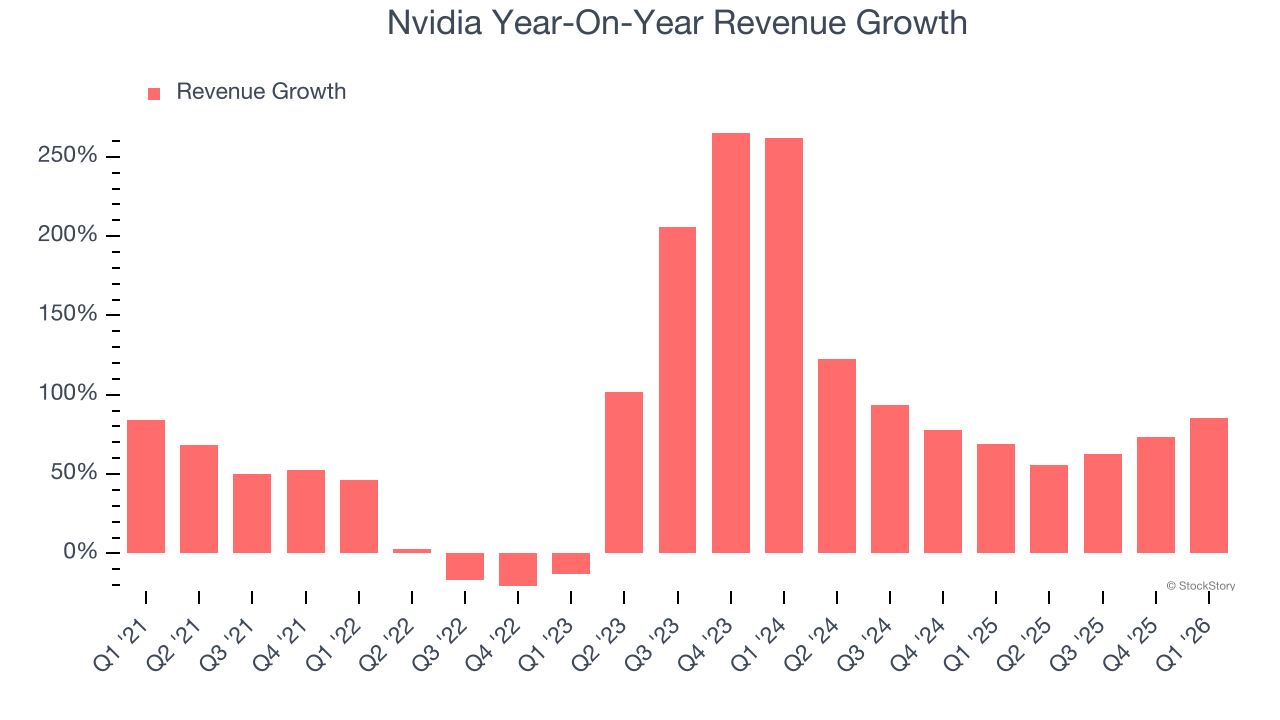
This quarter, Nvidia reported magnificent year-on-year revenue growth of 85.2%, and its $81.62 billion of revenue beat Wall Street’s estimates by 3.5%. Beyond the beat, this marks 12 straight quarters of growth, showing that the current upcycle has had a good run - a typical upcycle usually lasts 8-10 quarters. Company management is currently guiding for a 94.7% year-on-year increase in sales next quarter.
Looking further ahead, sell-side analysts expect revenue to grow 59.3% over the next 12 months, a deceleration versus the last two years. Still, this projection is eye-popping given its scale and suggests the market sees success for its products and services.
ONE MORE THING: 3 Hidden Platforms Growing 3X Faster than Amazon, Google, and PayPal. Amazon, Google, and Meta all followed the same playbook: Dominate an ignored market. Build an unbeatable moat. Scale until you’re unstoppable.
These three platforms are running that exact playbook right now. The early investors in Amazon made fortunes. The early investors in these could do the same. Get All 3 Stocks Here for FREE.
Product Demand & Outstanding Inventory
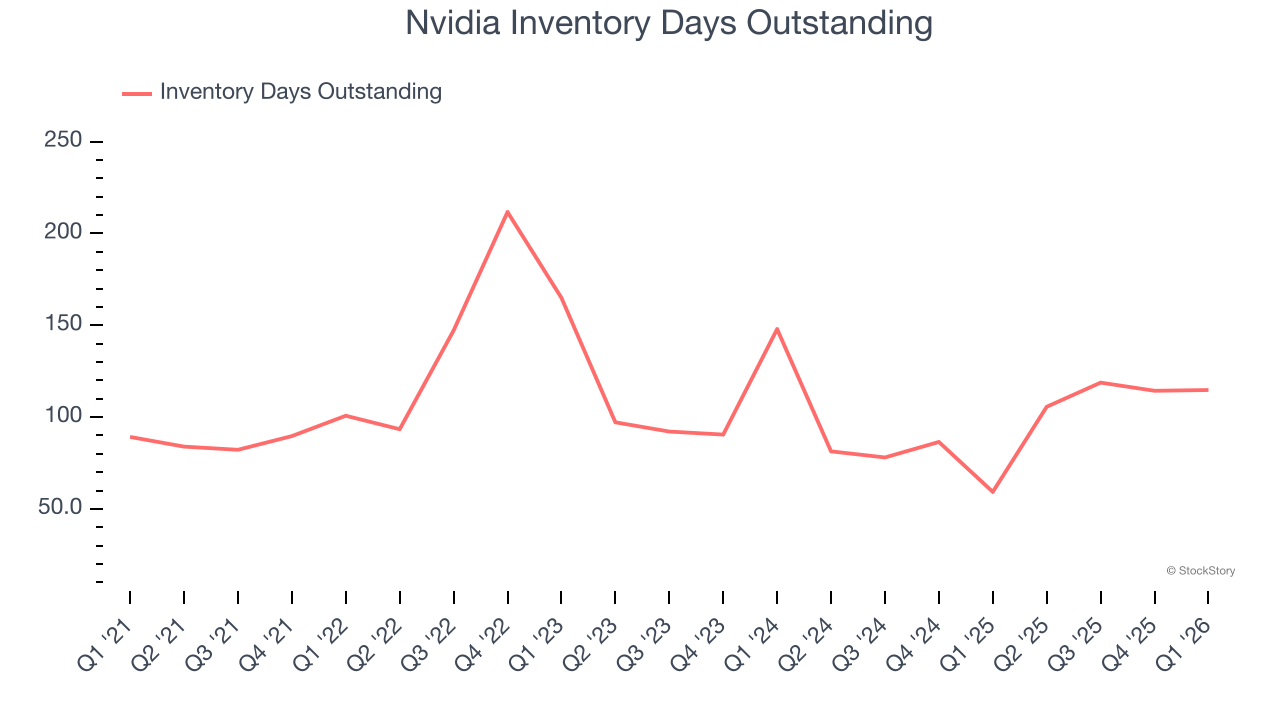
Days Inventory Outstanding (DIO) is an important metric for chipmakers, as it reflects a business’ capital intensity and the cyclical nature of semiconductor supply and demand. In a tight supply environment, inventories tend to be stable, allowing chipmakers to exert pricing power. Steadily increasing DIO can be a warning sign that demand is weak, and if inventories continue to rise, the company may have to downsize production.
This quarter, Nvidia’s DIO came in at 115, which is 7 days above its five-year average, suggesting that the company’s inventory has grown to higher levels than we’ve seen in the past.
Key Takeaways from Nvidia’s Q1 Results
It was great to see Nvidia’s revenue guidance for next quarter top analysts’ expectations. We were also glad its EPS outperformed Wall Street’s estimates. Zooming out, we think this was a good print with some key areas of upside. The stock remained flat at $223.13 immediately after reporting.
Should you buy the stock or not? The latest quarter does matter, but not nearly as much as longer-term fundamentals and valuation, when deciding if the stock is a buy. We cover that in our actionable full research report which you can read here (it’s free).