Outdoor lifestyle products brand (NYSE: YETI) announced better-than-expected revenue in Q1 CY2026, with sales up 8.3% year on year to $380.4 million. Its non-GAAP profit of $0.26 per share was 40.4% above analysts’ consensus estimates.
Is now the time to buy YETI? Find out by accessing our full research report, it’s free.
YETI (YETI) Q1 CY2026 Highlights:
- Revenue: $380.4 million vs analyst estimates of $374.3 million (8.3% year-on-year growth, 1.6% beat)
- Adjusted EPS: $0.26 vs analyst estimates of $0.19 (40.4% beat)
- Adjusted EBITDA: $35.81 million vs analyst estimates of $33.51 million (9.4% margin, 6.9% beat)
- Management raised its full-year Adjusted EPS guidance to $2.86 at the midpoint, a 2.1% increase
- Operating Margin: 3.3%, down from 6.2% in the same quarter last year
- Free Cash Flow was -$43.77 million compared to -$89.2 million in the same quarter last year
- Market Capitalization: $2.90 billion
Company Overview
Founded by two brothers from Texas, YETI (NYSE: YETI) specializes in durable outdoor goods including coolers, drinkware, and other gear tailored to adventure enthusiasts.
Revenue Growth
A company’s long-term sales performance can indicate its overall quality. Even a bad business can shine for one or two quarters, but a top-tier one grows for years. Over the last five years, YETI grew its sales at a 10.3% annual rate. Though this growth is acceptable on an absolute basis, we need to see more than just topline growth for the consumer discretionary sector, which can display significant earnings volatility. This means our bar for the sector is particularly high, reflecting the non-essential and hit-driven nature of the products and services offered. Additionally, five-year CAGR starts around Covid, when revenue was depressed then rebounded.
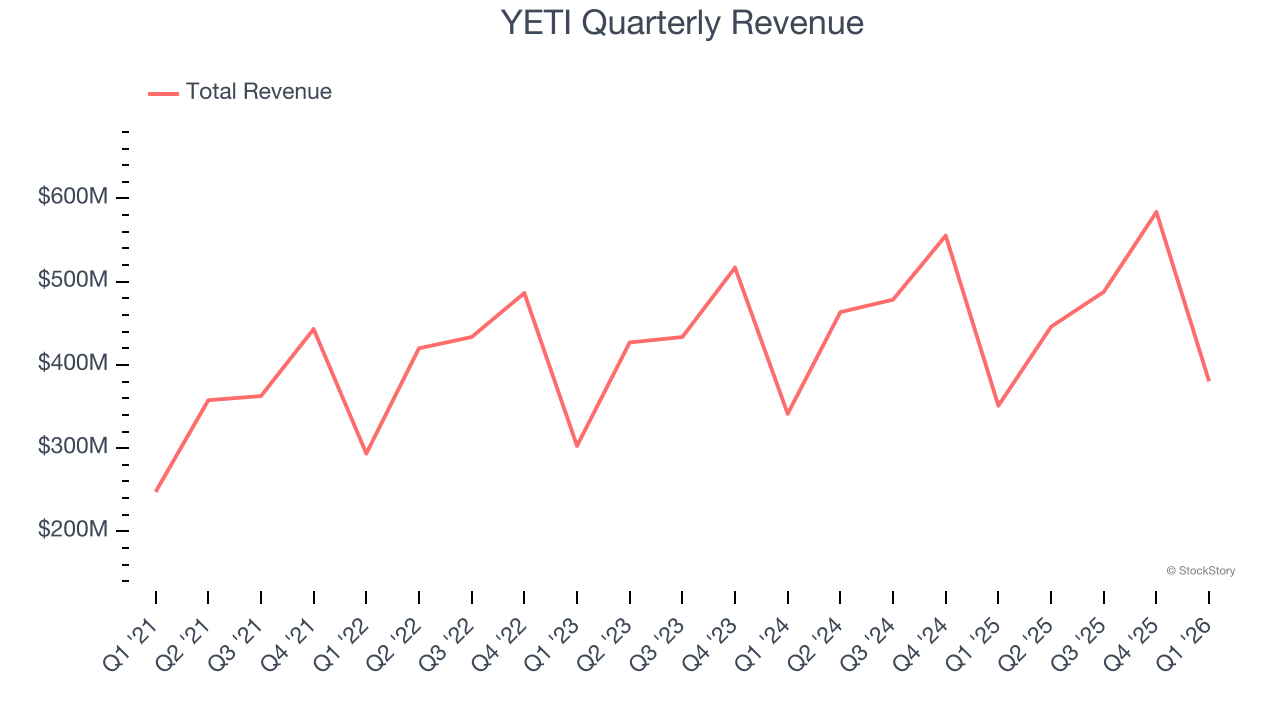
Long-term growth is the most important, but within consumer discretionary, product cycles are short and revenue can be hit-driven due to rapidly changing trends and consumer preferences. YETI’s recent performance shows its demand has slowed as its annualized revenue growth of 5.1% over the last two years was below its five-year trend. We’re wary when companies in the sector see decelerations in revenue growth, as it could signal changing consumer tastes aided by low switching costs. 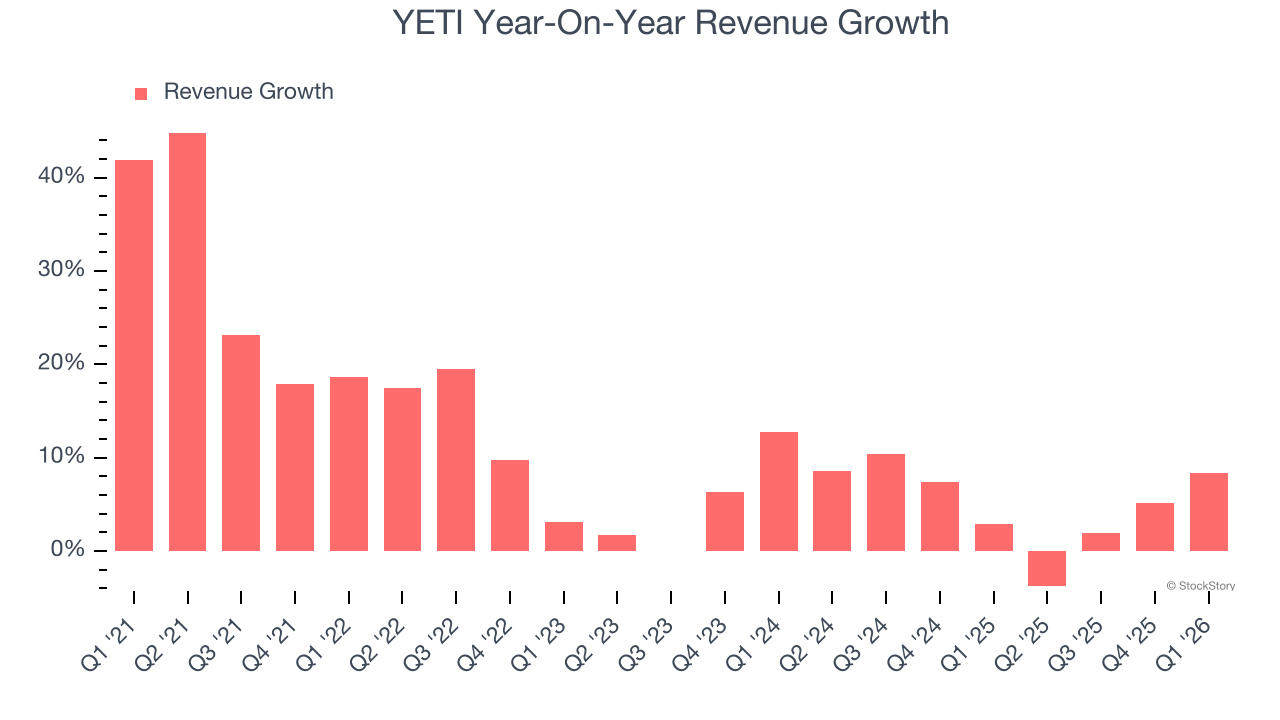
We can better understand the company’s revenue dynamics by analyzing its most important segments, Retail and Wholesale, which are 51.7% and 48.3% of revenue. Over the last two years, YETI’s Retail revenue (direct sales to customers) averaged 2.8% year-on-year growth while its Wholesale revenue (sales to retailers) averaged 3.8% growth. 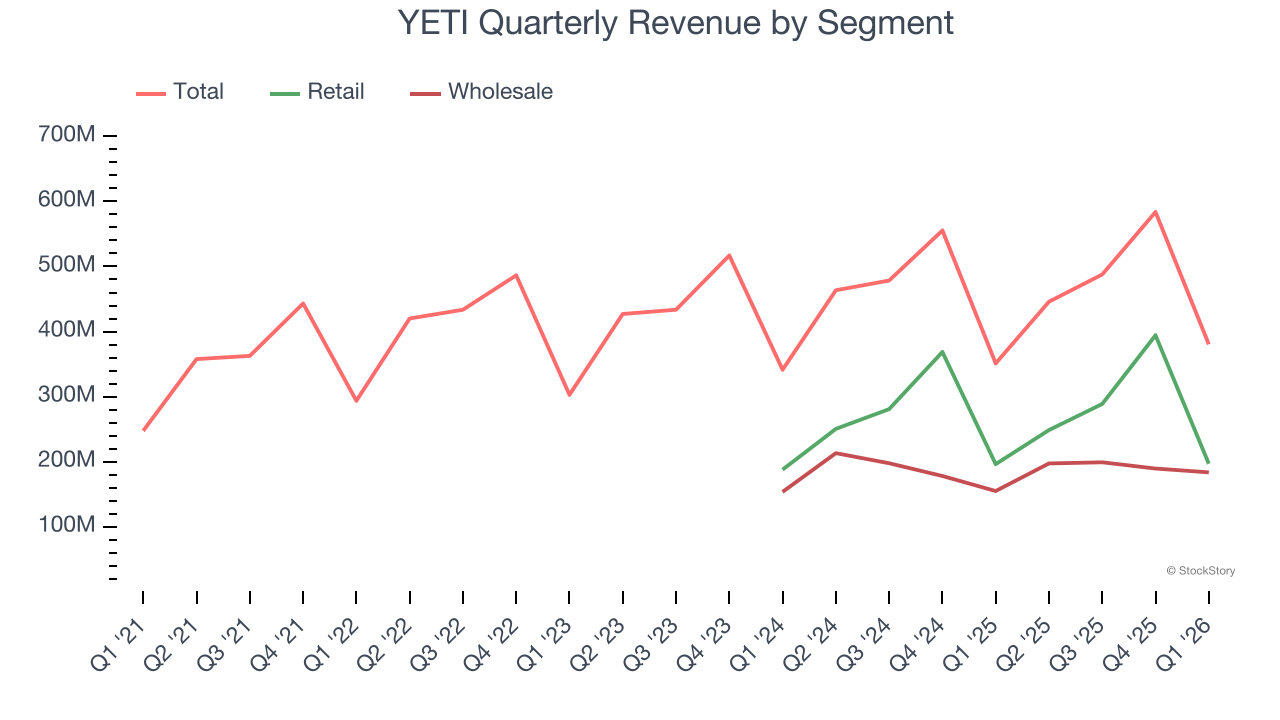
This quarter, YETI reported year-on-year revenue growth of 8.3%, and its $380.4 million of revenue exceeded Wall Street’s estimates by 1.6%.
Looking ahead, sell-side analysts expect revenue to grow 6.9% over the next 12 months. Although this projection indicates its newer products and services will catalyze better top-line performance, it is still below the sector average.
ONE MORE THING: 3 Hidden Platforms Growing 3X Faster than Amazon, Google, and PayPal. Amazon, Google, and Meta all followed the same playbook: Dominate an ignored market. Build an unbeatable moat. Scale until you’re unstoppable.
These three platforms are running that exact playbook right now. The early investors in Amazon made fortunes. The early investors in these could do the same. Get All 3 Stocks Here for FREE.
Operating Margin
YETI’s operating margin has shrunk over the last 12 months and averaged 11.9% over the last two years. The company’s profitability was mediocre for a consumer discretionary business and shows it couldn’t pass its higher operating expenses onto its customers.
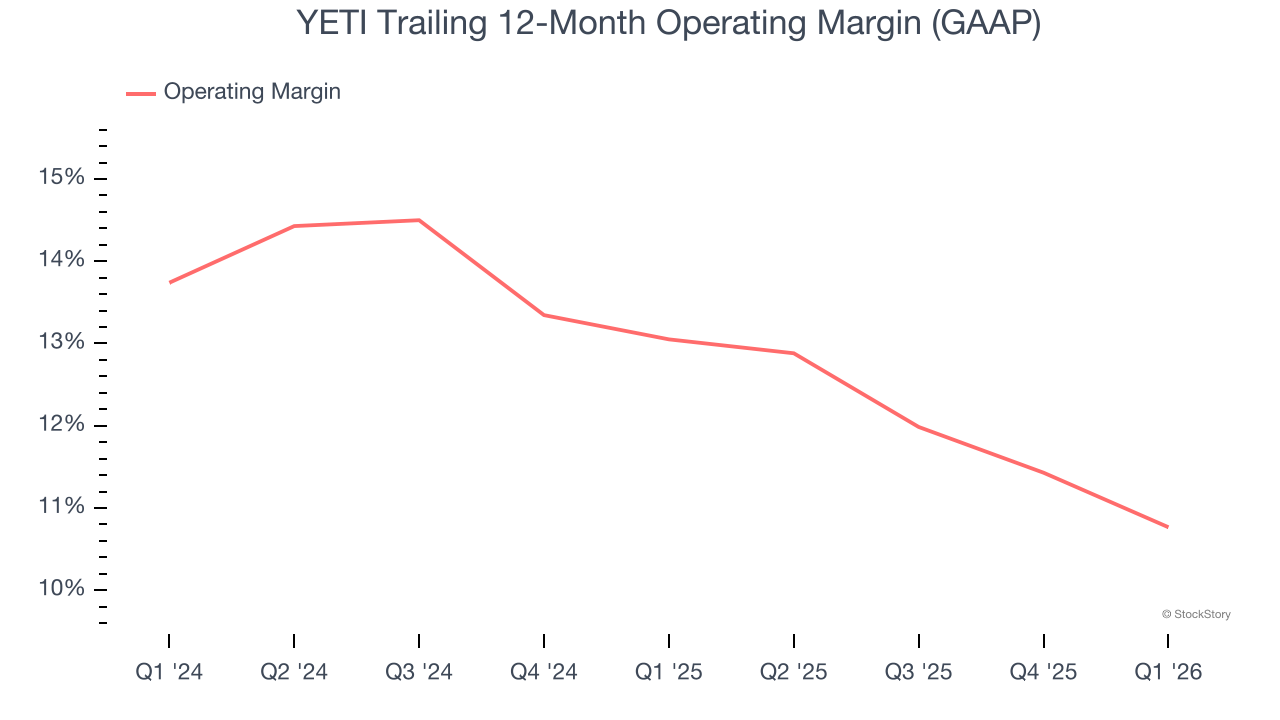
This quarter, YETI generated an operating margin profit margin of 3.3%, down 2.9 percentage points year on year. This contraction shows it was less efficient because its expenses grew faster than its revenue.
Earnings Per Share
We track the long-term change in earnings per share (EPS) for the same reason as long-term revenue growth. Compared to revenue, however, EPS highlights whether a company’s growth is profitable.
YETI’s EPS grew at a weak 2.7% compounded annual growth rate over the last five years, lower than its 10.3% annualized revenue growth. This tells us the company became less profitable on a per-share basis as it expanded due to non-fundamental factors such as interest expenses and taxes.
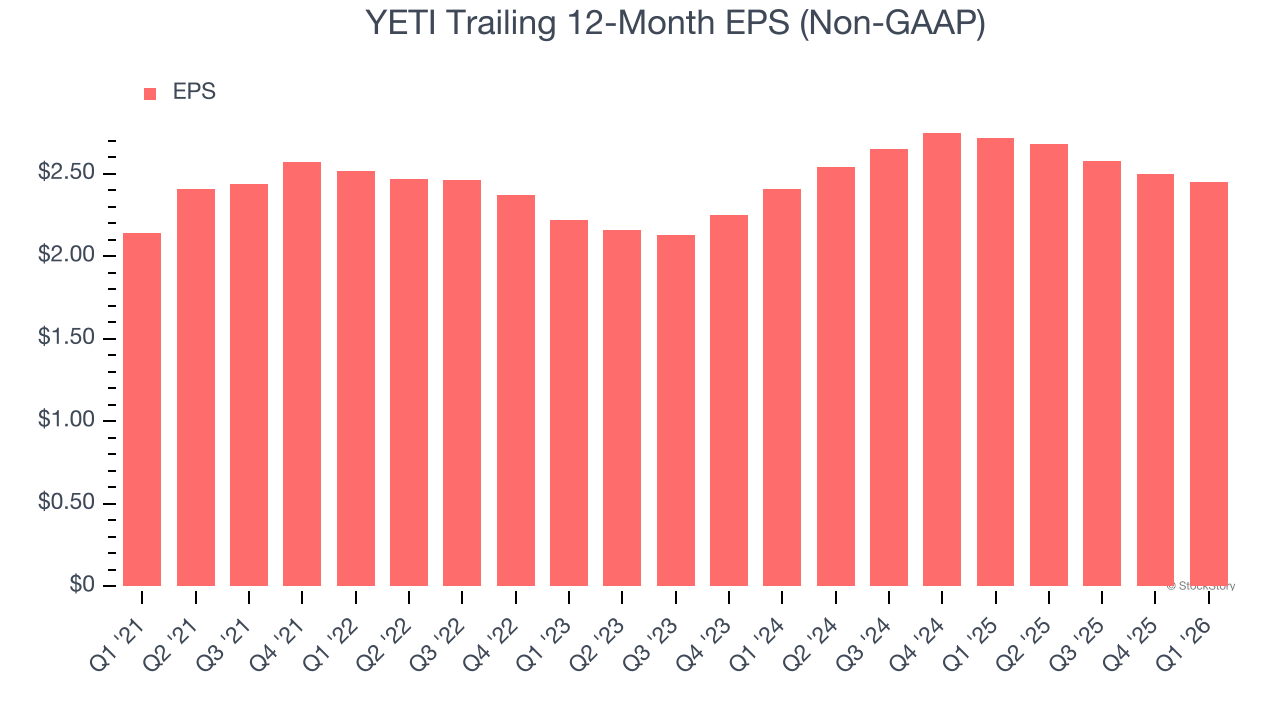
In Q1, YETI reported adjusted EPS of $0.26, down from $0.31 in the same quarter last year. Despite falling year on year, this print easily cleared analysts’ estimates. Over the next 12 months, Wall Street expects YETI’s full-year EPS of $2.45 to grow 18.9%.
Key Takeaways from YETI’s Q1 Results
It was good to see YETI beat analysts’ EPS expectations this quarter. We were also happy its adjusted operating income outperformed Wall Street’s estimates. Overall, we think this was a decent quarter with some key metrics above expectations. The stock traded up 2% to $39.10 immediately after reporting.
YETI had an encouraging quarter, but one earnings result doesn’t necessarily make the stock a buy. Let’s see if this is a good investment. What happened in the latest quarter matters, but not as much as longer-term business quality and valuation, when deciding whether to invest in this stock. We cover that in our actionable full research report which you can read here (it’s free).