

Let’s dig into the relative performance of Ladder Capital (NYSE: LADR) and its peers as we unravel the now-completed Q4 thrifts & mortgage finance earnings season.
Thrifts & Mortgage Finance institutions operate by accepting deposits and extending loans primarily for residential mortgages, earning revenue through interest rate spreads (difference between lending rates and borrowing costs) and origination fees. The industry benefits from demographic tailwinds as millennials enter prime homebuying age, technological advancements streamlining the loan approval process, and potential interest rate stabilization improving affordability. However, significant headwinds include net interest margin compression during rate volatility, increased competition from fintech disruptors offering digital-first experiences, mounting regulatory compliance costs, and potential housing market corrections that could impact loan portfolios and default rates.
The 13 thrifts & mortgage finance stocks we track reported a slower Q4. As a group, revenues beat analysts’ consensus estimates by 1.8% while next quarter’s revenue guidance was 3.9% below.
Amidst this news, share prices of the companies have had a rough stretch. On average, they are down 9.8% since the latest earnings results.
Ladder Capital (NYSE: LADR)
Founded during the 2008 financial crisis when traditional lenders retreated from commercial real estate, Ladder Capital (NYSE: LADR) is a real estate investment trust that originates commercial real estate loans, owns commercial properties, and invests in real estate securities.
Ladder Capital reported revenues of $50.47 million, down 26.4% year on year. This print fell short of analysts’ expectations by 9.2%. Overall, it was a disappointing quarter for the company with a significant miss of analysts’ tangible book value per share and revenue estimates.
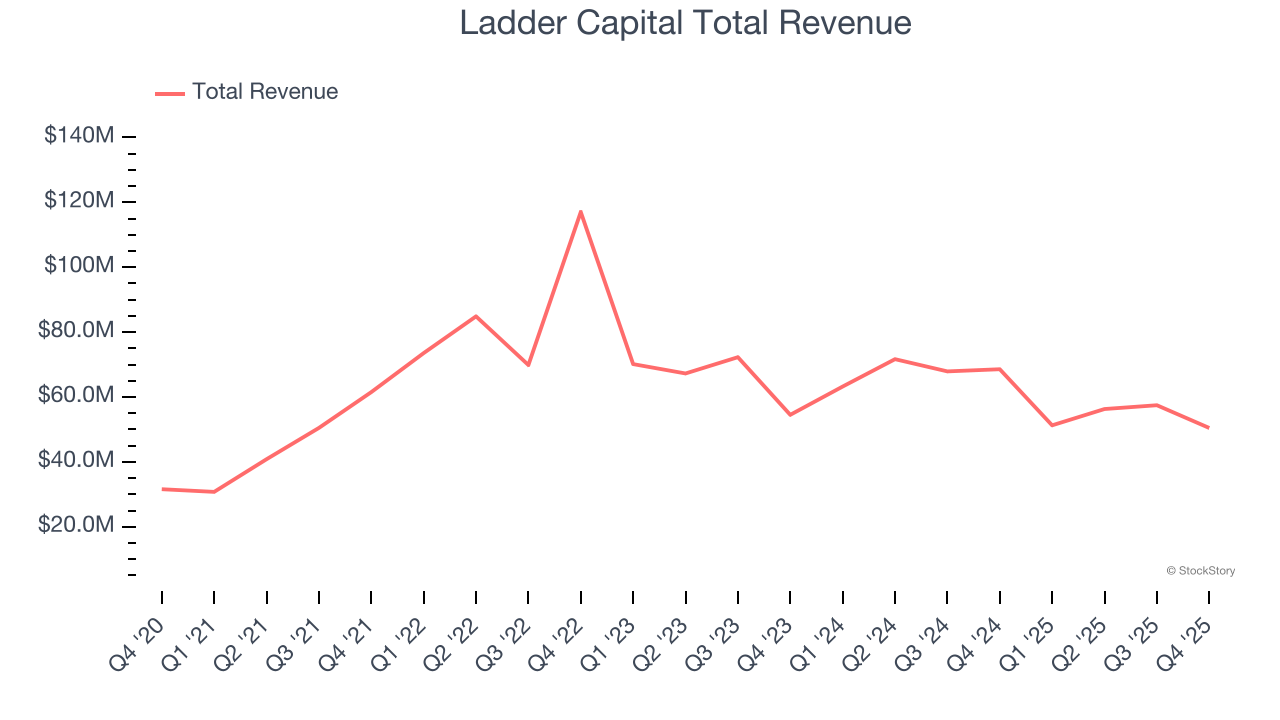
Ladder Capital delivered the slowest revenue growth of the whole group. Unsurprisingly, the stock is down 10.7% since reporting and currently trades at $9.87.
Read our full report on Ladder Capital here, it’s free.
Best Q4: Arbor Realty Trust (NYSE: ABR)
With roots dating back to 2003 and a focus on the stability of multifamily housing, Arbor Realty Trust (NYSE: ABR) is a specialized lender that provides financing solutions for multifamily and commercial real estate while also originating and servicing government-backed mortgage loans.
Arbor Realty Trust reported revenues of $133.4 million, down 12.1% year on year, outperforming analysts’ expectations by 10.3%. The business had a stunning quarter with a beat of analysts’ EPS and revenue estimates.
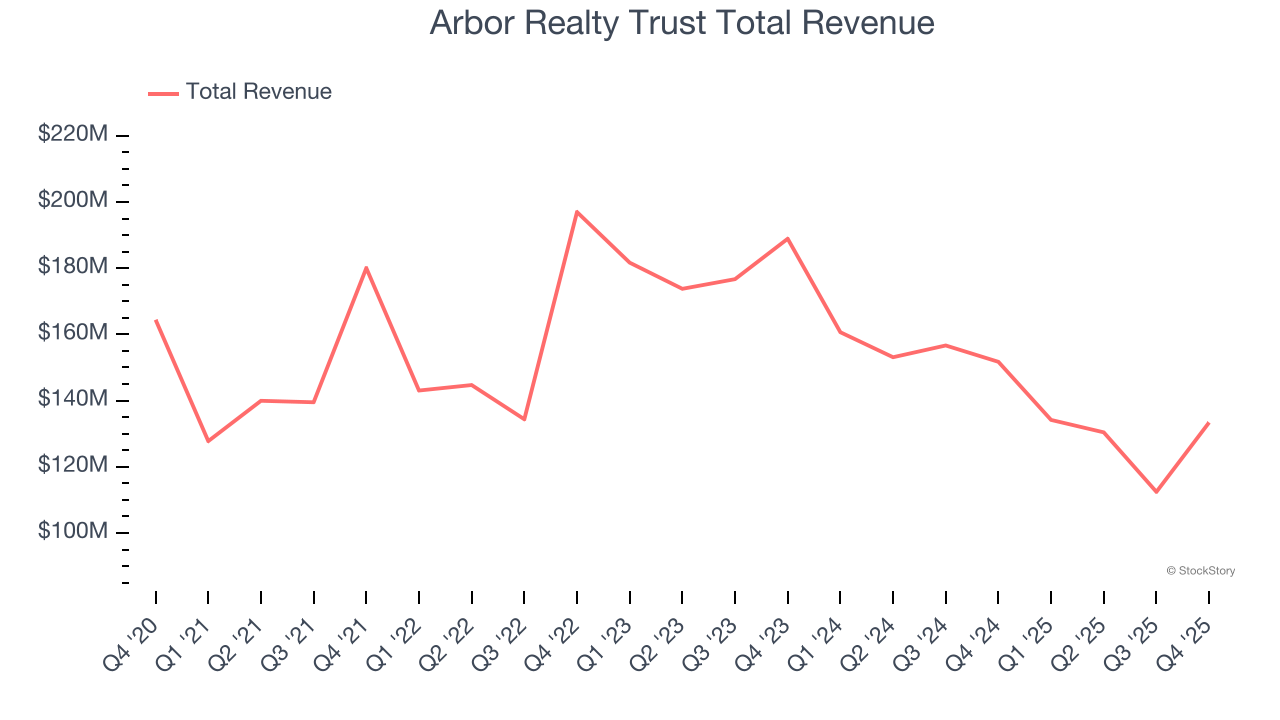
The market seems content with the results as the stock is up 3.7% since reporting. It currently trades at $7.53.
Is now the time to buy Arbor Realty Trust? Access our full analysis of the earnings results here, it’s free.
Franklin BSP Realty Trust (NYSE: FBRT)
Operating as a specialized real estate investment trust (REIT) with roots dating back to 2012, Franklin BSP Realty Trust (NYSE: FBRT) originates and manages a diversified portfolio of commercial real estate debt investments secured by properties in the United States and abroad.
Franklin BSP Realty Trust reported revenues of $84.04 million, up 49.8% year on year, falling short of analysts’ expectations by 10.3%. It was a disappointing quarter as it posted a significant miss of analysts’ revenue and net interest income estimates.
As expected, the stock is down 16.8% since the results and currently trades at $8.45.
Read our full analysis of Franklin BSP Realty Trust’s results here.
Walker & Dunlop (NYSE: WD)
Originating as a small mortgage banking firm during the Great Depression in 1937, Walker & Dunlop (NYSE: WD) provides commercial real estate financing, property sales, appraisal, and investment management services with a focus on multifamily properties.
Walker & Dunlop reported revenues of $340 million, flat year on year. This print lagged analysts' expectations by 1%. It was a disappointing quarter as it also recorded a significant miss of analysts’ tangible book value per share estimates and a significant miss of analysts’ net interest income estimates.
The stock is down 24.6% since reporting and currently trades at $44.44.
Read our full, actionable report on Walker & Dunlop here, it’s free.
WaFd Bank (NASDAQ: WAFD)
Founded in 1917 and rebranded from Washington Federal in 2023, WaFd (NASDAQ: WAFD) is a bank holding company that provides lending, deposit services, and insurance through its Washington Federal Bank subsidiary across eight western states.
WaFd Bank reported revenues of $188.3 million, up 7.6% year on year. This number missed analysts’ expectations by 2.6%. Overall, it was a softer quarter as it also produced a significant miss of analysts’ revenue estimates and a miss of analysts’ net interest income estimates.
The stock is down 5.7% since reporting and currently trades at $31.81.
Read our full, actionable report on WaFd Bank here, it’s free.
Market Update
Late in 2025 into early 2026, there was hand wringing around artificial intelligence. For software companies, the fear was that AI would erode pricing power and compress margins as new tools made it easier to replicate what once required expensive enterprise platforms. Crypto investors had their own version of the same anxiety: if AI agents could trade, allocate capital, and manage wallets autonomously, what exactly was the long-term value of today’s crypto infrastructure?
These concerns triggered a noticeable rotation away from these sectors and into safer havens. But markets rarely dwell on one narrative for long. Spring 2026 came, and the focus shifted abruptly from technological disruption to geopolitical risk. The US’ conflict with Iran became the dominant driver of market psychology, and when geopolitics takes center stage, the script changes quickly. Investors stop debating growth rates and start worrying about oil supply, inflation, and global stability.
Want to invest in winners with rock-solid fundamentals? Check out our Top 5 Quality Compounder Stocks and add them to your watchlist. These companies are poised for growth regardless of the political or macroeconomic climate.
StockStory’s analyst team — all seasoned professional investors — uses quantitative analysis and automation to deliver market-beating insights faster and with higher quality.