Energy technology company Baker Hughes (NASDAQ: BKR) reported Q1 CY2026 results exceeding the market’s revenue expectations, with sales up 2.5% year on year to $6.59 billion. Its non-GAAP profit of $0.58 per share was 17.5% above analysts’ consensus estimates.
Is now the time to buy Baker Hughes? Find out by accessing our full research report, it’s free.
Baker Hughes (BKR) Q1 CY2026 Highlights:
- Revenue: $6.59 billion vs analyst estimates of $6.33 billion (2.5% year-on-year growth, 4.1% beat)
- Adjusted EPS: $0.58 vs analyst estimates of $0.49 (17.5% beat)
- Adjusted EBITDA: $1.16 billion vs analyst estimates of $1.03 billion (17.6% margin, 12.2% beat)
- Operating Margin: 19.3%, up from 11.7% in the same quarter last year
- Free Cash Flow Margin: 2.5%, down from 7.1% in the same quarter last year
- Market Capitalization: $62.02 billion
"Our exceptional first-quarter performance highlights the strength of our portfolio and the momentum we are building as we progress through Horizon 2(1). Despite significant disruptions in the Middle East, our teams executed at a high level and delivered results that exceeded our guidance range. Although we recognize this achievement, we continue to prioritize the safety and wellbeing of our employees and their families in the region," said Lorenzo Simonelli, Baker Hughes Chairman and Chief Executive Officer.
Company Overview
Tracing lineage to a 1907 cable tool drill bit patent, Baker Hughes (NASDAQ: BKR) provides equipment and services for oil and gas drilling, production, and transport.
Revenue Growth
Cyclical sectors like Energy often flatter weaker operators during favorable price environments, but a longer-term lens separates those from businesses that can consistently perform across market cycles. Unfortunately, Baker Hughes’s 6.8% annualized revenue growth over the last five years was sluggish. This was below our standard for the energy upstream and integrated energy sector and is a poor baseline for our analysis.
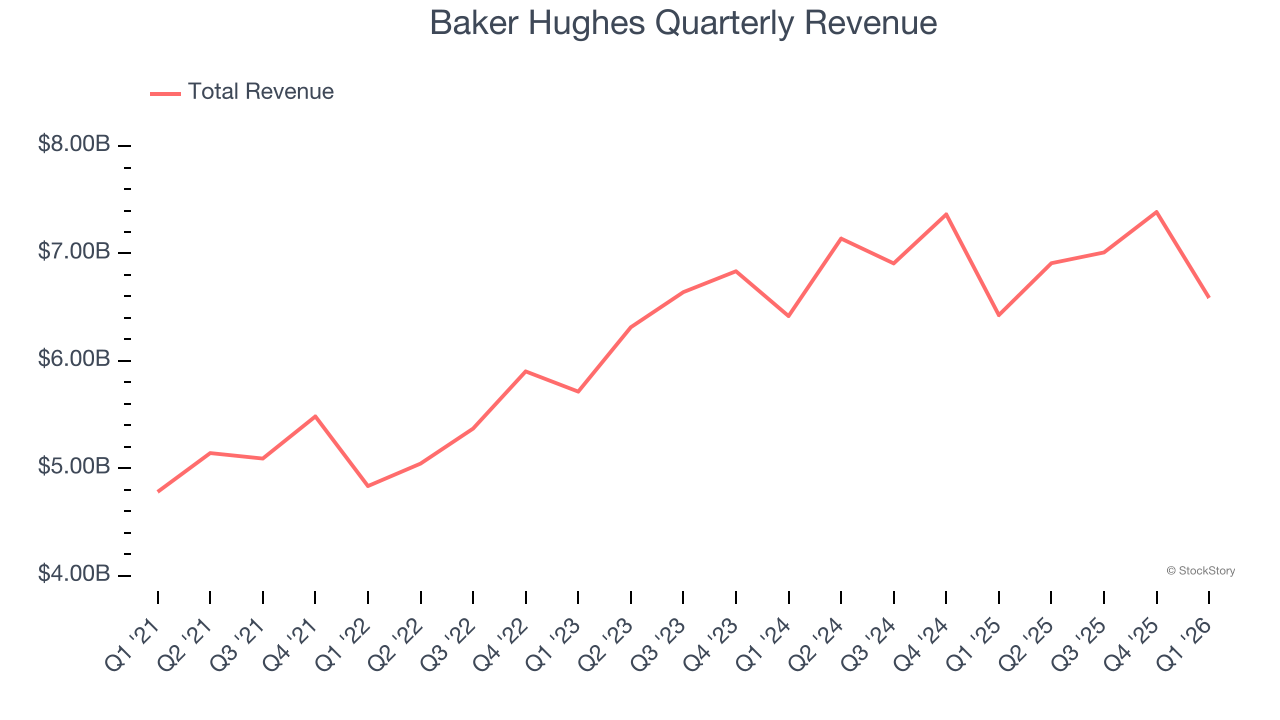
Within Energy, a singular timeframe, even if it’s quite long-term, only sheds light on how well a company rode the last commodity cycle. To better assess whether a company compounds through cycles, we validate our view with an even longer, ten-year view. Baker Hughes’s annualized revenue growth of 5.1% over the last ten years is below its five-year trend, but we still think the results were good.
This quarter, Baker Hughes reported modest year-on-year revenue growth of 2.5% but beat Wall Street’s estimates by 4.1%.
WHILE YOU’RE HERE: The Next Palantir? One satellite company captures images of every point on Earth. Every single day. The Pentagon wants it. Hedge funds are using it to beat earnings. You’ve probably never heard of it.
This is what the early days of Palantir looked like before it became a $437 billion giant. Same playbook. Different technology. If you missed Palantir, you need to see this. Claim The Stock Ticker for Free HERE.
Adjusted EBITDA Margin
Adjusted EBITDA margin strips out accounting distortions tied to depletion and historical drilling spend, providing a clearer view of the cash-generating power of the underlying asset base before financing and reinvestment decisions.
Baker Hughes was profitable over the last five years but held back by its large cost base. Its average EBITDA margin of 15.6% was among the worst in the energy upstream and integrated energy sector.
On the plus side, Baker Hughes’s EBITDA margin rose by 4.4 percentage points over the last year, as its sales growth gave it operating leverage.
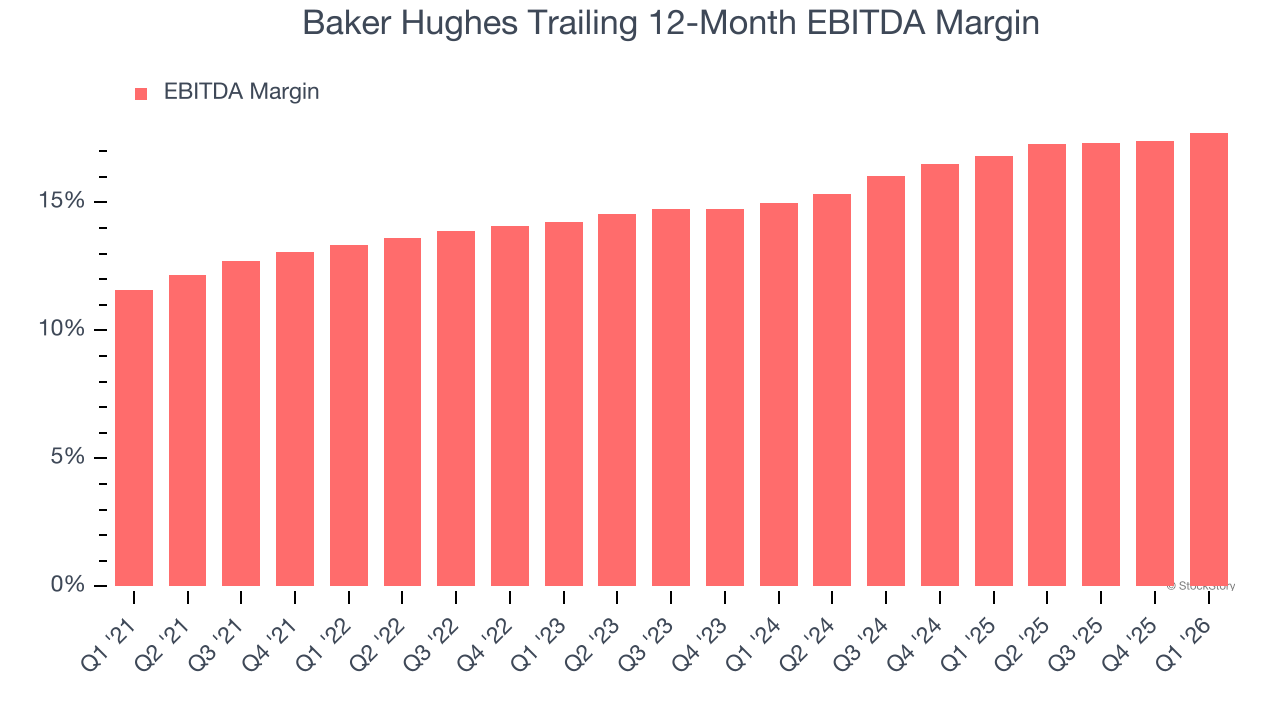
This quarter, Baker Hughes generated an EBITDA margin profit margin of 17.6%, up 1.4 percentage points year on year. This increase was a welcome development and shows it was more efficient. This adjusted EBITDA beat Wall Street’s estimates by 12.2%.
Cash Is King
Adjusted EBITDA shows how profitable a company’s existing wells are before financing and reinvestment decisions, but free cash flow shows how much value remains after paying the cost of replacing those wells. In upstream energy, production naturally declines over time, so companies must continuously reinvest just to stand still. A producer can report strong EBITDA margins yet generate little or no free cash flow if its wells decline quickly or if new drilling is expensive. Free cash flow therefore captures not only how efficiently a company produces hydrocarbons today, but also how costly it is to sustain that production into the future.
Baker Hughes has shown decent cash profitability, giving it some flexibility to reinvest or return capital to investors. The company’s free cash flow margin averaged 8% over the last five years, slightly better than the broader energy upstream and integrated energy sector.
The level of free cash flow is important, but its durability across cycles is just as critical. Consistent margins are far more valuable than volatile swings driven by commodity prices.
Baker Hughes’s ratio of quarterly free cash flow volatility to WTI crude price volatility over the past five years was 4.6 (lower is better), indicating excellent insulation from commodity swings. This stability supports capital access in downturns and positions Baker Hughes to act as a consolidator when weaker peers are forced to retrench.
You may be asking why we wait until the free cash flow line to perform this stability analysis versus commodity prices. Why not compare revenue or EBITDA to WTI in the case of Baker Hughes? Because what ultimately matters is not how much revenue or profit you earn when prices are high but how much cash you can generate when prices are low. Free cash flow is the superior metric because it includes everything from hedging prowess to growth and maintenance capex to management behavior during good times and bad.
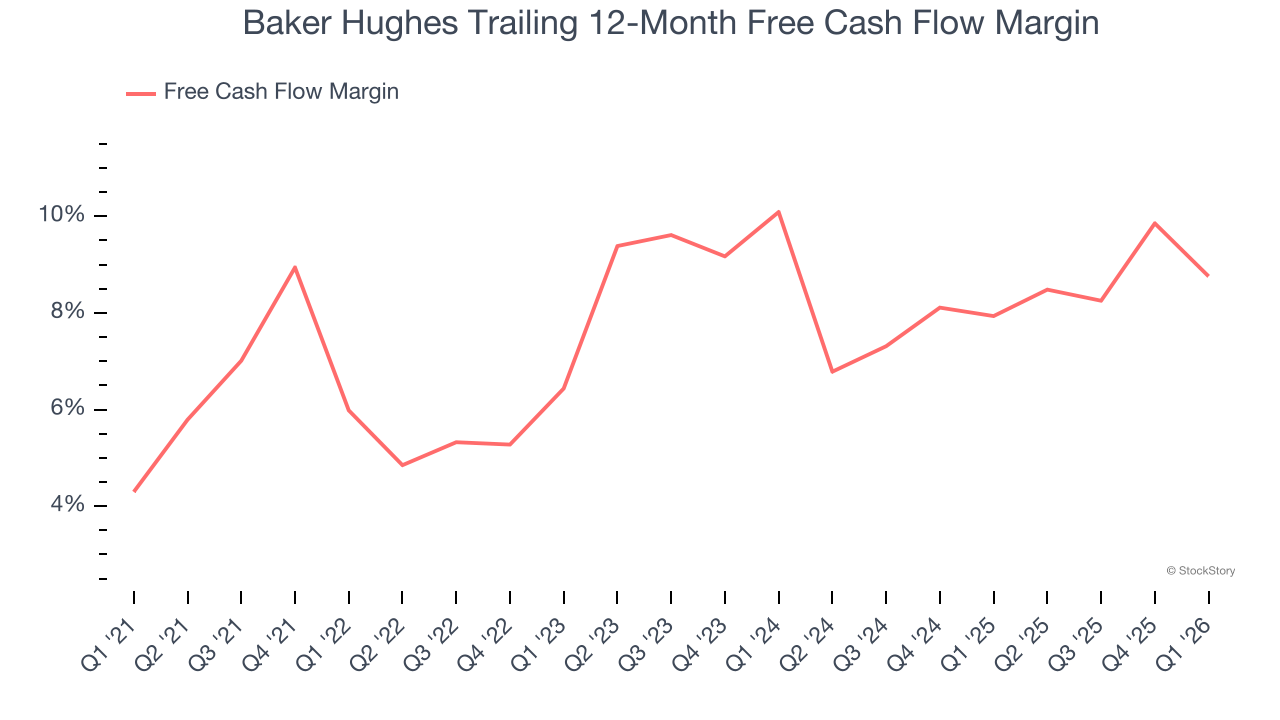
Baker Hughes’s free cash flow clocked in at $164 million in Q1, equivalent to a 2.5% margin. The company’s cash profitability regressed as it was 4.6 percentage points lower than in the same quarter last year, prompting us to pay closer attention. Short-term fluctuations typically aren’t a big deal because investment needs can be seasonal, but we’ll be watching to see if the trend extrapolates into future quarters.
Key Takeaways from Baker Hughes’s Q1 Results
We were impressed by how significantly Baker Hughes blew past analysts’ revenue expectations this quarter. We were also glad its EPS outperformed Wall Street’s estimates. Zooming out, we think this was a good print with some key areas of upside. The stock remained flat at $63.95 immediately following the results.
So should you invest in Baker Hughes right now? When making that decision, it’s important to consider its valuation, business qualities, as well as what has happened in the latest quarter. We cover that in our actionable full research report which you can read here (it’s free).