

IT distribution giant TD SYNNEX (NYSE: SNX) reported Q1 CY2026 results topping the market’s revenue expectations, with sales up 18.1% year on year to $17.16 billion. On top of that, next quarter’s revenue guidance ($16.5 billion at the midpoint) was surprisingly good and 4.1% above what analysts were expecting. Its non-GAAP profit of $4.73 per share was 43% above analysts’ consensus estimates.
Is now the time to buy TD SYNNEX? Find out by accessing our full research report, it’s free.
TD SYNNEX (SNX) Q1 CY2026 Highlights:
- Revenue: $17.16 billion vs analyst estimates of $15.67 billion (18.1% year-on-year growth, 9.5% beat)
- Adjusted EPS: $4.73 vs analyst estimates of $3.31 (43% beat)
- Adjusted EBITDA: $617.7 million vs analyst estimates of $466 million (3.6% margin, 32.6% beat)
- Revenue Guidance for Q2 CY2026 is $16.5 billion at the midpoint, above analyst estimates of $15.84 billion
- Adjusted EPS guidance for Q2 CY2026 is $4 at the midpoint, above analyst estimates of $3.45
- Operating Margin: 2.9%, in line with the same quarter last year
- Free Cash Flow was -$929 million compared to -$789.5 million in the same quarter last year
- Market Capitalization: $12.91 billion
“We’re pleased with how we’ve started fiscal 2026. In the first quarter, we delivered record non-GAAP gross billings and non-GAAP diluted earnings per share, while continuing to expand profitability and build on the execution and momentum established over the past year,” said Patrick Zammit, CEO of TD SYNNEX.
Company Overview
Serving as the crucial middleman in the technology supply chain, TD SYNNEX (NYSE: SNX) is a global technology distributor that connects thousands of IT manufacturers with resellers, helping businesses access hardware, software, and technology solutions.
Revenue Growth
Examining a company’s long-term performance can provide clues about its quality. Any business can have short-term success, but a top-tier one grows for years.
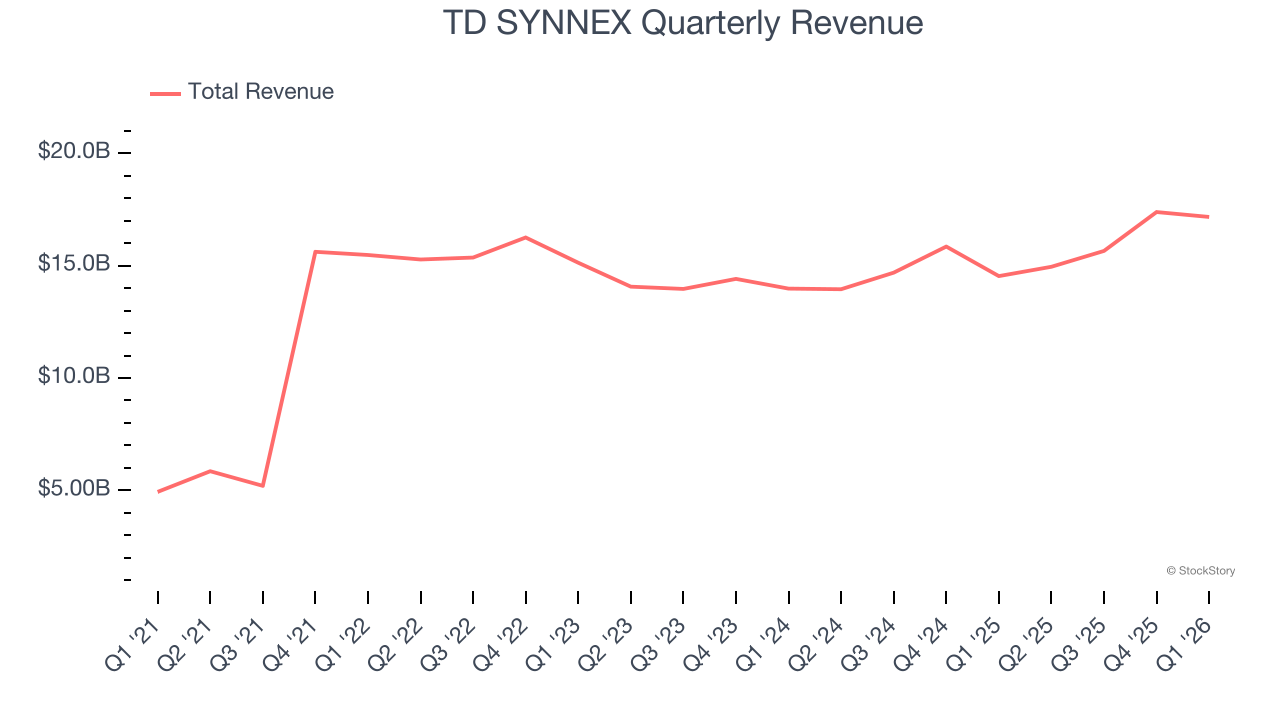
With $65.14 billion in revenue over the past 12 months, TD SYNNEX is a behemoth in the business services sector and benefits from economies of scale, giving it an edge in distribution. This also enables it to gain more leverage on its fixed costs than smaller competitors and the flexibility to offer lower prices.
As you can see below, TD SYNNEX’s sales grew at an incredible 25.6% compounded annual growth rate over the last five years. This shows it had high demand, a useful starting point for our analysis.
We at StockStory place the most emphasis on long-term growth, but within business services, a half-decade historical view may miss recent innovations or disruptive industry trends. TD SYNNEX’s annualized revenue growth of 7.5% over the last two years is below its five-year trend, but we still think the results suggest healthy demand. 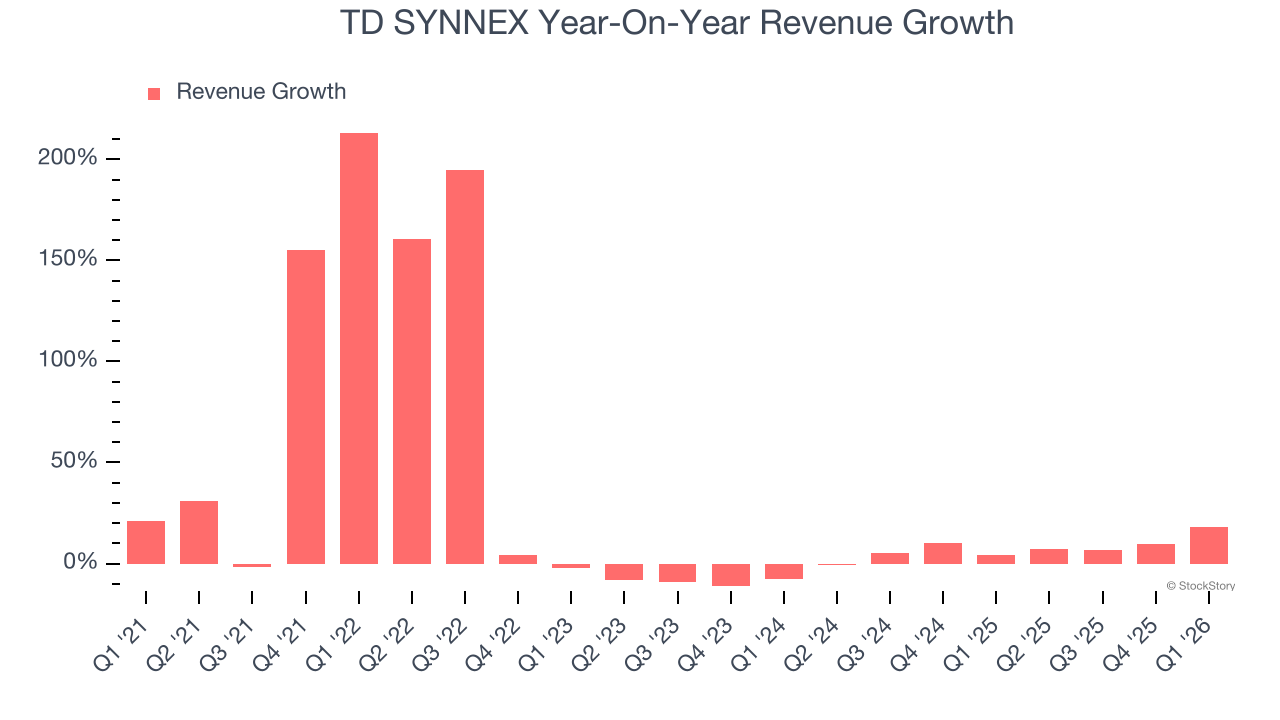
This quarter, TD SYNNEX reported year-on-year revenue growth of 18.1%, and its $17.16 billion of revenue exceeded Wall Street’s estimates by 9.5%. Company management is currently guiding for a 10.4% year-on-year increase in sales next quarter.
Looking further ahead, sell-side analysts expect revenue to remain flat over the next 12 months, a deceleration versus the last two years. This projection is underwhelming and indicates its products and services will see some demand headwinds.
ALSO WORTH WATCHING: Nvidia’s Quiet Partner. Nvidia’s chips cost a hundred grand. The connectors that make them work cost even more. One company makes them all.
Every AI server needs specialized infrastructure the chip companies don’t make. High-speed cables. Power connectors. Thermal sensors. This 90-year-old company built a monopoly on it. The AI boom just started. This stock is still flying under the radar. Claim The Stock Ticker Here for FREE.
Operating Margin
TD SYNNEX’s operating margin has generally stayed the same over the last 12 months, averaging 2% over the last five years. This profitability was lousy for a business services business and caused by its suboptimal cost structure.
Analyzing the trend in its profitability, TD SYNNEX’s operating margin might fluctuated slightly but has generally stayed the same over the last five years. This raises questions about the company’s expense base because its revenue growth should have given it leverage on its fixed costs, resulting in better economies of scale and profitability.
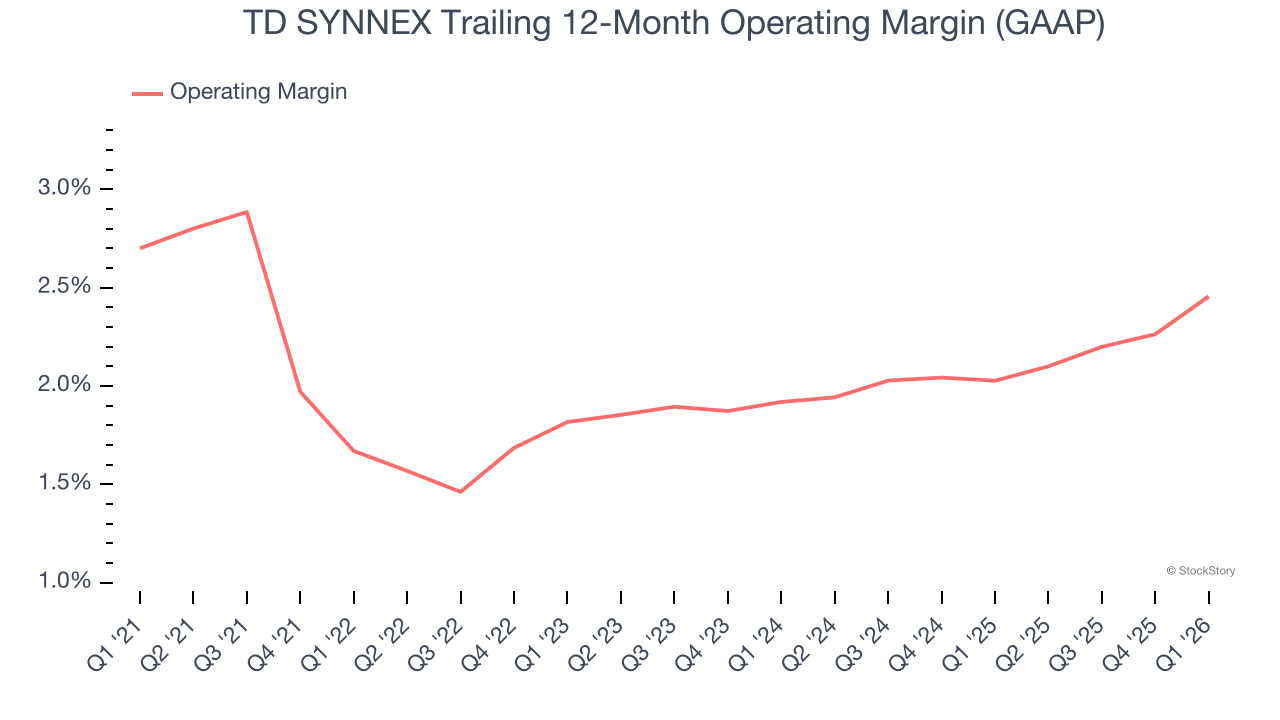
This quarter, TD SYNNEX generated an operating margin profit margin of 2.9%, in line with the same quarter last year. This indicates the company’s overall cost structure has been relatively stable.
Earnings Per Share
We track the long-term change in earnings per share (EPS) for the same reason as long-term revenue growth. Compared to revenue, however, EPS highlights whether a company’s growth is profitable.
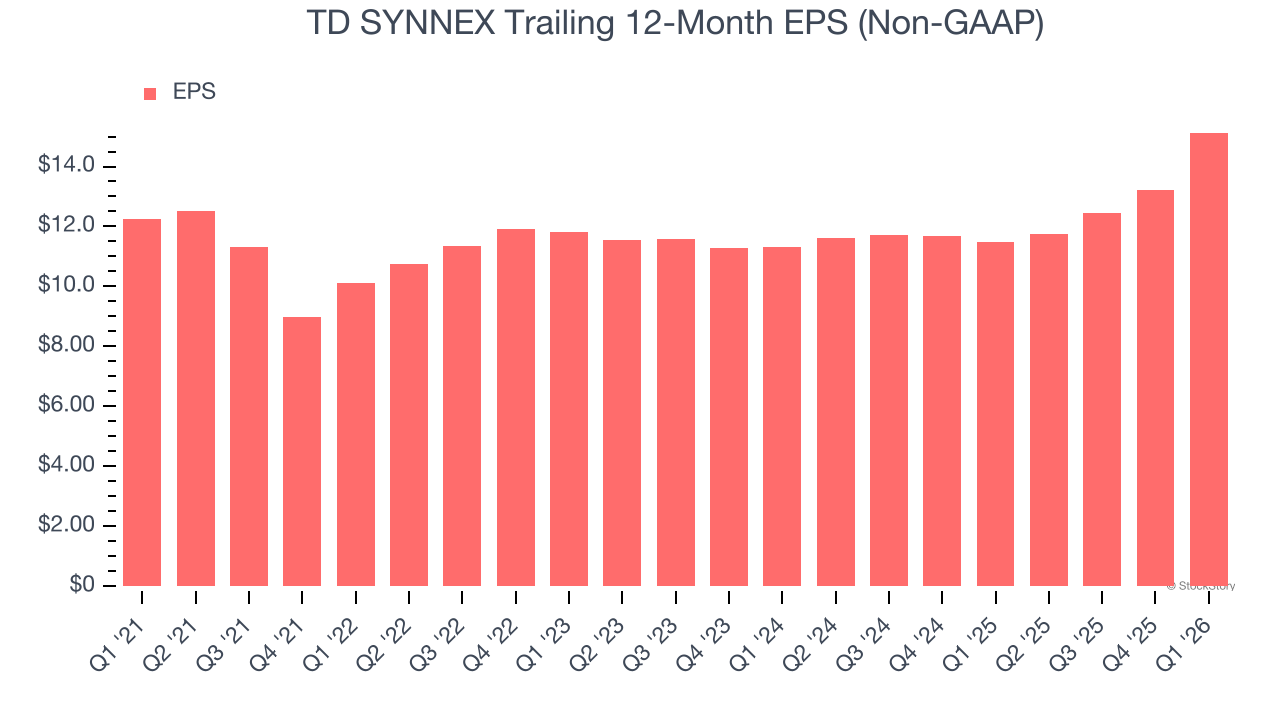
TD SYNNEX’s EPS grew at an unimpressive 4.3% compounded annual growth rate over the last five years, lower than its 25.6% annualized revenue growth. However, its operating margin didn’t change during this time, telling us that non-fundamental factors such as interest and taxes affected its ultimate earnings.
Like with revenue, we analyze EPS over a more recent period because it can provide insight into an emerging theme or development for the business.
For TD SYNNEX, its two-year annual EPS growth of 15.6% was higher than its five-year trend. This acceleration made it one of the faster-growing business services companies in recent history.
In Q1, TD SYNNEX reported adjusted EPS of $4.73, up from $2.80 in the same quarter last year. This print easily cleared analysts’ estimates, and shareholders should be content with the results. Over the next 12 months, Wall Street expects TD SYNNEX’s full-year EPS of $15.13 to stay about the same.
Key Takeaways from TD SYNNEX’s Q1 Results
It was good to see TD SYNNEX beat analysts’ EPS expectations this quarter. We were also excited its EPS guidance for next quarter outperformed Wall Street’s estimates by a wide margin. Zooming out, we think this quarter featured some important positives. The stock remained flat at $159.50 immediately after reporting.
So should you invest in TD SYNNEX right now? We think that the latest quarter is only one piece of the longer-term business quality puzzle. Quality, when combined with valuation, can help determine if the stock is a buy. We cover that in our actionable full research report which you can read here (it’s free).