
Building envelope solutions provider Carlisle Companies (NYSE: CSL) beat Wall Street’s revenue expectations in Q4 CY2025, but sales were flat year on year at $1.13 billion. Its non-GAAP profit of $3.90 per share was 8.9% above analysts’ consensus estimates.
Is now the time to buy Carlisle? Find out by accessing our full research report, it’s free.
Carlisle (CSL) Q4 CY2025 Highlights:
- Revenue: $1.13 billion vs analyst estimates of $1.11 billion (flat year on year, 1.4% beat)
- Adjusted EPS: $3.90 vs analyst estimates of $3.58 (8.9% beat)
- Adjusted EBITDA: $249 million vs analyst estimates of $234.2 million (22.1% margin, 6.3% beat)
- Operating Margin: 16.8%, down from 19.9% in the same quarter last year
- Free Cash Flow Margin: 31.2%, similar to the same quarter last year
- Organic Revenue fell 2.5% year on year (beat)
- Market Capitalization: $14.32 billion
Company Overview
Originally founded as Carlisle Tire and Rubber Company, Carlisle Companies (NYSE: CSL) is a multi-industry product manufacturer focusing on construction materials and weatherproofing technologies.
Revenue Growth
A company’s long-term sales performance can indicate its overall quality. Any business can experience short-term success, but top-performing ones enjoy sustained growth for years. Regrettably, Carlisle’s sales grew at a sluggish 3.4% compounded annual growth rate over the last five years. This wasn’t a great result compared to the rest of the industrials sector, but there are still things to like about Carlisle.
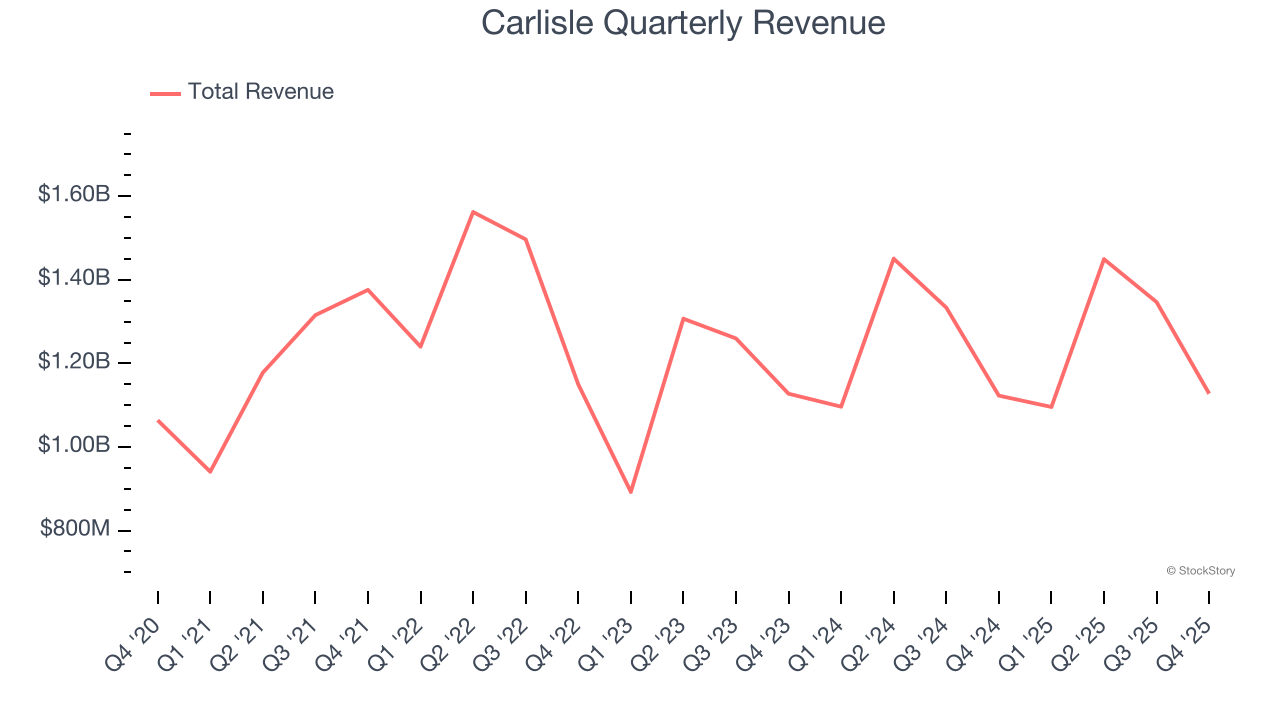
We at StockStory place the most emphasis on long-term growth, but within industrials, a half-decade historical view may miss cycles, industry trends, or a company capitalizing on catalysts such as a new contract win or a successful product line. Carlisle’s annualized revenue growth of 4.6% over the last two years is above its five-year trend, but we were still disappointed by the results. 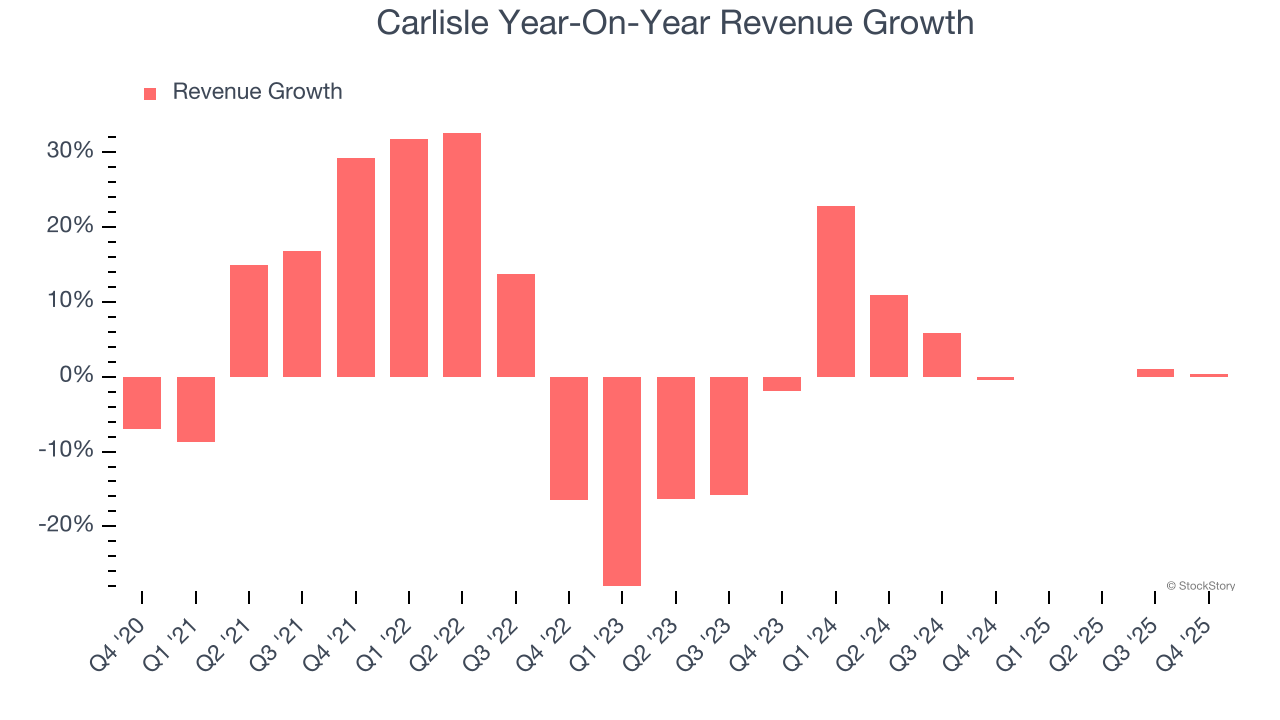
We can dig further into the company’s sales dynamics by analyzing its organic revenue, which strips out one-time events like acquisitions and currency fluctuations that don’t accurately reflect its fundamentals. Over the last two years, Carlisle’s organic revenue averaged 2.4% year-on-year growth. Because this number is lower than its two-year revenue growth, we can see that some mixture of acquisitions and foreign exchange rates boosted its headline results. 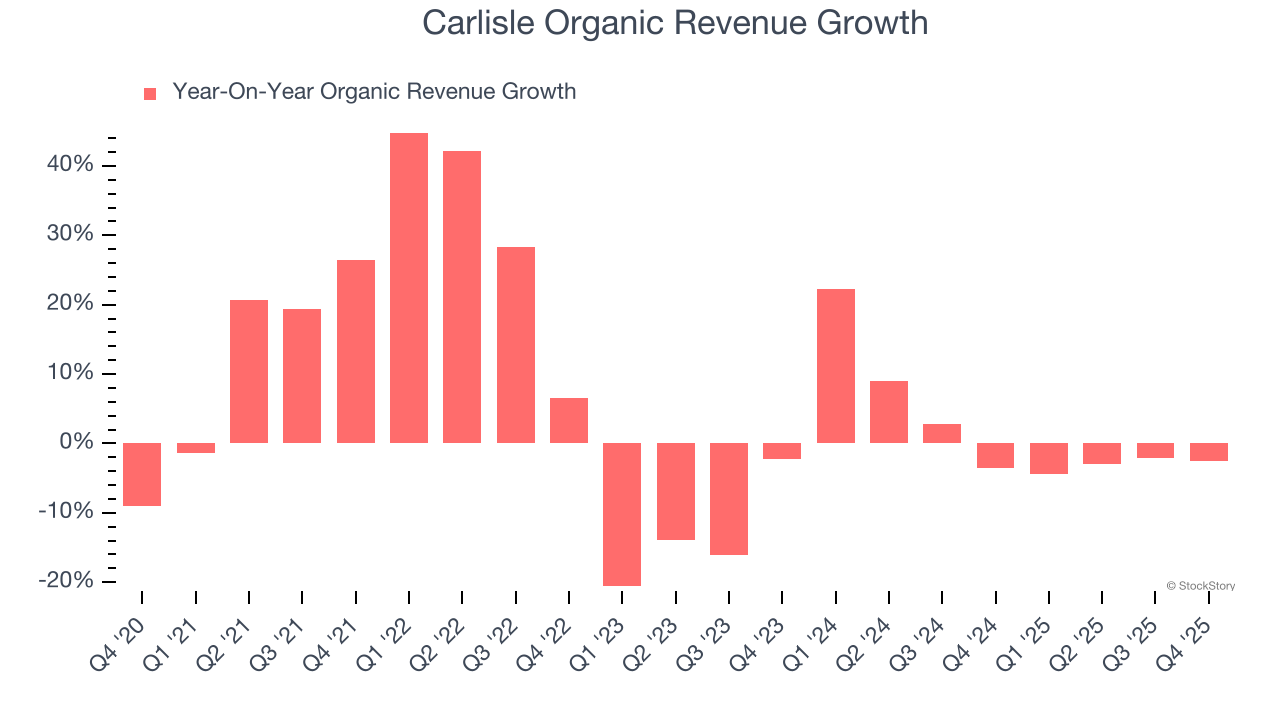
This quarter, Carlisle’s $1.13 billion of revenue was flat year on year but beat Wall Street’s estimates by 1.4%.
Looking ahead, sell-side analysts expect revenue to grow 2% over the next 12 months, a slight deceleration versus the last two years. This projection doesn't excite us and implies its products and services will see some demand headwinds. At least the company is tracking well in other measures of financial health.
Software is eating the world and there is virtually no industry left that has been untouched by it. That drives increasing demand for tools helping software developers do their jobs, whether it be monitoring critical cloud infrastructure, integrating audio and video functionality, or ensuring smooth content streaming. Click here to access a free report on our 3 favorite stocks to play this generational megatrend.
Operating Margin
Carlisle has been a well-oiled machine over the last five years. It demonstrated elite profitability for an industrials business, boasting an average operating margin of 19.7%. This result isn’t too surprising as its gross margin gives it a favorable starting point.
Analyzing the trend in its profitability, Carlisle’s operating margin rose by 8.2 percentage points over the last five years, as its sales growth gave it operating leverage.
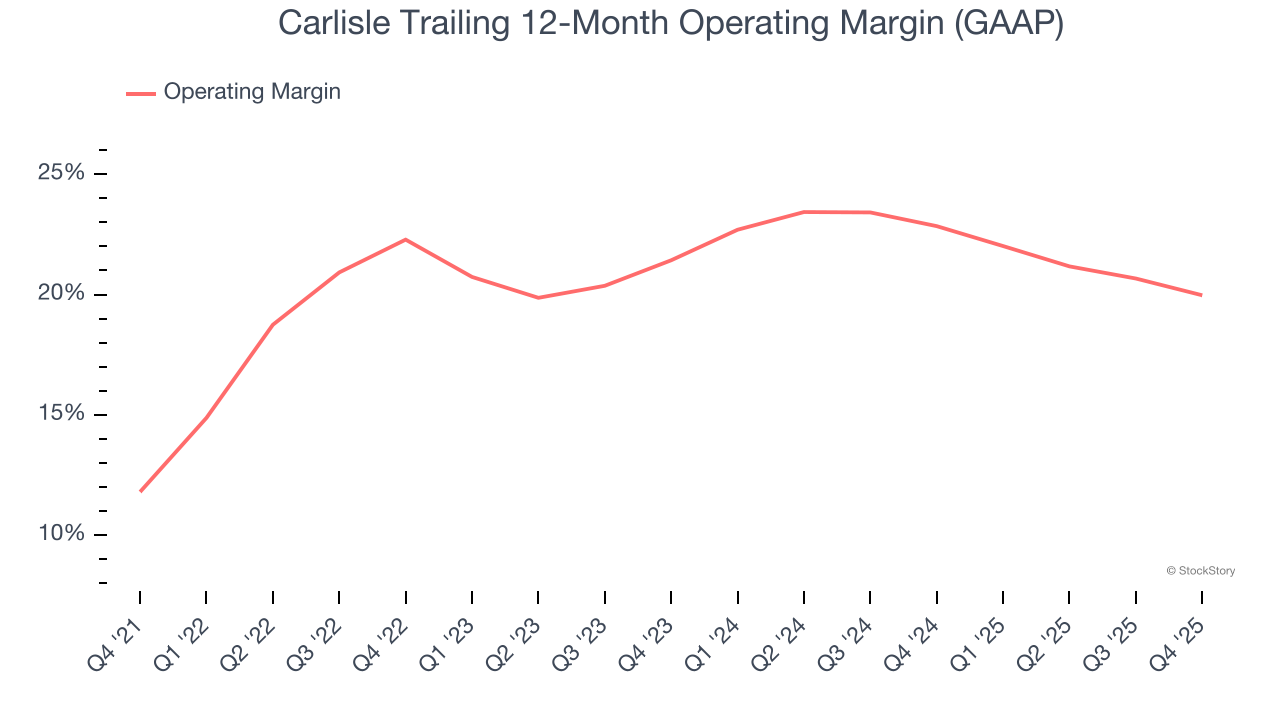
In Q4, Carlisle generated an operating margin profit margin of 16.8%, down 3.1 percentage points year on year. Since Carlisle’s operating margin decreased more than its gross margin, we can assume it was less efficient because expenses such as marketing, R&D, and administrative overhead increased.
Earnings Per Share
Revenue trends explain a company’s historical growth, but the long-term change in earnings per share (EPS) points to the profitability of that growth – for example, a company could inflate its sales through excessive spending on advertising and promotions.
Carlisle’s EPS grew at an astounding 25.1% compounded annual growth rate over the last five years, higher than its 3.4% annualized revenue growth. This tells us the company became more profitable on a per-share basis as it expanded.
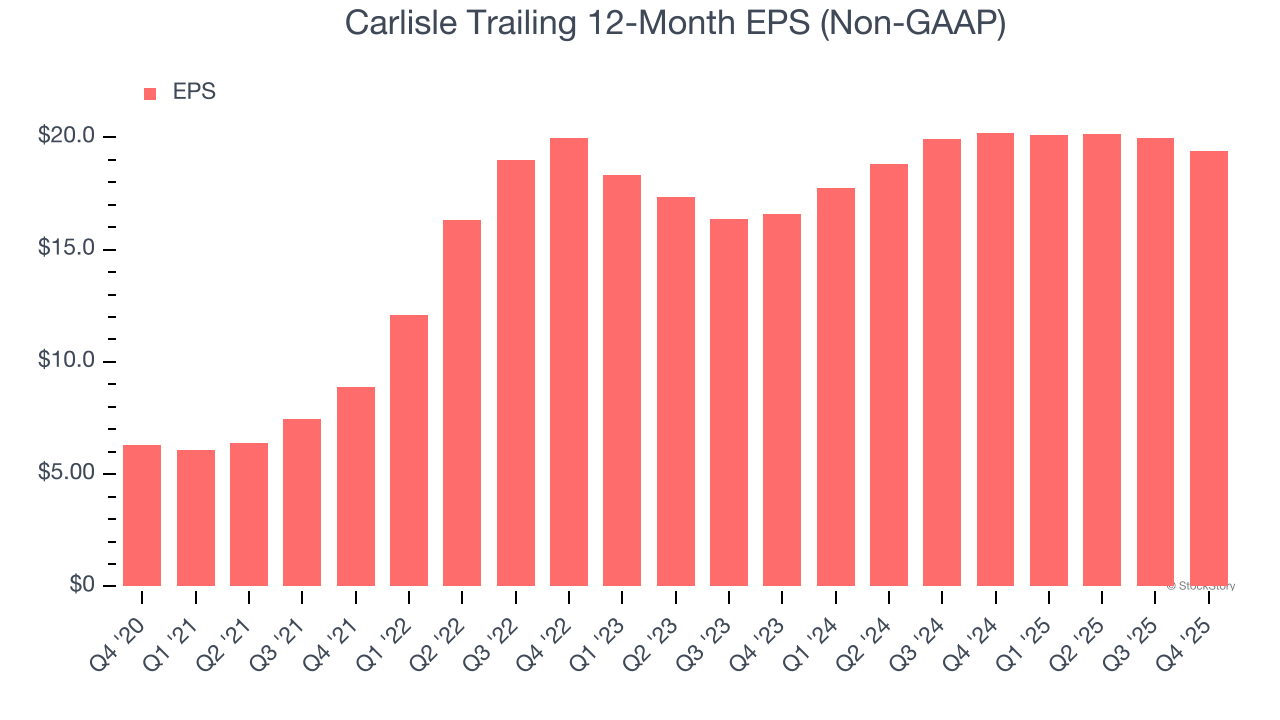
Diving into the nuances of Carlisle’s earnings can give us a better understanding of its performance. As we mentioned earlier, Carlisle’s operating margin declined this quarter but expanded by 8.2 percentage points over the last five years. Its share count also shrank by 22.3%, and these factors together are positive signs for shareholders because improving profitability and share buybacks turbocharge EPS growth relative to revenue growth. 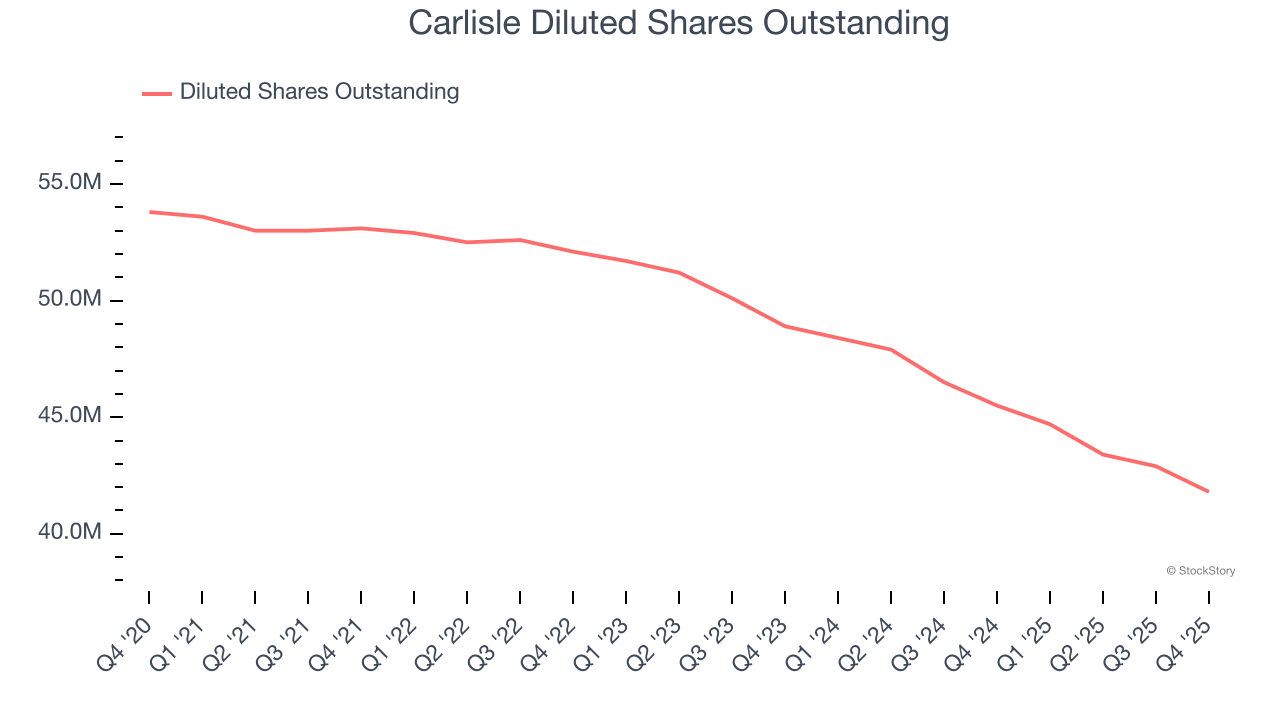
Like with revenue, we analyze EPS over a more recent period because it can provide insight into an emerging theme or development for the business.
For Carlisle, its two-year annual EPS growth of 8.1% was lower than its five-year trend. This wasn’t great, but at least the company was successful in other measures of financial health.
In Q4, Carlisle reported adjusted EPS of $3.90, down from $4.47 in the same quarter last year. Despite falling year on year, this print beat analysts’ estimates by 8.9%. Over the next 12 months, Wall Street expects Carlisle’s full-year EPS of $19.39 to grow 5.7%.
Key Takeaways from Carlisle’s Q4 Results
We enjoyed seeing Carlisle beat analysts’ EBITDA expectations this quarter. We were also happy its revenue narrowly outperformed Wall Street’s estimates. Overall, we think this was a decent quarter with some key metrics above expectations. The stock traded up 5.9% to $377 immediately after reporting.
Carlisle may have had a good quarter, but does that mean you should invest right now? If you’re making that decision, you should consider the bigger picture of valuation, business qualities, as well as the latest earnings. We cover that in our actionable full research report which you can read here (it’s free).