Fast-food pizza chain Papa John’s (NASDAQ: PZZA) fell short of the market’s revenue expectations in Q4 CY2025, with sales falling 6.1% year on year to $498.2 million. Its non-GAAP profit of $0.34 per share was 3.8% above analysts’ consensus estimates.
Is now the time to buy Papa John's? Find out by accessing our full research report, it’s free.
Papa John's (PZZA) Q4 CY2025 Highlights:
- Revenue: $498.2 million vs analyst estimates of $517.9 million (6.1% year-on-year decline, 3.8% miss)
- Adjusted EPS: $0.34 vs analyst estimates of $0.33 (3.8% beat)
- Adjusted EBITDA: $51.11 million vs analyst estimates of $48.19 million (10.3% margin, 6.1% beat)
- EBITDA guidance for the upcoming financial year 2026 is $205 million at the midpoint, below analyst estimates of $215.3 million
- Operating Margin: 4.9%, in line with the same quarter last year
- Free Cash Flow Margin: 0.4%, down from 4.7% in the same quarter last year
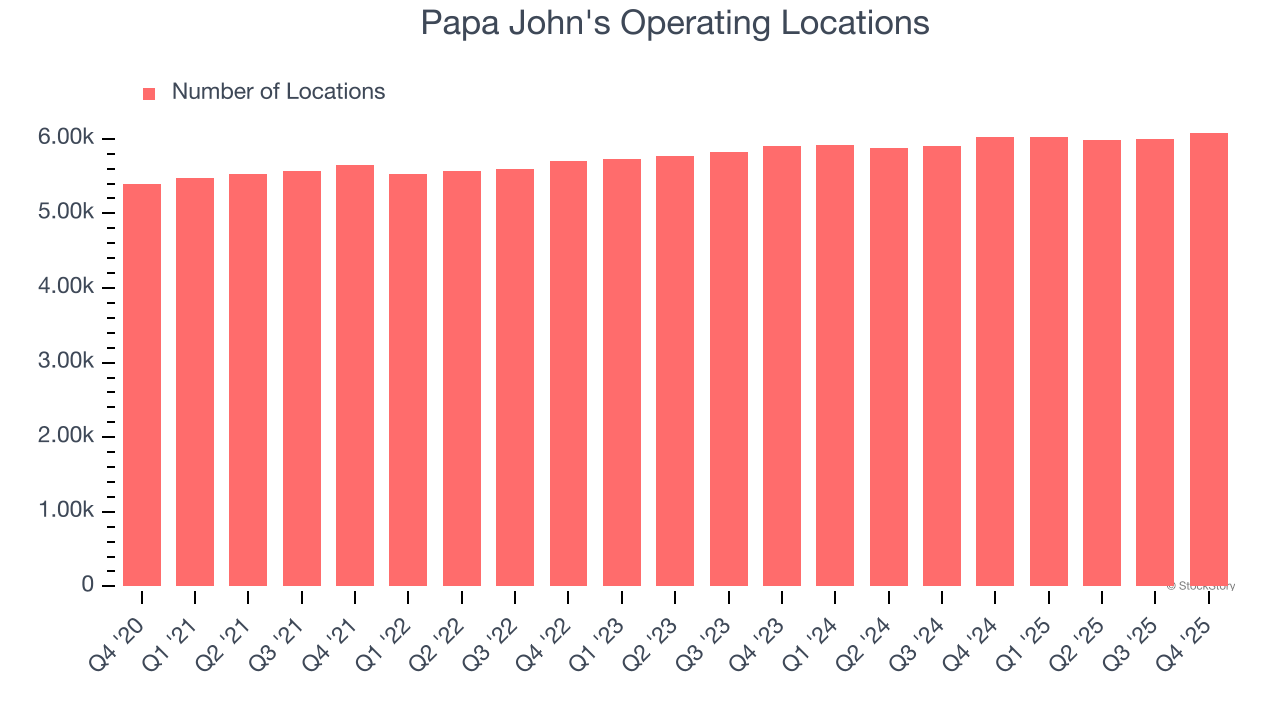
- Locations: 6,083 at quarter end, up from 6,030 in the same quarter last year
- Same-Store Sales fell 2.5% year on year, in line with the same quarter last year
- Market Capitalization: $1.11 billion
Company Overview
Founded by the eclectic John “Papa John” Schnatter, Papa John’s (NASDAQ: PZZA) is a globally recognized pizza delivery and carryout chain known for “better ingredients” and “better pizza”.
Revenue Growth
Examining a company’s long-term performance can provide clues about its quality. Any business can experience short-term success, but top-performing ones enjoy sustained growth for years.
With $2.05 billion in revenue over the past 12 months, Papa John's is a mid-sized restaurant chain, which sometimes brings disadvantages compared to larger competitors benefiting from better brand awareness and economies of scale.
As you can see below, Papa John’s sales grew at a sluggish 4% compounded annual growth rate over the last six years.
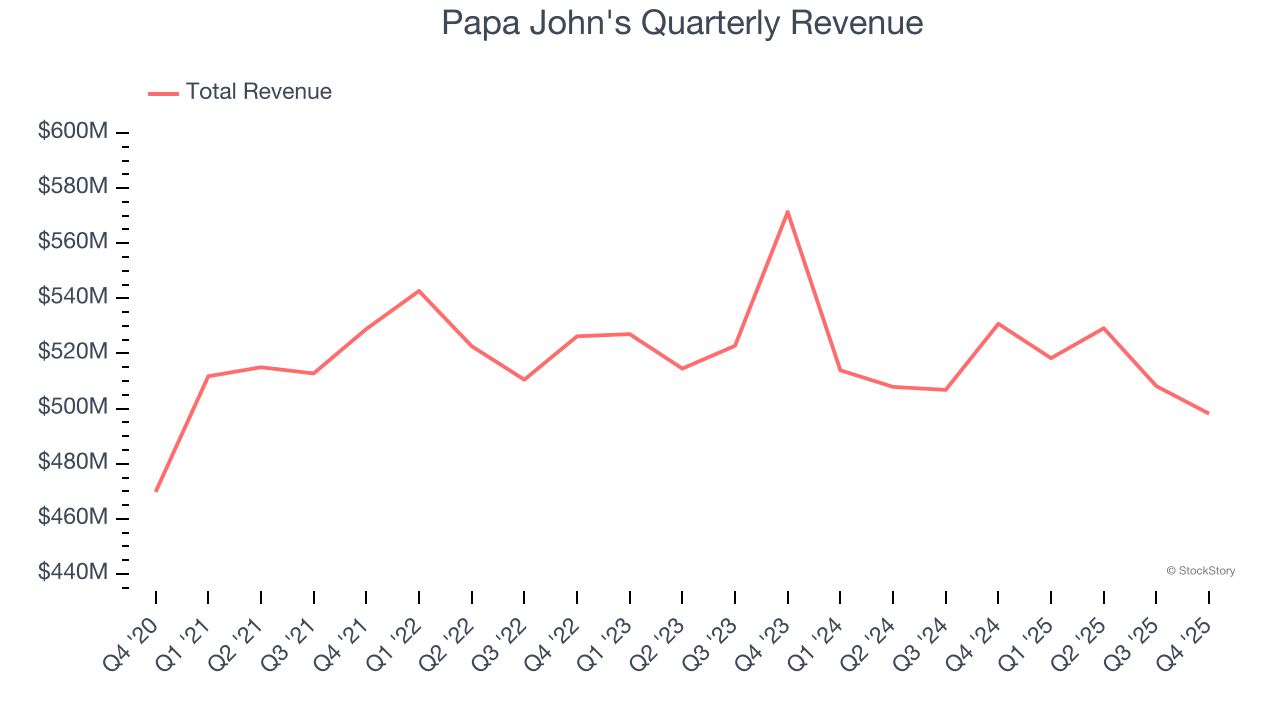
This quarter, Papa John's missed Wall Street’s estimates and reported a rather uninspiring 6.1% year-on-year revenue decline, generating $498.2 million of revenue.
Looking ahead, sell-side analysts expect revenue to decline by 1.1% over the next 12 months, a deceleration versus the last six years. This projection doesn't excite us and suggests its menu offerings will see some demand headwinds.
While Wall Street chases Nvidia at all-time highs, an under-the-radar semiconductor supplier is dominating a critical AI component these giants can’t build without. Click here to access our free report one of our favorites growth stories.
Restaurant Performance
Number of Restaurants
Papa John's operated 6,083 locations in the latest quarter. It has opened new restaurants quickly over the last two years, averaging 1.9% annual growth, faster than the broader restaurant sector. Furthermore, one dynamic making expansion more seamless is the company’s franchise model, where franchisees are primarily responsible for opening new restaurants while Papa John's provides support.
When a chain opens new restaurants, it usually means it’s investing for growth because there’s healthy demand for its meals and there are markets where its concepts have few or no locations.
Same-Store Sales
The change in a company's restaurant base only tells one side of the story. The other is the performance of its existing locations, which informs management teams whether they should expand or downsize their physical footprints. Same-store sales gives us insight into this topic because it measures organic growth at restaurants open for at least a year.
Papa John’s demand has been shrinking over the last two years as its same-store sales have averaged 1.9% annual declines. This performance is concerning - it shows Papa John's artificially boosts its revenue by building new restaurants. We’d like to see a company’s same-store sales rise before it takes on the costly, capital-intensive endeavor of expanding its restaurant base.
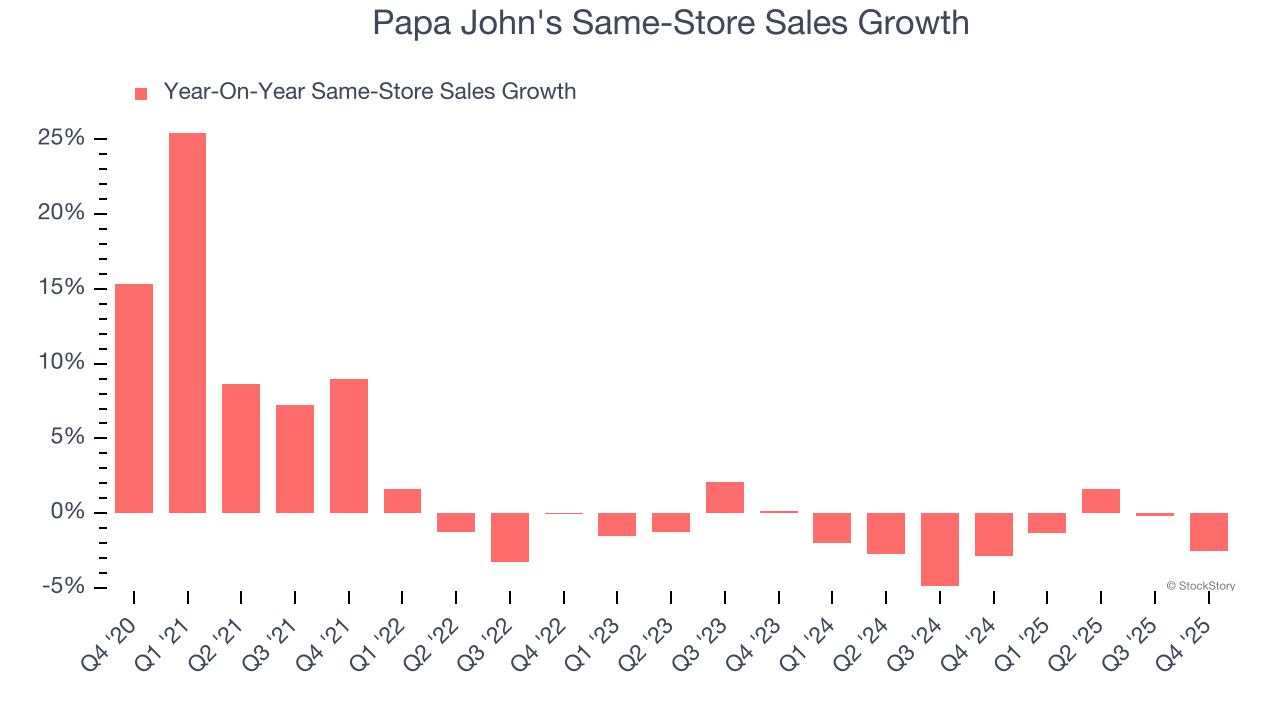
In the latest quarter, Papa John’s same-store sales fell by 2.5% year on year. This performance was more or less in line with its historical levels.
Key Takeaways from Papa John’s Q4 Results
We enjoyed seeing Papa John's beat analysts’ EBITDA expectations this quarter. On the other hand, its revenue missed and its full-year EBITDA guidance fell short of Wall Street’s estimates. Overall, this was a weaker quarter. The stock traded down 4.2% to $32.40 immediately after reporting.
Papa John’s latest earnings report disappointed. One quarter doesn’t define a company’s quality, so let’s explore whether the stock is a buy at the current price. If you’re making that decision, you should consider the bigger picture of valuation, business qualities, as well as the latest earnings. We cover that in our actionable full research report which you can read here (it’s free).