

Banking services provider Coastal Financial (NASDAQ: CCB) reported revenue ahead of Wall Streets expectations in Q4 CY2025, with sales up 23.3% year on year to $138 million. Its non-GAAP profit of $0.82 per share was 19.3% below analysts’ consensus estimates.
Is now the time to buy Coastal Financial? Find out by accessing our full research report, it’s free.
Coastal Financial (CCB) Q4 CY2025 Highlights:
- Net Interest Income: $79.37 million vs analyst estimates of $81.92 million (7.7% year-on-year growth, 3.1% miss)
- Net Interest Margin: 7% vs analyst estimates of 7.2% (12.4 basis point miss)
- Revenue: $138 million vs analyst estimates of $132.5 million (23.3% year-on-year growth, 4.2% beat)
- Efficiency Ratio: 52.8% vs analyst estimates of 55.1% (230 basis point beat)
- Adjusted EPS: $0.82 vs analyst expectations of $1.02 (19.3% miss)
- Tangible Book Value per Share: $32.13 vs analyst estimates of $32.47 (9.4% year-on-year growth, 1% miss)
- Market Capitalization: $1.53 billion
"During the fourth quarter of 2025, loans receivable increased by $45.7 million, representing a 1.2% rise, alongside another period of solid deposit growth totaling $171.6 million, or 4.3%. Our CCBX segment continued to progress during the quarter as we executed on a dual strategy of expanding product offerings with existing partners while selectively onboarding new relationships aligned with our long-term objectives. Looking ahead, we expect continued growth as existing programs scale, new products are introduced, and we leverage our growing operating history in the BaaS space to support disciplined, sustainable expansion,” stated CEO Eric Sprink.
Company Overview
Pioneering the intersection of traditional banking and financial technology in the Pacific Northwest, Coastal Financial (NASDAQ: CCB) operates as a bank holding company that provides traditional banking services and Banking-as-a-Service (BaaS) solutions to consumers and businesses.
Sales Growth
Net interest income and and fee-based revenue are the two pillars supporting bank earnings. The former captures profit from the gap between lending rates and deposit costs, while the latter encompasses charges for banking services, credit products, wealth management, and trading activities. Over the last five years, Coastal Financial grew its revenue at an incredible 47.4% compounded annual growth rate. Its growth surpassed the average banking company and shows its offerings resonate with customers, a great starting point for our analysis.
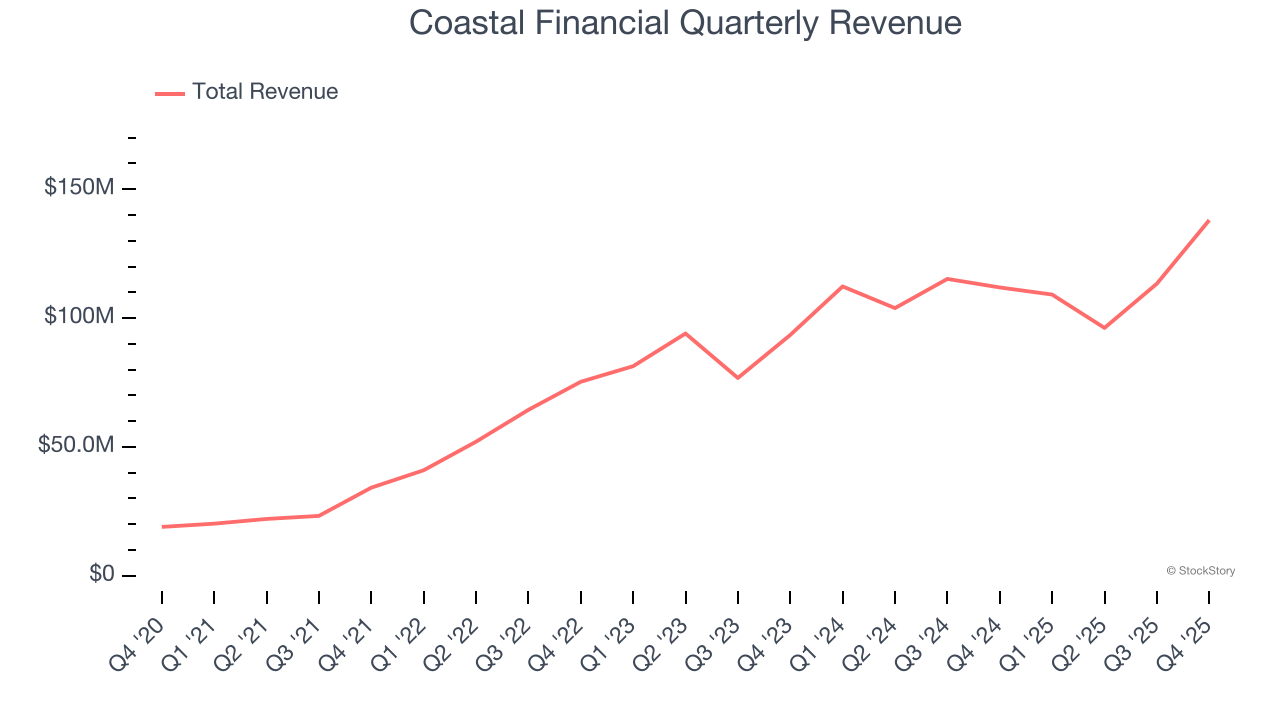
Long-term growth is the most important, but within financials, a half-decade historical view may miss recent interest rate changes and market returns. Coastal Financial’s annualized revenue growth of 15% over the last two years is below its five-year trend, but we still think the results suggest healthy demand. 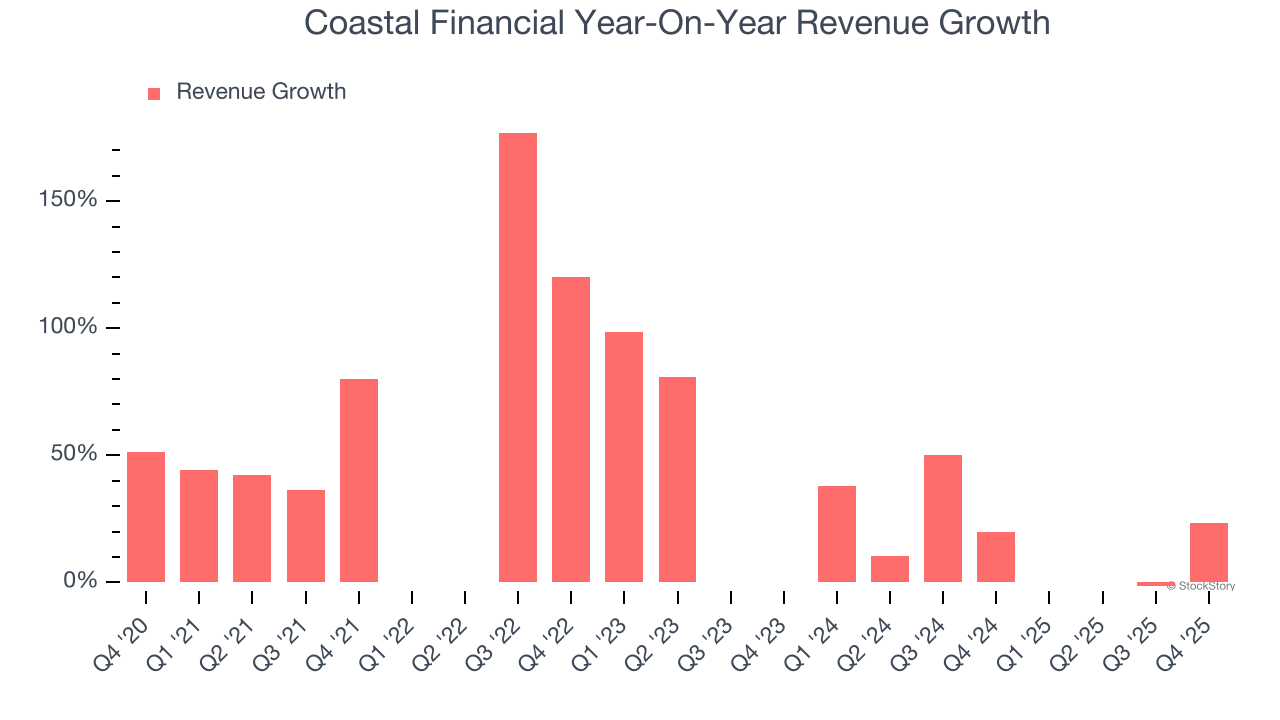 Note: Quarters not shown were determined to be outliers, impacted by outsized investment gains/losses that are not indicative of the recurring fundamentals of the business.
This quarter, Coastal Financial reported robust year-on-year revenue growth of 23.3%, and its $138 million of revenue topped Wall Street estimates by 4.2%.
Net interest income made up 70.6% of the company’s total revenue during the last five years, meaning lending operations are Coastal Financial’s largest source of revenue.
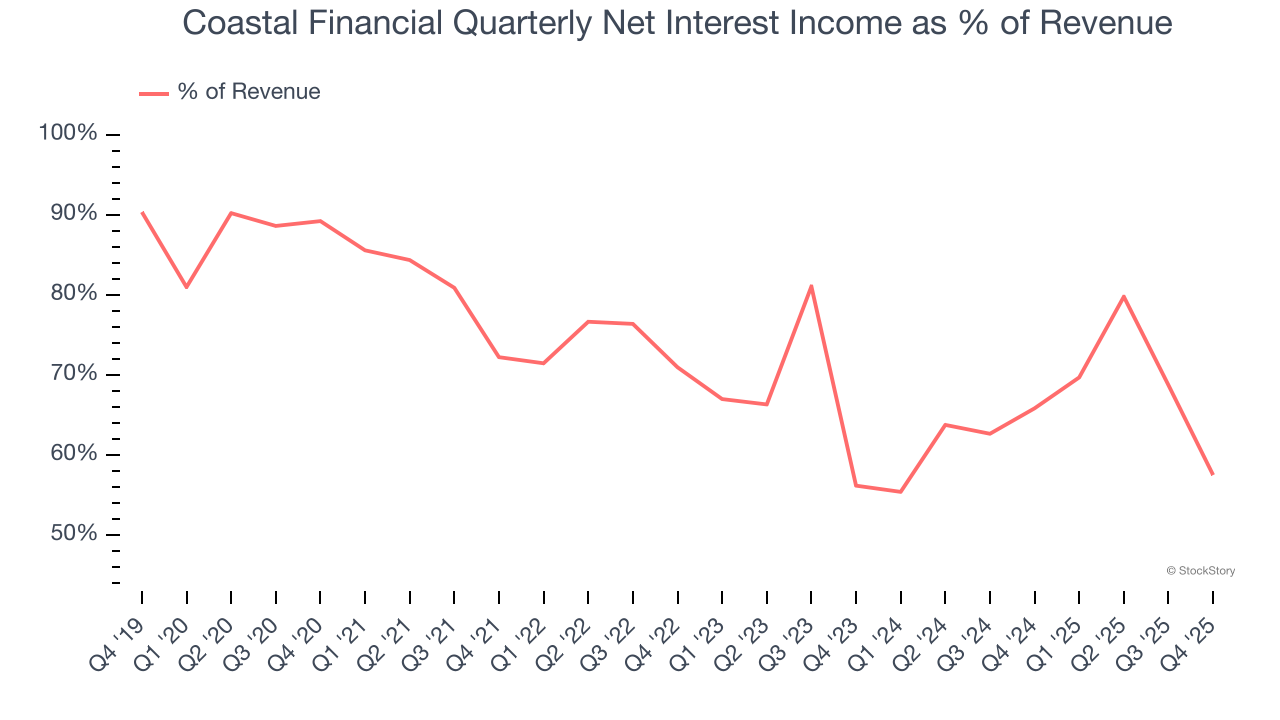
While banks generate revenue from multiple sources, investors view net interest income as the cornerstone - its predictable, recurring characteristics stand in sharp contrast to the volatility of non-interest income.
Software is eating the world and there is virtually no industry left that has been untouched by it. That drives increasing demand for tools helping software developers do their jobs, whether it be monitoring critical cloud infrastructure, integrating audio and video functionality, or ensuring smooth content streaming. Click here to access a free report on our 3 favorite stocks to play this generational megatrend.
Tangible Book Value Per Share (TBVPS)
The balance sheet drives banking profitability since earnings flow from the spread between borrowing and lending rates. As such, valuations for these companies concentrate on capital strength and sustainable equity accumulation potential.
This explains why tangible book value per share (TBVPS) stands as the premier banking metric. TBVPS strips away questionable intangible assets, revealing concrete per-share net worth that investors can trust. Other (and more commonly known) per-share metrics like EPS can sometimes be murky due to M&A or accounting rules allowing for loan losses to be spread out.
Coastal Financial’s TBVPS grew at an incredible 22.3% annual clip over the last five years. TBVPS growth has recently decelerated a bit to 20.4% annual growth over the last two years (from $22.17 to $32.13 per share).
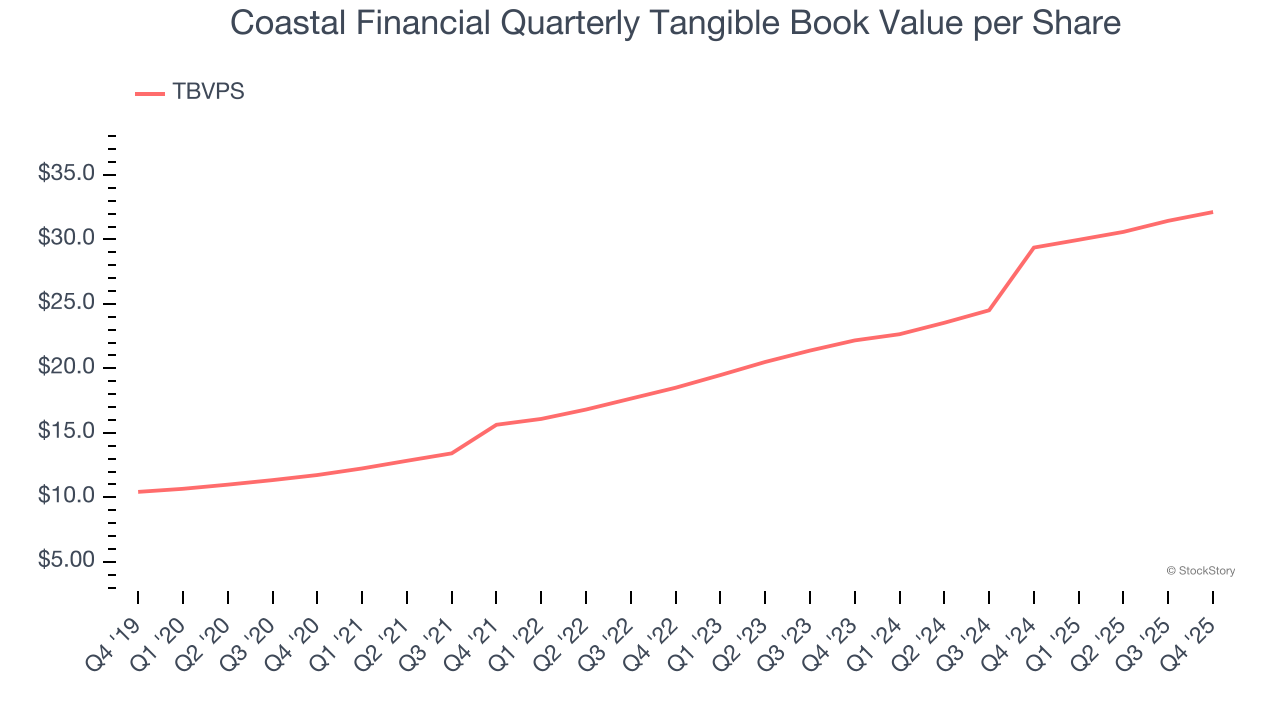
Over the next 12 months, Consensus estimates call for Coastal Financial’s TBVPS to grow by 19.9% to $38.53, top-notch growth rate.
Key Takeaways from Coastal Financial’s Q4 Results
We enjoyed seeing Coastal Financial beat analysts’ revenue expectations this quarter. On the other hand, its net interest income missed and its EPS fell short of Wall Street’s estimates. Overall, this was a softer quarter. The stock remained flat at $100.96 immediately following the results.
Should you buy the stock or not? The latest quarter does matter, but not nearly as much as longer-term fundamentals and valuation, when deciding if the stock is a buy. We cover that in our actionable full research report which you can read here (it’s free).