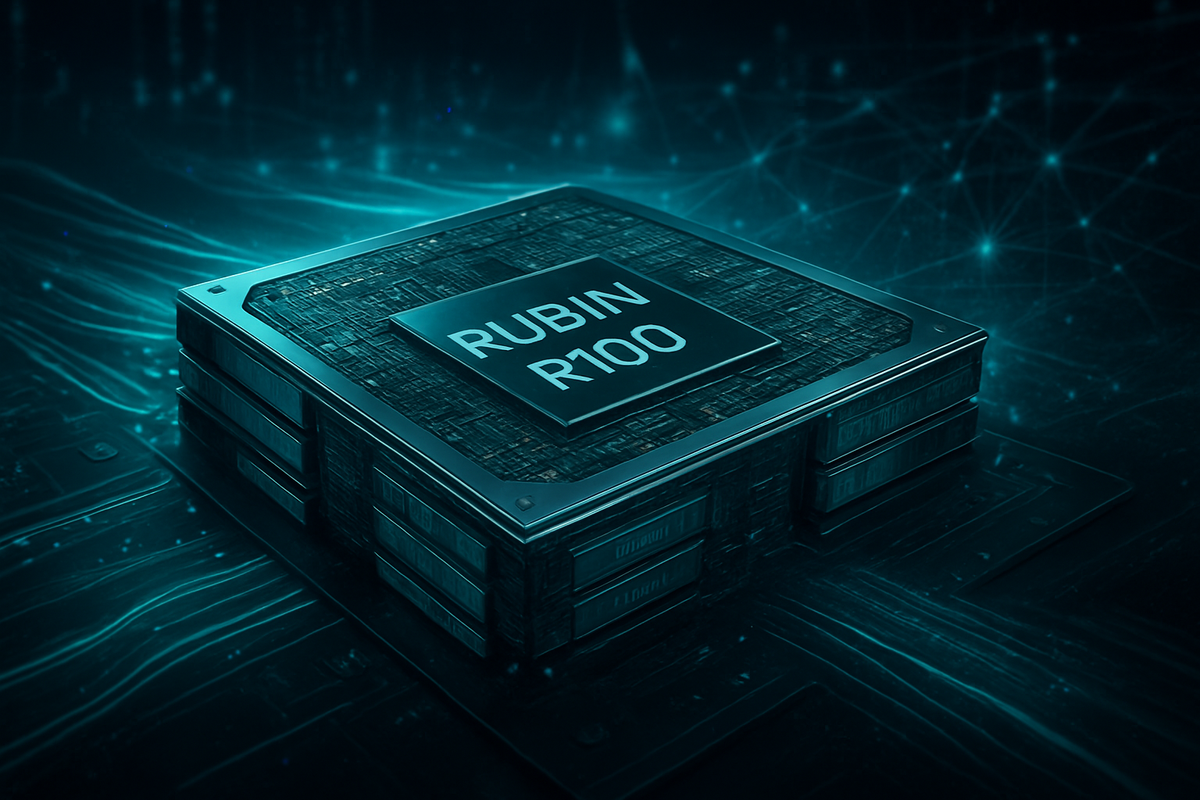
Nvidia (NASDAQ: NVDA) has once again redefined the pace of the semiconductor industry, confirming today that its next-generation "Rubin" R100 GPUs have entered mass production ahead of the previously anticipated late-2026 schedule. This acceleration signals a critical victory for the Santa Clara-based giant, as it seeks to maintain its iron grip on the artificial intelligence training market by delivering unprecedented compute density and memory bandwidth to a hungry ecosystem of hyperscalers.
The move into mass production as of April 2026 underscores Nvidia's successful transition to a one-year product release cadence, a strategy first laid out by CEO Jensen Huang at Computex 2024. By hitting this milestone early, Nvidia is effectively shutting the window of opportunity for competitors who were hoping to catch up during the transition from the Blackwell architecture. The R100 is not merely an incremental update; it represents a paradigm shift in how data centers handle trillion-parameter models, integrating the first-ever HBM4 memory stacks on a commercial scale.
The Rubin Revolution: Cutting-Edge Specs and the Road to April 2026
The journey to today’s announcement began nearly two years ago when Nvidia unveiled its roadmap to move beyond the Blackwell architecture. Named after the pioneering astronomer Vera Rubin, the Rubin platform was designed from the ground up to address the "memory wall"—the bottleneck where data movement speed fails to keep pace with processing power. The R100 GPU achieves this by utilizing High Bandwidth Memory 4 (HBM4), which features a massive 2048-bit memory interface, doubling the bandwidth capabilities of the previous Blackwell generation.
This technical feat is made possible through a deep partnership with Taiwan Semiconductor Manufacturing Co. (NYSE: TSM). The Rubin R100 is built on TSMC’s advanced 3-nanometer (N3P) process, allowing for a significant leap in transistor density and energy efficiency. To marry the 3nm logic dies with the advanced HBM4 stacks, Nvidia is employing CoWoS-L (Chip-on-Wafer-on-Substrate with Local Interconnect) packaging. This high-precision manufacturing process was once considered a potential bottleneck, but the current ahead-of-schedule production indicates that Nvidia and TSMC have successfully scaled their supply chains to meet the immense complexity of the Rubin design.
Industry reactions have been swift and overwhelmingly positive. Major cloud service providers, including Microsoft (NASDAQ: MSFT), Alphabet (NASDAQ: GOOGL), and Amazon (NASDAQ: AMZN), are reportedly already queuing for initial shipments. These companies are desperate for the R100’s efficiency gains as they grapple with the skyrocketing electricity costs of running massive AI clusters. Early benchmarks suggest the Rubin architecture can train models up to 3x faster than Blackwell Ultra while consuming 40% less power per petaflop of compute.
Market Winners and Losers in the Rubin Era
The primary winner of this announcement is undoubtedly Nvidia itself, which has effectively demonstrated that it can execute on a "warp speed" engineering schedule without the delays that typically plague high-end silicon. By moving into mass production now, Nvidia captures the first-mover advantage for the 2026 fiscal year, likely leading to another series of "beat and raise" earnings quarters. Alongside Nvidia, TSMC (NYSE: TSM) stands to gain significantly as the exclusive foundry for the R100, further solidifying its role as the indispensable backbone of the AI economy.
The memory manufacturers are also seeing a massive windfall. SK Hynix (KRX:000660), having been a primary partner in HBM4 development, is set to be the lead supplier for the Rubin launch. As the R100 requires 8 to 12 stacks of these high-margin chips, the revenue per GPU for memory suppliers is expected to hit record highs. Similarly, infrastructure providers like Vertiv (NYSE: VRT), which specializes in liquid cooling solutions for high-density data centers, are seeing increased demand as the Rubin platform pushes thermal design power (TDP) limits to the edge of what traditional air cooling can handle.
On the other side of the ledger, traditional rivals like Intel (NASDAQ: INTC) and Advanced Micro Devices (NASDAQ: AMD) face a daunting challenge. AMD’s Instinct MI400, designed to compete with Rubin, was expected to launch in a similar timeframe, but Nvidia’s "ahead of schedule" status puts the pressure on AMD to accelerate its own roadmap or risk losing more market share in the high-end training tier. Intel, currently pivoting its strategy toward the Falcon Shores "XPU" architecture, may find it increasingly difficult to break Nvidia’s software moat (CUDA) now that the hardware gap has widened yet again.
Breaking the Memory Wall: Wider Industry Significance
The start of Rubin R100 mass production is a milestone that fits into the broader trend of "Sovereign AI" and the global race for computational supremacy. As nations and corporations move toward training larger, more specialized Large Language Models (LLMs), the R100’s use of HBM4 is a definitive solution to the data-starvation issues that hampered earlier AI chips. This transition suggests that the industry is moving away from simply adding more "compute" (FLOPS) and is now focusing on "throughput"—the ability to move massive amounts of data in and out of the processor instantly.
Furthermore, Nvidia’s ability to shift to an annual release cadence creates a "moving target" problem for regulators and competitors alike. While the U.S. government and international bodies have discussed policies to curb the rapid growth of AI capabilities for safety reasons, the sheer speed of hardware iteration makes policy-making a reactive rather than proactive endeavor. Historically, few industries have seen this level of concentrated innovation; the current era is often compared to the 1960s Space Race, but with private capital rather than taxpayer funding driving the propulsion.
The ripple effects will also be felt in the custom silicon market. While companies like Google and Amazon have developed their own AI ASICs (TPUs and Trainium), the R100 sets a very high bar for what "off-the-shelf" silicon can achieve. For many enterprises, the cost of developing a custom chip that can compete with the Rubin architecture may no longer be justifiable, potentially leading to a consolidation of the AI hardware market around Nvidia’s ecosystem for at least the next several years.
What Lies Ahead: From Rubin to Rubin Ultra
In the short term, the market will be watching for the first "first-light" benchmarks from the early-access Rubin clusters. Investors should look for signs of supply chain constraints—specifically in CoWoS packaging—that could limit the actual number of units reaching customers, regardless of mass production status. If Nvidia can avoid the supply-side bottlenecks that characterized the H100 and Blackwell launches, the company’s revenue growth could enter a new parabolic phase.
Looking further ahead, the roadmap already points to the "Rubin Ultra" R200 in 2027, which is expected to feature 16-hi HBM4 stacks and even more advanced interconnects. The strategic pivot for the industry may soon shift from "how do we get more chips?" to "how do we find enough power to run them?" This shift will likely spark a massive wave of investment in energy infrastructure and nuclear modular reactors (SMRs) dedicated to powering the next generation of Nvidia-powered data centers. The Rubin R100 is not just a chip; it is the catalyst for a total reconfiguration of the global energy and compute landscape.
Conclusion: The New Standard for AI Dominance
The confirmation of Rubin R100 mass production in April 2026 marks a historic moment in the evolution of artificial intelligence. Nvidia has successfully navigated the transition to its most complex architecture yet, doing so ahead of schedule and with a technological lead that appears increasingly insurmountable. By integrating HBM4 and 3nm processing, Nvidia is addressing the fundamental bottlenecks of AI training, ensuring its GPUs remain the "gold standard" for the foreseeable future.
For investors and market observers, the next few months will be critical. Key indicators to watch include the ramp-up of HBM4 yields at SK Hynix and Samsung, and the commentary from hyperscale CEOs during the upcoming earnings season regarding their capital expenditure (CapEx) allocations for the Rubin platform. As the AI gold rush enters this new, high-velocity phase, Nvidia’s Rubin R100 stands as the most potent tool yet created, cementing the company's position at the vanguard of the fourth industrial revolution.
This content is intended for informational purposes only and is not financial advice.