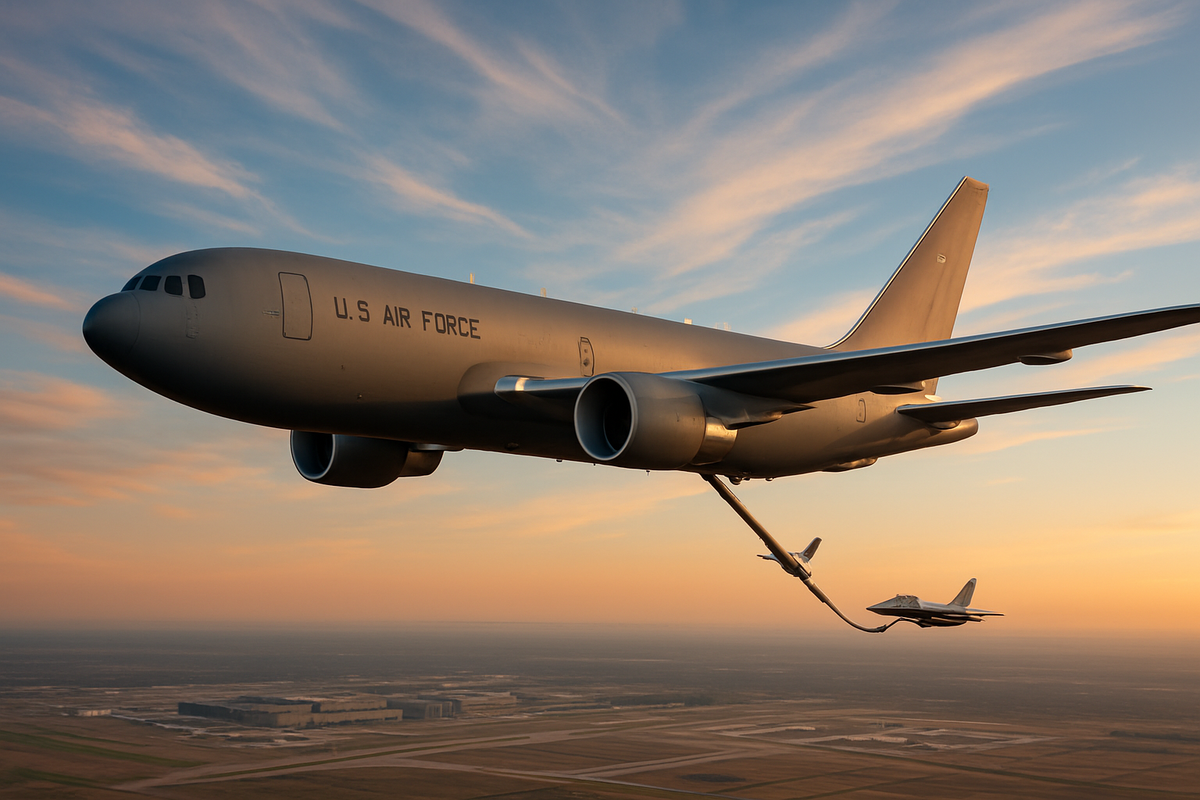
In a move that underscores the U.S. military’s continued reliance on its primary aerial refueling platform, the U.S. Air Force has awarded Boeing (NYSE: BA) a $101.3 million contract for the procurement of KC-46 Pegasus parts and support services. Announced on April 6, 2026, the undefinitized delivery order focuses on "commercial common depot-level repairables," ensuring that the existing fleet remains flight-ready as the Pentagon manages a complex transition toward next-generation refueling capabilities.
While the contract is a fraction of Boeing’s multi-billion dollar defense backlog, its timing is vital. It arrives as Boeing’s Defense, Space & Security (BDS) segment attempts to turn the corner on years of financial instability and technical setbacks. For investors, the award represents a steady stream of sustainment revenue that helps offset the heavy development costs and "fixed-price" contract penalties that have historically weighed down the company's defense margins.
Sustainment in the Shadow of Technical Scrutiny
The $101,288,162 contract, designated under the delivery order SPRPA1-26-F-0LB1, is a one-year, sole-source acquisition funded by the Air Force's 2026 and 2027 working capital funds. The agreement tasks Boeing with providing essential spare parts, maintenance components, and logistical support through April 6, 2027. This sustainment push is particularly urgent; just two months ago, in February 2026, the Air Force briefly suspended acceptance of new deliveries after structural cracks were discovered in the aileron hinges of two aircraft. While the issue was not deemed a fleet-wide safety grounding, it added to a timeline already crowded with corrective measures.
The KC-46 program has been a "double-edged sword" for the aerospace giant. Since the program's inception, Boeing has absorbed over $7 billion in cumulative losses due to the fixed-price nature of the original development contract. The program’s history is marred by high-profile "Category 1" deficiencies, including the ongoing redesign of the Remote Vision System (RVS 2.0) and the boom telescope actuator—the latter of which is required to refuel lighter aircraft like the A-10 Thunderbolt II. Despite these hurdles, the Air Force signaled its long-term commitment on April 1, 2026, by announcing plans to order an additional 75 aircraft to bridge the gap until the Next-Generation Air Refueling System (NGAS) enters service in the mid-2030s.
Winners, Losers, and the Defense Supply Chain
The primary beneficiary of this contract is undoubtedly Boeing (NYSE: BA), as it transitions the KC-46 from a money-losing development project into a long-term sustainment program. In the world of defense contracting, "sustainment" and "logistics" are often where the real profits are realized, free from the R&D risks that have plagued the Pegasus for a decade. This award also provides stability for major sub-tier suppliers, such as RTX Corporation (NYSE: RTX), whose Pratt & Whitney division supplies the PW4062 engines, and Honeywell (NASDAQ: HON), which provides critical avionics and mechanical components.
However, the continued investment in the KC-46 presents a strategic "loss" for competitors who had hoped to disrupt the Air Force’s tanker strategy. For years, Lockheed Martin (NYSE: LMT) and Airbus (OTC: EADSY) positioned the LMXT tanker as a superior alternative for the "Bridge Tanker" requirement. The Air Force’s decision to stick with an additional 75 Boeing-built aircraft essentially shuts the door on a competitive procurement process for this decade, forcing rivals to focus their efforts entirely on the far-off NGAS competition.
A Strategic Pivot in a Volatile Geopolitical Landscape
This contract award fits into a broader industry trend where the U.S. Department of Defense is prioritizing "readiness" over "newness" in the immediate term. With geopolitical tensions in Eastern Europe and the Indo-Pacific requiring high operational availability for tanker fleets, the Air Force cannot afford to have its current KC-46 units grounded for lack of parts. The $101 million injection ensures that as Boeing works through its "Category 1" fixes, the existing fleet does not suffer from a lack of depot-level support.
Furthermore, this event highlights the "new" Boeing strategy under CEO Kelly Ortberg. In February 2026, the company announced it would relocate its BDS headquarters from Arlington, Virginia, back to St. Louis, Missouri. This move was intended to put leadership back on the "factory floor" to address the quality control issues that have hampered programs like the KC-46 and the T-7A Red Hawk. The Air Force's decision to grant this sustainment contract suggests a degree of cautious optimism that Boeing’s internal restructuring is beginning to yield more reliable operational results.
Looking Ahead: The 2027 RVS 2.0 Milestone
In the short term, the market will be looking for Boeing to resume a regular delivery cadence following the aileron hinge investigation. The $101 million in support funds should mitigate some of the operational stress on the fleet through the end of the year. However, the long-term viability of the program rests on the 2027 deadline for the RVS 2.0 fix. If Boeing can successfully integrate the updated vision system without further "cost growth" charges, the KC-46 could finally become the financial engine it was designed to be.
Strategic pivots are also expected as Boeing prepares for the NGAS competition. While the 75-aircraft extension provides a "bridge," the Air Force is increasingly looking toward stealthy, autonomous, and distributed refueling solutions. Boeing must use the stability provided by these sustainment contracts to fund the R&D necessary to remain competitive in a future where the traditional "converted airliner" tanker may no longer be the preferred solution for contested airspaces.
Market Outlook and Final Takeaways
The $101 million contract for KC-46 support is a significant, if expected, step in the maturation of Boeing’s defense business. It confirms that the U.S. Air Force is doubling down on the Pegasus platform despite its troubled history. For Boeing, the challenge remains managing the thin line between narrowing its operational losses—which stood at $128 million for the full year of 2025—and delivering on the high-quality standards demanded by its primary customer.
Investors should watch for Boeing’s Q2 2026 earnings report to see if the $565 million charge taken in January was the final major "bath" for the tanker program, or if structural issues like the aileron cracks will trigger further financial adjustments. While the defense segment is showing signs of stabilization, the KC-46 remains the ultimate barometer for Boeing’s ability to execute on complex, fixed-price military contracts in an era of heightened global demand.
This content is intended for informational purposes only and is not financial advice.