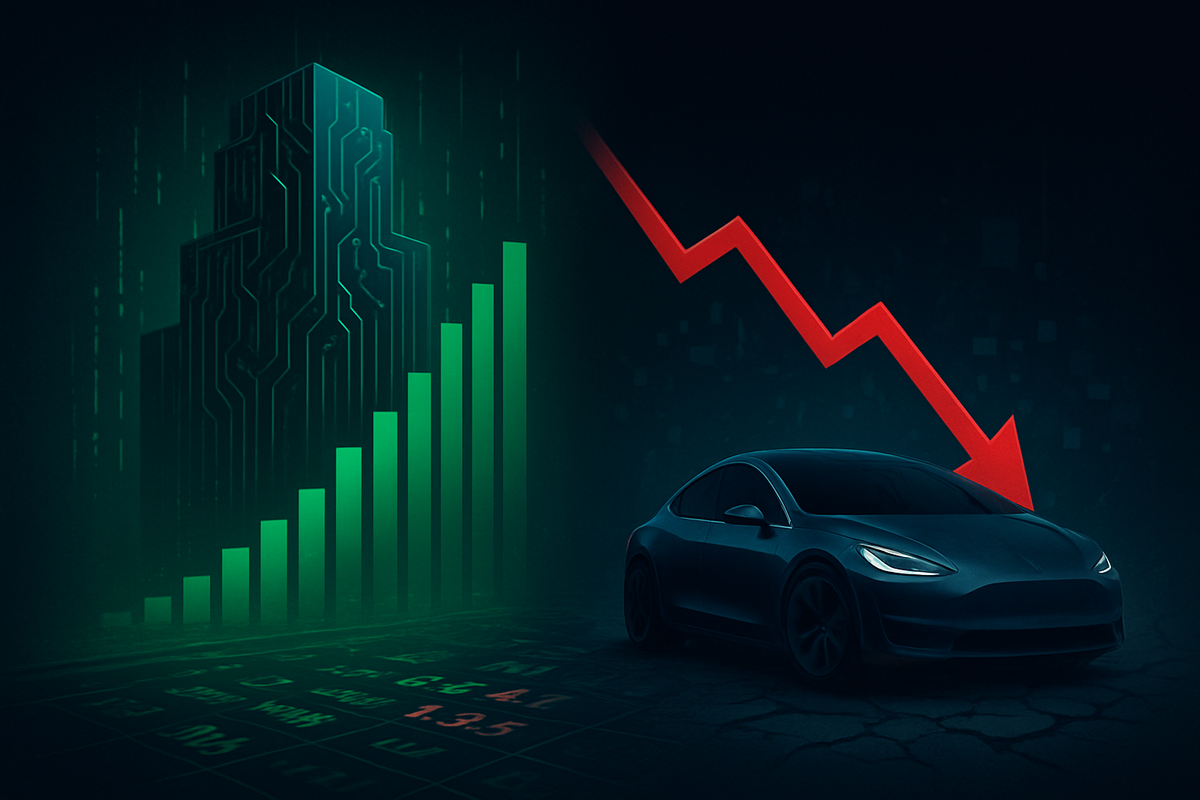
On Monday, April 6, 2026, the technology sector witnessed a stark divergence in market sentiment, highlighting a growing rift between reliable mega-cap stalwarts and high-beta growth stories. While the broader indices remained relatively flat, Apple Inc. (Nasdaq:AAPL) rose 1.1% and Amazon.com Inc. (Nasdaq:AMZN) gained 1.4%, as investors funneled capital into companies with proven artificial intelligence monetization and robust cash flows. In contrast, Tesla Inc. (Nasdaq:TSLA) continued to experience significant weakness, extending a downward trend fueled by cooling electric vehicle demand and heightening competition from global rivals.
This shift underscores a "flight to safety" within the technology landscape. As the market enters the second quarter of 2026, the euphoria surrounding the initial AI buildout has been replaced by a rigorous "show-me" phase. Investors are increasingly favoring the "fortress" balance sheets of established giants that can self-fund their massive capital expenditures, while distancing themselves from companies whose valuations rely heavily on speculative future breakthroughs.
A Tale of Two Realities: Reliable Growth vs. Speculative Pivots
The trading session on April 6 served as a microcosm of the year’s broader market dynamics. Apple’s 1.1% climb was largely attributed to growing anticipation for its "Spring Refresh" of the Siri ecosystem. Reports circulating this morning suggest that the latest iteration of Apple Intelligence—now fully integrated with localized generative AI models—has significantly boosted retention rates for the iPhone 17 series. Analysts estimate that Apple is on track to maintain its $4 trillion market capitalization, a milestone it first breached in late 2025, as it successfully transitions from a hardware-first company to an AI-services powerhouse.
Amazon’s 1.4% gain followed news that its proprietary AI training chip, Trainium3, has reached full capacity for the remainder of the 2026 fiscal year. The cloud computing giant has successfully re-accelerated its Amazon Web Services (AWS) growth to 24% year-over-year by leveraging these custom chips to lower costs for enterprise clients. This vertical integration has shielded Amazon from the margin compression that has plagued other cloud providers who remain overly dependent on third-party silicon.
Meanwhile, Tesla found itself on the defensive once again. The stock's weakness follows a disappointing Q1 delivery report released earlier this month, which confirmed that Tesla has officially lost its crown as the world’s top electric vehicle seller to BYD Co. (OTC:BYDDF). With an inventory glut in key markets like China and North America, Tesla's pivot toward autonomous "Robotaxis" and humanoid robotics—projects not expected to contribute meaningful revenue until 2029—has left shorter-term investors seeking the exits.
Fortress Giants and Vulnerable Disruptors
The primary winners in this current market cycle are companies that have demonstrated "High-Margin AI." Apple’s strategy of processing AI tasks locally on devices rather than in the cloud has allowed it to keep operating margins near record highs of 48%. This efficiency has made (Nasdaq:AAPL) a preferred parking spot for institutional capital looking to hedge against potential energy price volatility and rising cloud infrastructure costs.
Amazon’s win is rooted in its scale and infrastructure lead. By committing to a staggering $200 billion in capital expenditure for 2026, (Nasdaq:AMZN) has effectively raised the barrier to entry for cloud competitors. While the spend is massive, the market has rewarded the company because its AWS revenue run rate—now exceeding $142 billion annually—comfortably services its debt and expansion. Alphabet Inc. (Nasdaq:GOOGL) and Microsoft Corp. (Nasdaq:MSFT) have seen similar, albeit more muted, support as they also navigate the high-stakes AI infrastructure race.
Tesla, on the other hand, represents the primary "loser" in this current flight to safety. The company is currently caught in a "valuation gap," where it is no longer being valued solely as a high-growth automaker but has yet to prove its viability as a pure-play AI robotics firm. As traditional automakers like Ford Motor Co. (NYSE: F) and General Motors (NYSE: GM) scale back their EV ambitions in favor of profitable hybrids, Tesla’s lack of a diversified powertrain lineup has left it vulnerable to the current "EV winter."
The Shift to AI Monetization and the End of Cheap Speculation
The divergence seen on April 6 is part of a broader industry trend where the "AI Buildout" phase has matured into the "AI Monetization" phase. In 2023 and 2024, nearly any company mentioning "AI" saw its stock price appreciate. By April 2026, the market has become much more discerning. Investors are now scrutinizing how much revenue is actually being generated per dollar of AI investment.
This trend mirrors the post-dot-com era, where the initial infrastructure providers were eventually surpassed in stability by the companies that used that infrastructure to build resilient, cash-generating ecosystems. The current "flight to quality" is a defensive reaction to higher-for-longer interest rates and geopolitical uncertainty, leading investors to treat mega-cap tech stocks almost like treasury bonds—albeit with significantly higher growth potential.
Furthermore, regulatory pressures in the EU and the US have begun to favor the incumbents. The high cost of compliance with the 2025 AI Safety Accords has inadvertently created a "moat" around companies like Apple and Amazon, who have the legal and financial resources to navigate complex international frameworks that smaller or more specialized companies struggle to manage.
Navigating the Q2 Landscape
Looking ahead, the market will be laser-focused on the upcoming Q1 earnings season, which begins in earnest later this month. For Apple, the focus will be on whether the Siri "Spring Refresh" can drive a sustained software services revenue bump. For Amazon, analysts will be looking for signs that the $200 billion CapEx plan is not eroding free cash flow more quickly than AWS can replenish it.
Tesla faces a more difficult path. The company is expected to announce a series of strategic pivots during its next investor day, potentially including a more affordable "Model 2" or a finalized timeline for its autonomous driving subscription service in Europe. However, until Tesla can prove it has cleared its inventory surplus and stabilized its margins, it is likely to remain a source of volatility rather than a haven for safety.
We may also see a rotation into other "Value Tech" sectors. As the year progresses, if Apple and Amazon become too "crowded" as trades, investors may look toward enterprise software giants like Oracle Corp. (NYSE: ORCL) or Salesforce Inc. (NYSE: CRM), provided they can prove their AI integrations are driving enterprise-wide productivity gains.
The New Hierarchy of Big Tech
The market activity on April 6, 2026, clarifies the new hierarchy within the "Magnificent Seven." The group is no longer moving in lockstep. Instead, we are seeing the emergence of a "Tier 1" class—Apple and Amazon—whose diversified revenue streams and infrastructure dominance provide a buffer against macroeconomic headwinds.
Tesla’s current struggle serves as a reminder that innovation without immediate market demand is a risky bet in a high-interest-rate environment. For investors, the takeaway is clear: the market is no longer rewarding potential; it is rewarding performance. Resilience, cash flow, and the ability to monetize AI today—not five years from now—are the qualities that will define the winners of 2026.
As the second quarter unfolds, market participants should keep a close watch on Treasury yields and enterprise IT spending surveys. If the "flight to safety" continues, the valuation gap between the "Fortress Tech" giants and the rest of the sector will likely only widen, fundamentally reshaping the composition of the modern stock market.
This content is intended for informational purposes only and is not financial advice