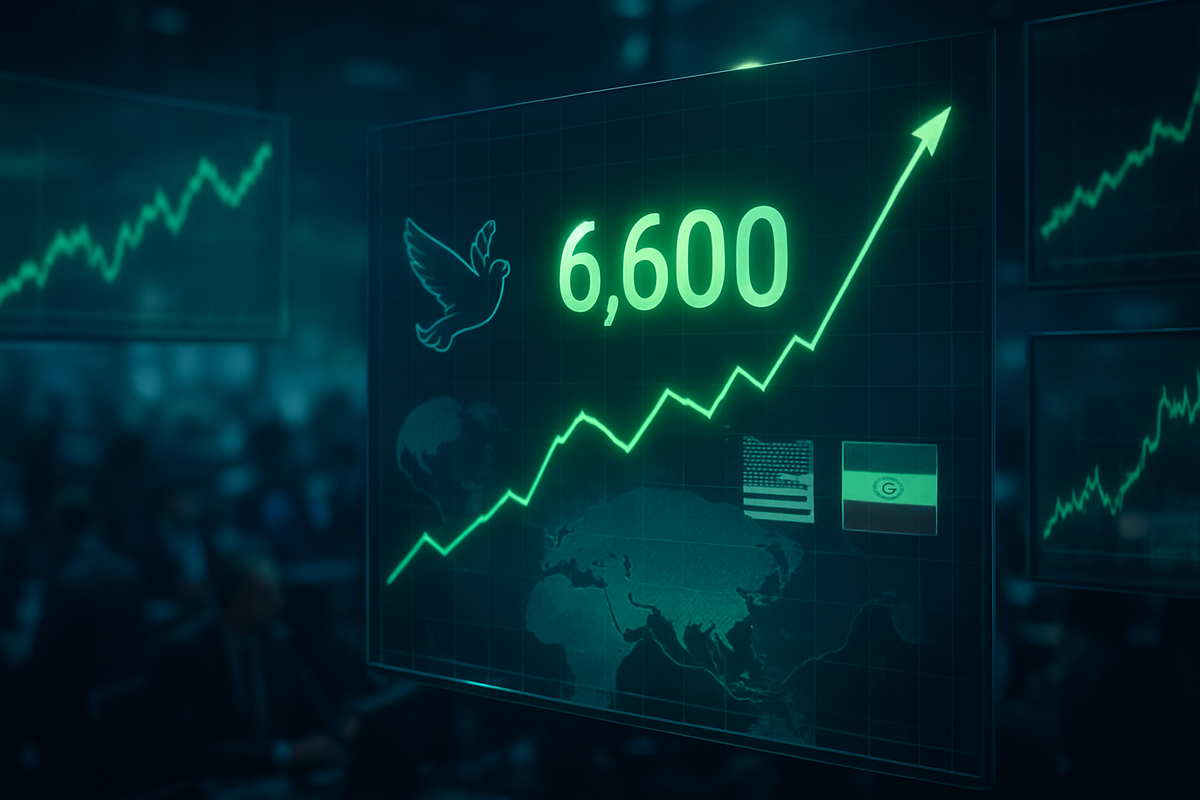
Financial markets experienced a seismic shift in sentiment on Monday as reports of a potential 50-day ceasefire between the United States and Iran triggered a massive relief rally across global exchanges. The breakthrough, which comes after weeks of heightened kinetic conflict in the Middle East, sent S&P 500 (INDEXSP:.INX) futures surging more than 3%, decisively reclaiming the psychologically and technically significant 6,600 level.
The rally marks a turning point for an equity market that had been battered by "Operation Epic Fury"—a multi-week military campaign that saw the closure of the Strait of Hormuz and a spike in global energy prices. As diplomats from Pakistan, Egypt, and Turkey finalized the framework for what is being called the "Islamabad Accord," traders moved aggressively out of defensive hedges and back into high-growth sectors, betting that the worst of the 2026 geopolitical crisis may be in the rearview mirror.
The Road to the Islamabad Accord: A High-Stakes Breakthrough
The current optimism centers on a proposed 50-day pause in hostilities designed to allow for humanitarian aid and the reopening of vital maritime trade routes. The conflict, which began in late February 2026, had reached a fever pitch in late March when U.S. and Israeli forces targeted Iranian leadership infrastructure following a series of maritime escalations. By early April, the S&P 500 had slumped nearly 10% from its yearly highs, bottoming near 6,310 as investors braced for a full-scale regional war.
The tide began to turn over the April 4-5 weekend. The successful rescue of two U.S. airmen whose F-15E was downed over Iranian territory provided a necessary emotional reprieve, but the real catalyst was the arrival of a formal ceasefire proposal brokered by Islamabad. Under the terms of the deal, Iran would immediately cease its interference with shipping in the Strait of Hormuz in exchange for a temporary pause in U.S. airstrikes and the opening of a diplomatic corridor for a permanent settlement.
The market’s reaction was instantaneous. S&P 500 futures, which had been languishing below 6,500 for most of the previous week, gapped up on the Sunday night open. By mid-morning Monday, April 6, the index had crossed the 6,600 threshold, a move analysts describe as "flipping the script" on the bearish narrative that dominated the first quarter of the year. However, the rally remains shadowed by a strict deadline set by the White House for Tuesday evening, demanding full compliance with the maritime reopening or further strikes on Iranian infrastructure.
Winners and Losers: A Violent Sector Rotation
The "peace rally" has created a stark divide between the sectors that thrived during the conflict and those that are poised to lead the recovery. Technology giants, which were heavily sold off during the March "war scare," have emerged as the primary beneficiaries of the de-escalation. NVIDIA (Nasdaq:NVDA) and Microsoft (Nasdaq:MSFT) both saw gains exceeding 4% in early Monday trading, as the receding threat of energy-driven inflation lowered the risk premium on high-duration growth stocks.
Conversely, the sectors that served as "geopolitical hedges" are now seeing significant capital outflows. The defense industry, which hit record highs in mid-March, experienced a sharp "sell-on-the-news" correction. Lockheed Martin (NYSE: LMT), Northrop Grumman (NYSE: NOC), and RTX Corporation (NYSE: RTX) all traded lower as the immediate demand for munitions replenishment appeared to stabilize. Despite their massive backlogs from the 2026 conflict, investors are rotating into more cyclical plays.
Energy markets are also feeling the weight of the ceasefire reports. Brent crude, which had flirted with $115 per barrel just ten days ago, retreated toward the $100 mark. This has put downward pressure on integrated oil majors like ExxonMobil (NYSE: XOM) and Chevron (NYSE: CVX). While lower oil prices act as a "tax cut" for the broader economy and companies like Amazon (Nasdaq:AMZN) and Delta Air Lines (NYSE: DAL), they represent a direct hit to the outsized margins energy firms enjoyed during the first quarter.
Broader Significance: Breaking the Cycle of Stagflation
The reclaim of the 6,600 level is more than just a technical victory; it represents a fundamental shift in the macro outlook for 2026. For months, the primary fear among institutional investors was "geopolitical stagflation"—a scenario where rising energy costs from the Middle East conflict would force the Federal Reserve to keep interest rates high despite slowing economic growth.
Historically, such "energy shocks" have led to prolonged bear markets. By de-escalating the conflict before the Strait of Hormuz closure could trigger a permanent shift in global supply chains, the Islamabad Accord may have saved the "soft landing" narrative. Technicians are now eyeing the 200-day moving average at 6,660 as the next major hurdle. If the S&P 500 can hold above 6,600 and break 6,660, it would signal a transition from a tactical bounce to a sustained bull market trend.
Furthermore, the ceasefire highlights a shifting geopolitical landscape where mid-tier powers like Turkey and Pakistan are increasingly taking the lead in brokerage, reducing the market's reliance on traditional Western-only diplomatic channels. This diversification of diplomatic risk is something long-term strategists are watching closely as they adjust their "tail risk" models for the latter half of the decade.
The Path Forward: Volatility Lurks Behind the Deadline
While the 50-day window provides a much-needed breathing room, the market is far from being out of the woods. The short-term focus remains fixed on the April 7 deadline. If Iran fails to visibly clear shipping lanes in the Strait of Hormuz by the Tuesday evening cutoff, the "de-escalation rally" could evaporate as quickly as it arrived. Traders are currently pricing in a "fragile peace," meaning any headline suggesting a breakdown in the Islamabad talks could send the S&P 500 back toward the 6,300 support level.
In the long term, the strategic pivots required by major corporations will be significant. Defense firms will likely focus on long-range standoff capabilities and missile defense, anticipating that the underlying tensions in the region are merely paused, not resolved. Tech and retail companies, meanwhile, will likely use this window of stability to further diversify their supply chains away from high-conflict zones, a trend that has accelerated since the early 2020s.
The next few weeks will determine if the 6,600 level becomes a floor for a new leg of the bull market or merely a "bull trap" before a second phase of the conflict. Investors will be parsing every statement from Tehran and Washington for clues on whether the 50-day pause can be converted into a multi-year settlement.
Summary of the Market Outlook
The reclaim of the 6,600 level on S&P 500 futures is a powerful signal of the market's desire to look past the "Operation Epic Fury" conflict. The immediate takeaways for investors are clear: the "war premium" is exiting the market, and the "AI and growth" narrative is returning to the forefront. However, the longevity of this rally is entirely dependent on the successful implementation of the Islamabad Accord.
Moving forward, the market will transition from watching military maneuvers to watching diplomatic ones. The key metrics to monitor in the coming months will be the total volume of oil shipping through the Strait of Hormuz and the finalized 2027 defense budget figures. While the 50-day ceasefire is a major win for bulls, the "Tuesday Deadline" serves as a stark reminder that in the 2026 market, the line between a record-breaking rally and a sharp correction remains razor-thin.
Investors should remain nimble, keeping a close eye on the 6,660 resistance level. A sustained move above that mark would likely open the door for a run toward the 7,000 milestone by year-end, provided the geopolitical clouds continue to part.
This content is intended for informational purposes only and is not financial advice.