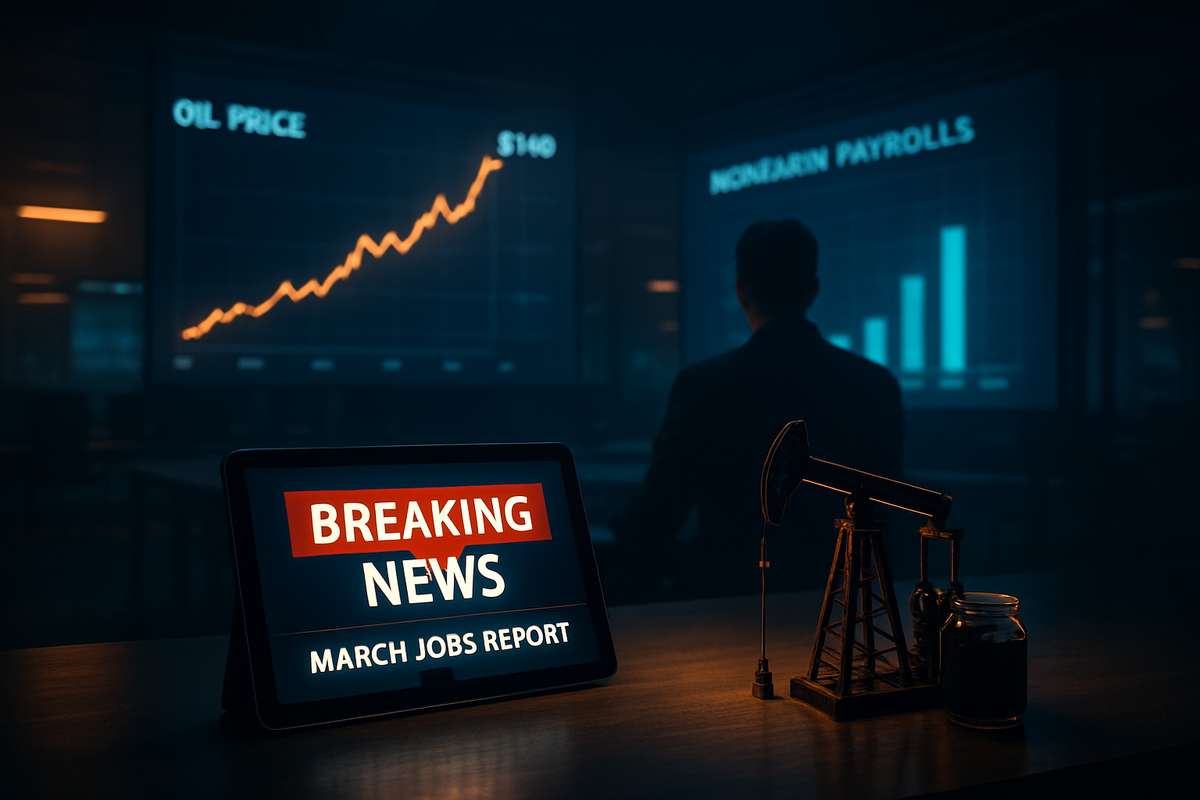
The United States labor market faces a defining moment this morning as the Bureau of Labor Statistics (BLS) prepares to release the March nonfarm payrolls report. In a rare "calendar collision," the data arrives on Good Friday, April 3, 2026, a day when major U.S. stock exchanges are shuttered, leaving investors to parse the results in a low-liquidity environment. With a consensus estimate of just 60,000 new jobs—roughly half of the growth seen in January—the report serves as a critical health check for an economy reeling from a sudden and violent spike in global energy prices.
The stakes could not be higher. Following a disastrous February that saw a net loss of 92,000 jobs due to a combination of severe winter storms and healthcare sector strikes, the March figures will reveal whether the U.S. economy is merely "thawing out" or if it is beginning to buckle under the weight of $140-a-barrel oil. As the Middle East conflict continues to disrupt global supply chains, this morning’s 8:30 AM ET release will either provide a much-needed sign of stabilization or signal the onset of a stagflationary spiral that could force the Federal Reserve into an impossible policy corner.
A Perfect Storm: From February Freezes to Geopolitical Shocks
The road to this morning’s report has been paved with volatility. The initial economic narrative for 2026 was one of "normalization," but that was shattered in late February when military escalations in the Middle East led to threats against the Strait of Hormuz. Crude oil prices, which began the year near $70, skyrocketed to a range of $115 to $140 per barrel in just five weeks. This energy shock hit just as the labor market was already showing signs of fatigue. The February jobs report, which reported a contraction of 92,000 positions, was largely dismissed by the market as a "weather-driven anomaly," but the March data will offer no such excuses.
The expected 60,000 job gain represents a modest technical rebound, yet it remains far below the 150,000 to 200,000 monthly average required to keep pace with population growth. Key stakeholders, including Federal Reserve Chair Jerome Powell and Treasury officials, are watching closely to see if the "energy tax" of high gasoline prices has begun to trigger preemptive layoffs in the retail and hospitality sectors. While the BLS remains open today, the CME Group (NASDAQ: CME) will only trade equity futures for a brief 45-minute window following the release, closing at 9:15 AM ET. This means the vast majority of the "price discovery" will be deferred until Monday morning, potentially leading to a massive "gap" in stock prices when the New York Stock Exchange and Nasdaq reopen.
Winners and Losers in a High-Fuel Economy
The divergence in sector performance leading into this report has been stark. Energy giants like ExxonMobil (NYSE: XOM) and Chevron (NYSE: CVX) have emerged as the primary beneficiaries of the oil shock, with their stock prices reaching multi-year highs as refining margins expand. These companies have continued to hire, particularly in the Permian Basin, as the U.S. ramps up domestic production to offset global shortages. However, their gains are a double-edged sword for the broader market, as high energy costs act as a drag on nearly every other sector.
Conversely, the "losers" list is growing. Logistics and transportation firms are facing a margin squeeze that many analysts fear will lead to hiring freezes. FedEx (NYSE: FDX) and United Airlines (NASDAQ: UAL) are particularly vulnerable; both have already signaled that fuel surcharges may not be enough to offset the rapid rise in kerosene and diesel costs. In the consumer space, Amazon (NASDAQ: AMZN) and major retailers are bracing for a drop in discretionary spending. If today’s jobs report misses the 60,000 mark, it will confirm fears that the "American Consumer," the traditional engine of global growth, is finally running out of gas—literally and figuratively.
The Fed’s "Trolley Problem": Inflation vs. Growth
This report carries massive weight for the Federal Reserve’s upcoming policy meetings. Economists are calling the current situation a "Trolley Problem": if the Fed raises interest rates to combat the inflation caused by $140 oil, they risk crushing an already weakening labor market. If they cut rates to support job growth, they risk letting energy-driven inflation become permanent. Historical precedents, such as the oil shocks of the 1970s and the brief energy spike of 2015, suggest that the Fed often "looks through" energy prices, but the scale of the current geopolitical conflict makes that strategy far riskier today.
Major financial institutions are divided on the path forward. Analysts at Goldman Sachs (NYSE: GS) remain dovish, arguing that the U.S. is less oil-dependent than in previous decades and that the Fed should proceed with planned rate cuts in the second half of the year. However, JPMorgan Chase (NYSE: JPM) has issued a more hawkish warning, suggesting that if oil remains above $130 into May, a "preventative hike" may be necessary to anchor inflation expectations. The March payrolls data will serve as the primary piece of evidence for either side of this debate, influencing whether the "soft landing" narrative survives the spring.
The Road Ahead: What to Watch After the Holiday
In the short term, the low-liquidity environment of Good Friday means that the initial reaction in the Treasury and Foreign Exchange (FX) markets may be exaggerated. Investors should expect significant volatility in the U.S. Dollar as global traders react to the 8:30 AM release. If the number comes in significantly below 60,000—perhaps even showing a second month of losses—the market will likely pivot toward a "recession trade," with bond yields falling as investors bet on emergency rate cuts.
Looking toward May and June, the focus will shift from "hiring" to "spending." Even if the March report shows modest growth, the lagging effects of the oil shock are expected to hit the April and May data much harder. Strategic pivots will be required for companies in the consumer discretionary and travel sectors, many of whom may need to revise their 2026 guidance downward if energy prices do not stabilize. For investors, the "Monday Open" will be the true test, as institutional players finally get the chance to rebalance their portfolios in response to today’s data.
Conclusion: A Fragile Balance
As the 8:30 AM ET release approaches, the U.S. economy finds itself in a fragile state of equilibrium. A 60,000-job gain would be a victory of sorts—a sign that the labor market can withstand a geopolitical hurricane—but it is a slim margin of error. The "Good Friday Payrolls" will be remembered as the moment the market truly began to price in the long-term consequences of the 2026 energy crisis.
The key takeaway for the coming months is the concept of "real wages." Even if hiring continues, the spike in energy costs is currently outpacing wage growth, meaning the average worker's purchasing power is shrinking. Investors should watch for revisions to previous months and the "underemployment" rate for a clearer picture of the economy's underlying health. While the trading floors are quiet today, the data released this morning will echo through the markets for the remainder of the year.
This content is intended for informational purposes only and is not financial advice.