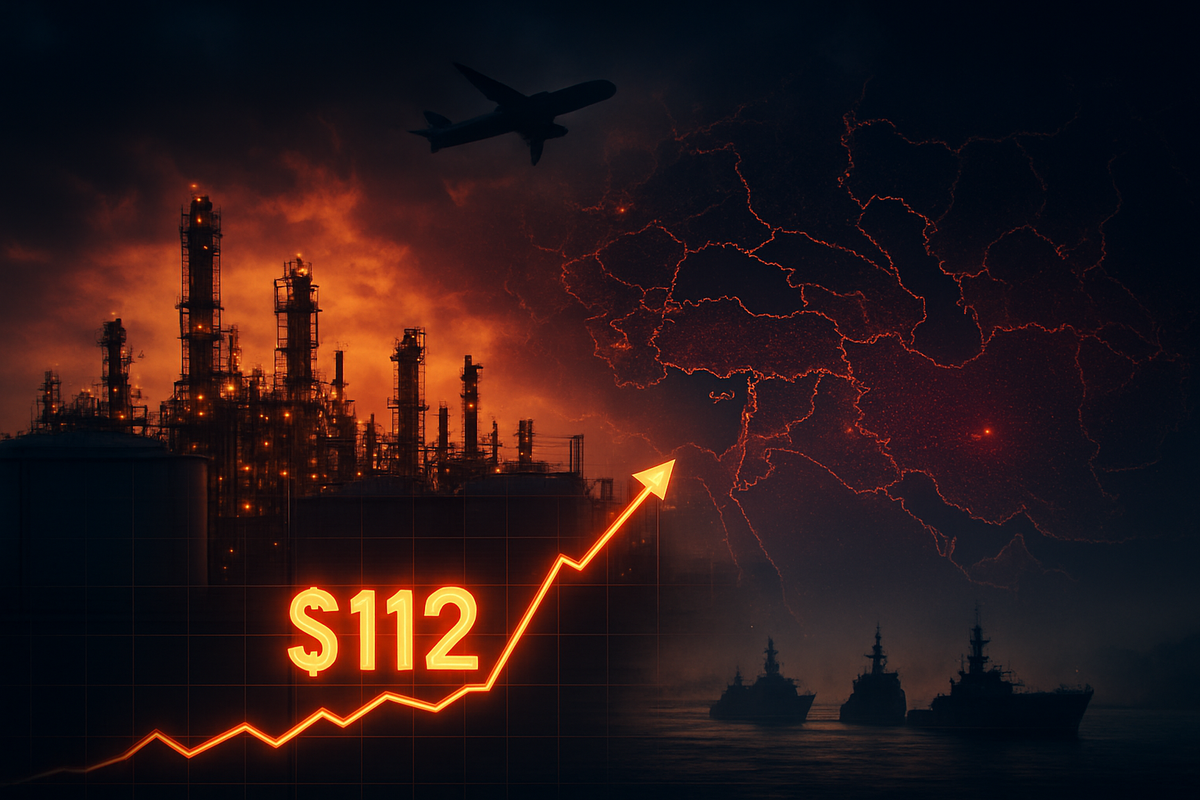
NEW YORK — Global energy markets are reeling today as West Texas Intermediate (WTI) crude oil surged past the $112 per barrel mark, marking a volatile 14.4% climb over the past seven days. The spike, fueled by a dramatic escalation in Middle East hostilities and combative foreign policy rhetoric from the White House, has sent shockwaves through the financial sector, forcing a violent repricing of energy-dependent industries. With the Strait of Hormuz effectively paralyzed and geopolitical tensions reaching a fever pitch, the "peace dividend" that many investors had bet on for 2026 has evaporated almost overnight.
The immediate implications are stark: U.S. gasoline prices have jumped to a national average of $4.50 per gallon, and the transportation sector is facing its most significant fuel-cost crisis in years. While energy producers are seeing record-breaking intraday gains, the broader market is grappling with the specter of renewed inflation. Analysts warn that if the blockade in the Persian Gulf persists, the global economy could face a supply deficit of over 10 million barrels per day, a gap that domestic production—despite reaching record highs—cannot immediately fill.
A Perfect Storm: From $100 to $112 in Seven Days
The catalyst for this week’s historic rally was a series of rapid-fire events in the Persian Gulf. On March 27, 2026, WTI was trading at a relatively stable $99.64. However, the situation deteriorated following reports of "Operation Epic Fury," a U.S.-led coalition strike against Iranian nuclear and military infrastructure. In retaliation, Tehran deployed advanced anti-ship missiles to effectively close the Strait of Hormuz, a chokepoint through which 20% of the world’s daily oil supply flows. By Thursday, April 2, WTI futures breached the $112 resistance level, with some intraday trades flashing as high as $114.
President Donald Trump further intensified market anxiety during a prime-time address on the evening of April 1. While claiming the military operation was "nearing completion," the President simultaneously threatened to push the Iranian regime "back to the Stone Age" if they continued to disrupt global shipping. His "Energy Ultimatum" directed at European and Asian allies—insisting they either secure the waterways themselves or switch entirely to U.S. oil exports—added a layer of geopolitical uncertainty that traders were quick to price in. The administration’s stance that the U.S. is now "energy independent" has done little to soothe the markets, as the global nature of oil pricing remains tied to the crisis in the Middle East.
Initial market reactions have been characterized by "flight-to-safety" behavior, with gold and the U.S. dollar rising alongside crude. However, the most visible impact has been in the equity markets, where the decoupling of energy stocks and the rest of the S&P 500 has reached extreme levels. Trading desks in New York and London reported high volumes of panic-buying in oil futures, as hedge funds and commercial hedgers scrambled to cover short positions in the face of the 14% weekly move.
Market Fallout: Winners in the Oil Patch, Losers in the Skies
The surge in crude has created a sharp divergence in the corporate landscape. The clear winners are the domestic oil majors. ExxonMobil (NYSE: XOM) and Chevron (NYSE: CVX) have seen their valuations swell as higher price realizations directly pad their bottom lines. These companies, which have spent the last two years refining their Permian Basin operations, are now positioned to reap massive windfall profits from a price environment they hadn't projected until much later in the decade. Smaller independent producers are also seeing a resurgence, as $112 oil makes even the most marginal shale plays highly profitable.
On the other side of the ledger, the travel and leisure industry is under immense pressure. Airlines, which rely on jet fuel for nearly a third of their operating costs, were hammered in Thursday's session. United Airlines (NASDAQ: UAL) saw its shares slump 6.6%, while American Airlines (NASDAQ: AAL) fell 6.5%. American Airlines, in particular, is being watched closely by analysts at firms like UBS, who noted the carrier’s high leverage and sensitivity to domestic fuel costs. The company’s stock is now down nearly 29% year-to-date, reflecting deep skepticism about its ability to pass these costs onto consumers.
Delta Air Lines (NYSE: DAL) fared slightly better, dropping 4.6%, as investors wagered on its premium pricing power and more efficient fleet. However, even for the "Big Three," the math is becoming difficult. Industry data suggests that a typical domestic flight on a 737-800 aircraft, which might have generated a $1,500 profit last month, is now operating at a loss of nearly $3,900 due to the fuel spike. If prices remain at these levels, a significant reduction in flight capacity and a sharp increase in ticket prices appear inevitable.
Wider Significance: A Return to 1970s Geopolitical Risk?
This event marks a significant shift in the broader industry trend of "energy transition." For several years, the narrative focused on the declining influence of Middle Eastern oil; however, the current crisis proves that the global economy remains tethered to the Persian Gulf. The 14% weekly climb is being compared by many veteran traders to the 1973 oil embargo, highlighting how quickly geopolitical friction can override market fundamentals of supply and demand.
The regulatory implications are also mounting. In Washington, there is already talk of renewed windfall profit taxes on energy companies, a move the Trump administration has signaled it would veto, preferring instead to push for further deregulation to "unleash" domestic production. Conversely, the high cost of fossil fuels may inadvertently accelerate the adoption of electric vehicles and alternative energy sources in the long term, though these provide no relief for the immediate logistics and aviation crises.
Historical precedents suggest that such rapid price spikes often lead to demand destruction. In 2008 and 2022, when oil approached these levels, consumer spending in other areas slowed significantly. The "ripple effect" is already being felt in the shipping industry and the manufacturing sector, where the cost of petroleum-based plastics and fertilizers is beginning to tick upward, threatening to reignite the inflationary fires the Federal Reserve has spent years trying to extinguish.
What Comes Next: Diplomacy or Deficit?
In the short term, the market is waiting to see if the U.S. will tap the Strategic Petroleum Reserve (SPR) to cool prices. While the Trump administration has traditionally favored domestic production over SPR intervention, the political pressure of $4.50 gasoline ahead of the mid-year economic cycle may force a pivot. Strategic analysts are also monitoring whether the "Energy Ultimatum" will lead to a multinational naval task force to reopen the Strait of Hormuz, an escalation that could either stabilize the market or lead to a broader regional war.
Long-term, the airline and travel sectors may be forced into radical restructuring. We may see a return to fuel surcharges not seen in a decade, or a strategic pivot toward more aggressive fuel hedging strategies—a practice some airlines had abandoned in the low-volatility years. For investors, the opportunity lies in identifying which companies have the balance sheet strength to survive a prolonged period of high energy costs and which are "fuel-fragile."
Scenario planning now includes the possibility of oil reaching $120 or even $130 if military engagement deepens. Conversely, if a diplomatic "back-channel" success or a sudden cessation of hostilities occurs, the market could see an equally violent "crash" back to the $80 range, as the "war premium" is stripped out of the price.
Summary: Navigating a High-Octane Market
The surge to $112 WTI is a stark reminder that energy remains the ultimate geopolitical lever. The combination of active conflict in the Middle East and a "maximum pressure" foreign policy from the White House has created a volatility spike that few were prepared for. While oil giants like ExxonMobil (NYSE: XOM) are benefiting, the travel industry—led by American Airlines (NASDAQ: AAL) and United Airlines (NASDAQ: UAL)—is facing a crisis that threatens to erase a year of recovery.
Moving forward, the market will be hyper-sensitive to any news regarding the Strait of Hormuz and the tone of future addresses from the President. Investors should watch for the "demand destruction" threshold—the point at which high prices cause consumers to stop traveling and spending—as this will dictate the next phase of the economic cycle. For now, the energy market is in the driver's seat, and the road ahead looks increasingly expensive.
This content is intended for informational purposes only and is not financial advice.