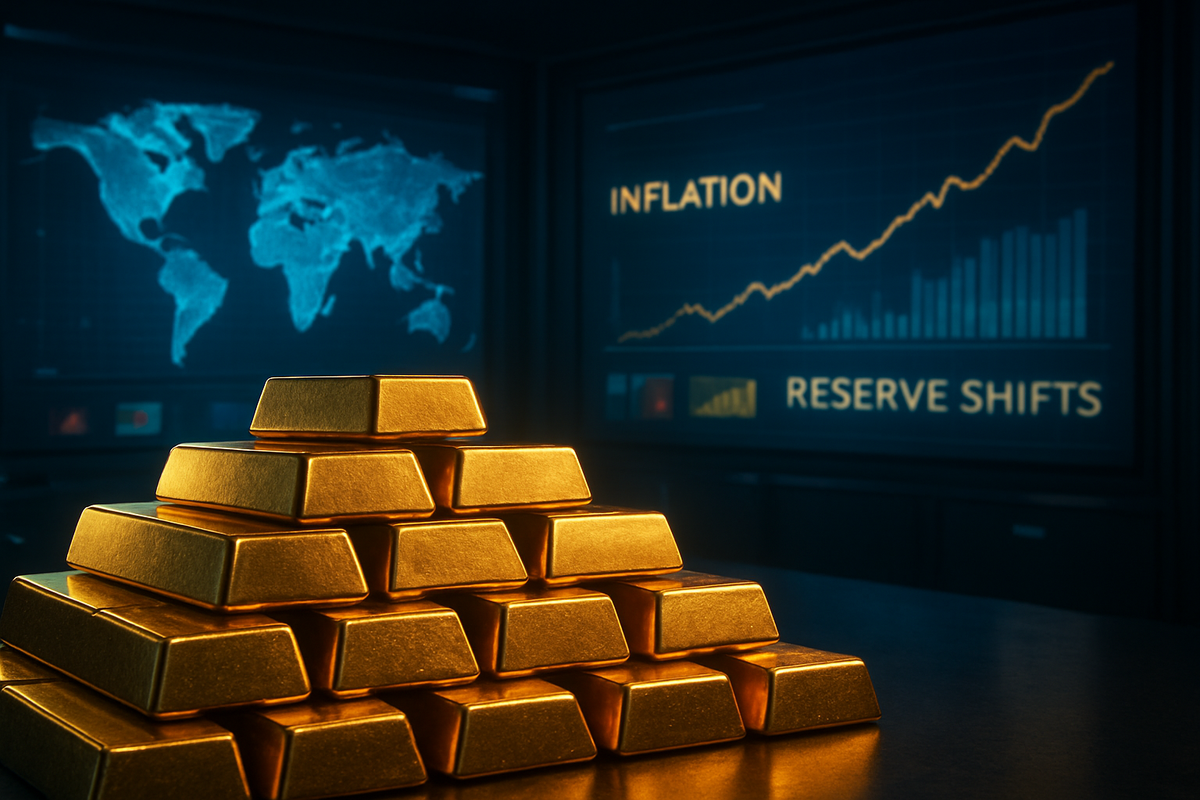
As of April 2, 2026, the global financial landscape is witnessing a historic realignment as central banks accelerate their departure from U.S. dollar dominance in favor of gold. This structural shift, which began in earnest following the geopolitical tremors of 2022, has reached a critical tipping point this month. Official sector demand for the precious metal has effectively doubled compared to pre-2022 averages, with the total value of central bank gold holdings now reaching a staggering $5.1 trillion—eclipsing total foreign official holdings of U.S. Treasury securities for the first time in modern history.
The immediate implications are profound for both currency markets and the broader economy. Despite a sharp price correction from January’s record highs of $5,594 per ounce down to the current $4,200 range, central banks are viewing the dip as a strategic buying opportunity rather than a signal of weakness. This persistent accumulation comes as a "second wave" of global inflation, triggered by early 2026 energy shocks and regional conflicts in the Middle East, forces monetary authorities to prioritize "sanction-proof" assets that carry no counterparty risk.
The New Normal: Doubling Down on Gold
The momentum behind this accumulation is driven by a coordinated effort among emerging markets to diversify their reserves. Since 2022, when the freezing of Russian sovereign assets sent a shockwave through global finance, central banks have shifted from tactical hedging to strategic stockpiling. Data from the first quarter of 2026 indicates that annual official sector demand is holding steady at approximately 850 to 1,000 tonnes, nearly twice the 450-tonne baseline seen during the 2010–2021 period. The People’s Bank of China remains a dominant force, maintaining a multi-year buying streak that has pushed its reported reserves to over 2,300 tonnes.
This shift isn't limited to the usual suspects. In early 2026, we have seen a surge in activity from nations like Poland, which has aggressively targeted a 700-tonne reserve goal, and a re-entry into the market by Southeast Asian nations including Malaysia and Indonesia. Even African nations, such as Uganda and Kenya, have established domestic gold-buying programs to bolster their economic sovereignty. This widespread participation has created a floor for gold prices, even as the U.S. Federal Reserve maintains a "higher for longer" interest rate stance to combat a resurgence in energy-driven inflation.
The timeline of this shift is inextricably linked to the "Iran Conflict" shock of Q1 2026, which sent Brent crude oil prices soaring above $100 per barrel. This event reignited inflationary fears that many hoped were buried in 2024. Eurozone inflation, for instance, jumped from 1.9% in February to 2.5% in March 2026, prompting a sudden pivot in market expectations. While individual investors may have been spooked by the resulting price volatility in precious metals, central bank policies have remained resolute, treating gold as the ultimate insurance policy against a multi-polar and increasingly unstable world.
Market Winners and the Mining Renaissance
The beneficiaries of this structural demand shift are led by the major gold producers who have spent the last four years optimizing their balance sheets. Newmont (NYSE: NEM), the world’s largest gold miner, has seen its strategic focus on Tier-1 assets pay off as margins expand despite rising operational costs. Similarly, Agnico Eagle Mines (NYSE: AEM) has emerged as a favorite among institutional investors in 2026, credited for its high-grade assets and the successful integration of its recent mega-mergers, which have provided a buffer against the short-term price swings seen this April.
On the losing end of this transition are traditional "safe-haven" fixed-income products. As central banks allocate a larger share of their "new money" to gold, the demand for long-dated U.S. Treasuries has faced persistent headwinds, contributing to higher yield volatility. Financial institutions heavily reliant on the recycling of dollar reserves are finding the market more fragmented. However, mid-tier miners like Kinross Gold (NYSE: KGC) and growth-oriented players like Alamos Gold (NYSE: AGI) are finding new life, as the "new normal" of $4,000+ gold prices allows for the development of projects that were previously deemed uneconomical.
For retail and institutional investors seeking to ride this wave, the exchange-traded fund (ETF) market has evolved. While the SPDR Gold Shares (NYSE: GLD) remains the liquidity king, newer, lower-cost vehicles like the iShares Gold Trust Micro (NYSE: IAUM) have seen record inflows in the first half of 2026. Furthermore, the VanEck Gold Miners ETF (NYSE: GDX) has become a primary tool for those looking to capture the operating leverage of the mining sector, which is finally beginning to outperform the underlying metal as dividends and share buybacks reach multi-year highs.
De-Dollarization and the Geopolitical Ripple Effect
The wider significance of this event cannot be overstated; it marks a fundamental change in the global monetary order. This isn't just about gold; it’s about the erosion of the "exorbitant privilege" held by the U.S. dollar. As central banks move toward a reserve mix that is more balanced between the dollar, gold, and other regional currencies, the effectiveness of financial sanctions as a tool of Western foreign policy is being diluted. This trend fits into a broader industry move toward "resource nationalism," where countries are increasingly viewing their natural mineral wealth as a direct component of their monetary base.
Historically, this era draws parallels to the collapse of the Bretton Woods system in the early 1970s, yet the current shift is more gradual and driven by a wider array of international actors. The "BRICS+" expansion has further accelerated this, with member nations exploring gold-backed settlement mechanisms to bypass the SWIFT system. The regulatory implications are also surfacing, as international accounting standards for central banks are being revised to reflect the increased importance of "physical" over "paper" gold, leading to a scramble for secure, domestic storage facilities across Europe and Asia.
The Road Ahead: Volatility as the Price of Admission
Looking forward, the market should prepare for a period of "high-floor volatility." While the $5,000 mark may remain a psychological ceiling in the short term as the world grapples with high interest rates, the structural demand from the official sector suggests that the floor for gold has moved permanently higher. In the coming months, the focus will shift to how the Federal Reserve and the European Central Bank respond to "sticky" energy inflation. If they are forced to keep rates elevated, we may see further consolidation in gold prices, providing more entry points for the central banks of the global south.
Potential strategic pivots will be required from global asset managers, who must now account for gold as a permanent, high-weighting component of a diversified portfolio rather than a zero-yield relic. The emergence of digital "tokenized" gold products, which allow for easier cross-border settlements, is likely to be the next frontier of this market. Investors should watch for any signs of the U.S. Treasury responding to this shift, perhaps through new incentives for domestic and foreign holding of sovereign debt, though such measures have yet to materialize in the face of the golden tide.
Final Assessment for the 2026 Investor
In summary, April 2026 serves as the definitive confirmation that the central bank "gold rush" is a permanent structural feature of the modern economy, not a fleeting reaction to a single crisis. The doubling of demand since 2022 has created a supply-demand imbalance that favors long-term price appreciation, even as short-term technical factors lead to the current $4,200 stabilization. The core takeaway is clear: the global reserve system is being re-anchored.
Moving forward, the market will be defined by the tension between the "higher for longer" interest rate environment and the relentless diversification needs of emerging economies. Investors should keep a close eye on upcoming inflation prints and the monthly reserve disclosures from the People’s Bank of China and the Reserve Bank of India. In this new era, gold is no longer just a hedge against what could go wrong—it is a central pillar of what is being built in a multi-polar financial world.
This content is intended for informational purposes only and is not financial advice.