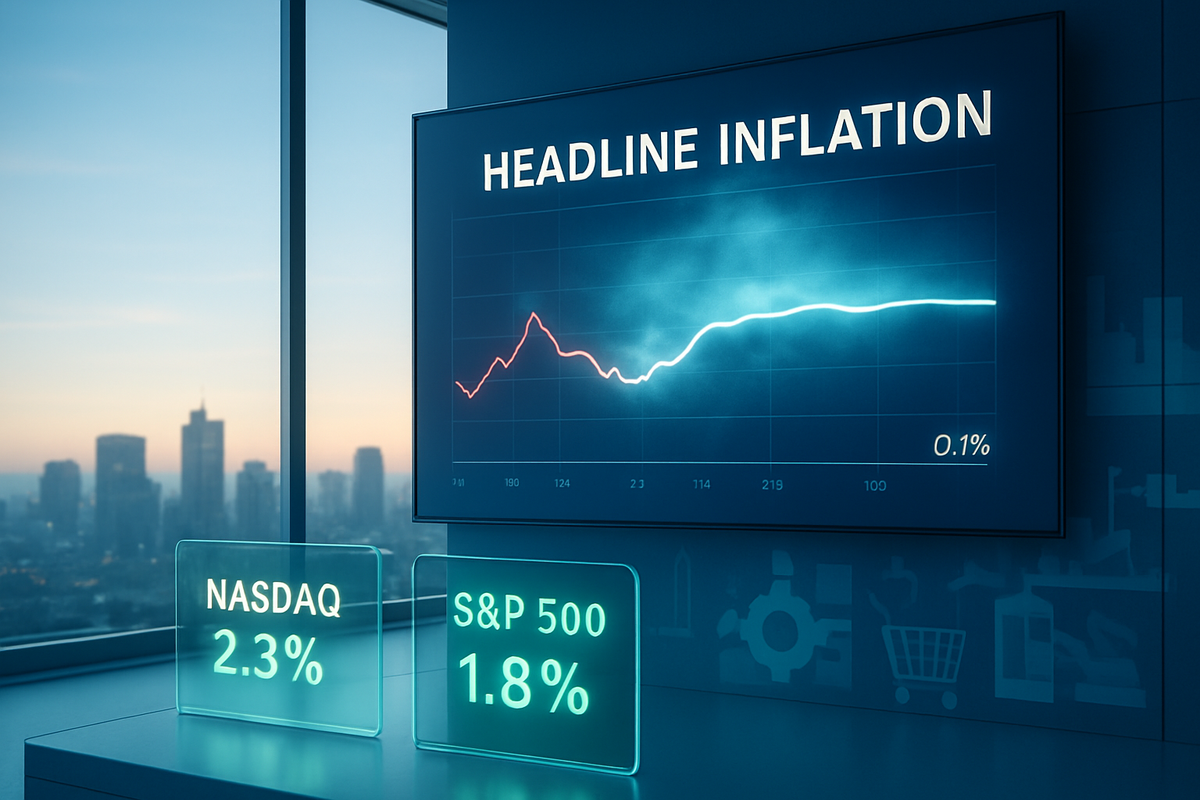
In a week dominated by geopolitical tensions and fears of a "higher-for-longer" interest rate environment, Wall Street found a much-needed reprieve on April 14, 2026. The Bureau of Labor Statistics released the March Producer Price Index (PPI) report, revealing a core inflation figure that defied even the most optimistic analyst projections. The core PPI, which strips out the volatile food and energy sectors, rose by a mere 0.1% month-over-month, a sharp contrast to the 0.5% to 0.6% increase that consensus estimates had anticipated.
The immediate reaction was palpable across trading floors. This "disinflationary surprise" acted as a vital stabilizer, cooling the feverish narrative that inflation was spiraling out of control due to rising energy costs. While the headline PPI—influenced by a surge in oil prices—rose by 0.5%, the underlying core data suggested that the domestic engine of inflation is finally losing its heat. For investors, the report was more than just a data point; it was a signal that the Federal Reserve might finally have the room it needs to pivot.
Inside the Numbers: A Tale of Two Inflations
The March PPI report highlighted a significant divergence between the "energy tax" impacting the global economy and the cooling core of domestic production. While the headline figure rose 0.5% month-over-month (bringing the year-over-year headline rate to 4.0%), the core figure’s 0.1% print was the lowest monthly increase since mid-2025. This indicates that while businesses are paying more for fuel and transportation, the prices for intermediate goods and services—the building blocks of the economy—are stabilizing or even falling in some sectors.
The timeline leading up to this moment was fraught with anxiety. Following a late February flare-up in Middle Eastern conflict and the subsequent blockade of the Strait of Hormuz, oil prices had spiked, leading many to fear a 1970s-style stagflationary spiral. However, the April 14 data showed that the "inflation monster" is being tamed from the inside. Following the 8:30 AM ET release, the Nasdaq Composite (INDEXNASDAQ: .IXIC) led a massive relief rally, closing up 1.96%, while the S&P 500 (INDEXSP: .INX) climbed 1.18%, erasing nearly all losses sustained since the start of the regional conflict.
Key stakeholders, including Federal Reserve officials and Treasury Secretary Scott Bessent, were quick to monitor the fallout. Prior to the report, the market was bracing for a hawkish stance from the Fed at its May meeting. However, the core PPI's cooling has shifted the conversation. Chicago Fed President Austan Goolsbee noted that the disinflationary trend in services remains intact, a sentiment that sent the 10-year Treasury yield retreating as traders began pricing out the risk of an immediate rate hike.
Corporate Winners and Losers in the PPI Wake
The cooling of wholesale costs creates a tiered landscape for public companies, particularly those in retail, manufacturing, and logistics. Large-scale retailers like Walmart Inc. (NYSE: WMT) are emerging as winners. Despite facing increased energy surcharges from shipping partners, Walmart has utilized its massive scale to absorb these costs rather than passing them on to consumers. By "investing in price" for grocery and essential goods, Walmart is positioned to gain market share as smaller competitors, lacking the same margin cushion, are forced to raise prices.
In the technology and manufacturing sectors, Apple Inc. (NASDAQ: AAPL) has demonstrated significant resilience. Reports from early April indicate that Apple has absorbed over $3.3 billion in tariff and supply chain costs without hiking the price of its flagship devices. The cooling PPI data validates Apple’s aggressive "American Manufacturing Plan" (AMP), which aims to insulate its supply chain from the very geopolitical volatility that has driven headline inflation upward. For Apple, lower core wholesale costs provide a buffer that protects its high-margin hardware business.
Conversely, industrial giants like Caterpillar Inc. (NYSE: CAT) face a more complex reality. While the core PPI cooling is a positive sign, Caterpillar has warned of a $2.6 billion tariff hit for 2026, with a significant portion hitting in the first quarter. As a company sensitive to raw material costs and expensive domestic power, Caterpillar is battling a "double whammy" of geopolitical energy spikes and manufacturing overhead. While the PPI report is a "breath of fresh air," for Caterpillar, the pressure on transportation and heavy manufacturing margins remains a significant hurdle. Meanwhile, logistics leaders like FedEx Corp. (NYSE: FDX) and United Parcel Service Inc. (NYSE: UPS) are navigating a tightrope, implementing fuel surcharges to offset headline energy costs while trying to maintain volume in a stabilizing core economy.
Broader Significance: The Path to a June Pivot
This PPI report fits into a broader trend of "selective inflation," where energy and geopolitical factors create noise, but the underlying economic fundamentals show steady cooling. Historically, periods where core inflation dives below headline inflation indicate that the "cost-push" factors are external, rather than a symptom of an overheating domestic economy. This distinction is critical for the Federal Reserve as it navigates the final stretch of its inflation fight.
The regulatory and policy implications are profound. If the trend of 0.1% core growth continues, the "higher-for-longer" mantra that has dominated central bank rhetoric may be retired by the summer. Analysts at JPMorgan Chase & Co. (NYSE: JPM) and other major institutions have noted that this data likely moves the base-case for the first Federal Reserve interest rate cut to June 2026. This shift could trigger a massive rotation of capital from defensive cash positions back into growth-oriented tech and mid-cap stocks that have been battered by high borrowing costs.
What Comes Next: Watching the "Goldilocks" Horizon
In the short term, the market will look to the upcoming Consumer Price Index (CPI) and Personal Consumption Expenditures (PCE) data to see if the cooling wholesale prices are translating to the retail level. If the 0.1% core PPI is mirrored in retail data, the June rate cut becomes almost a certainty. However, the long-term challenge remains the energy sector. If geopolitical tensions in the Middle East escalate further, the "energy tax" could eventually bleed into core goods, reversing the progress seen in March.
Strategic pivots are already underway. Companies that have relied on "just-in-time" global supply chains are moving toward the "China Plus One" or "Friend-shoring" models to minimize the impact of headline-driven volatility. For investors, the opportunity lies in identifying companies that can maintain margins despite energy fluctuations—firms with high pricing power or those that have already localized their supply chains.
A Final Assessment: A Stabilized Outlook
The March PPI report has successfully changed the market narrative from one of fear to one of cautious optimism. By providing a "breath of fresh air," the core 0.1% print has effectively put a ceiling on interest rate expectations for the immediate future. While the headline figures reminded everyone that energy remains a wildcard, the core data proved that the structural drivers of inflation are retreating.
Moving forward, the market will be characterized by a "wait and see" approach regarding the Federal Reserve's June meeting. Investors should watch for any signs of the energy blockade easing, as this would likely trigger the final leg of an inflation-cool-down rally. For now, the takeaway is clear: the economy is showing remarkable resilience, and the path to a "soft landing" is once again visible on the horizon.
This content is intended for informational purposes only and is not financial advice.