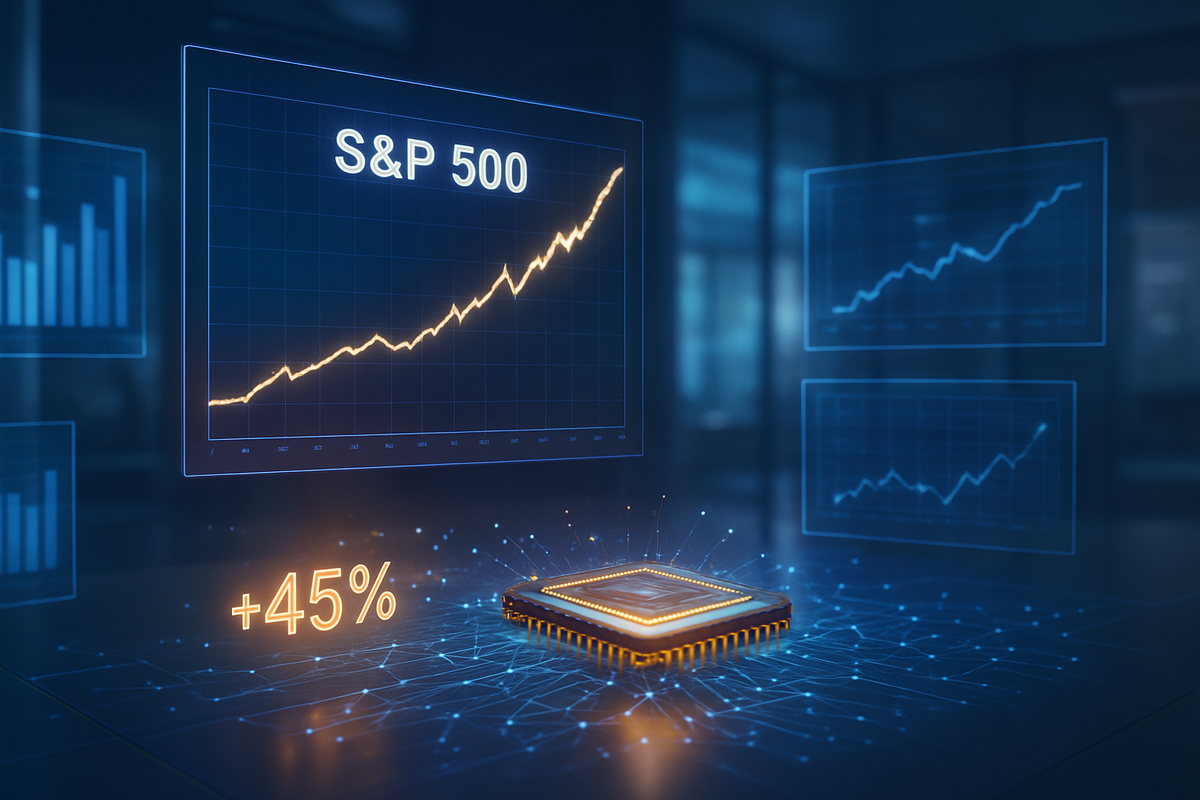
As the first-quarter earnings season of 2026 kicks off, Wall Street is bracing for a high-stakes performance that could determine the trajectory of the market for the remainder of the year. With the S&P 500 projected to deliver a robust 12.6% year-over-year earnings-per-share (EPS) growth, the index is on the verge of its sixth consecutive quarter of double-digit expansion. However, the headline figure masks a stark divergence between sectors, with the Information Technology industry expected to carry the heavy lifting via a massive 45% projected expansion in earnings.
The implications for the broader market are profound. In an environment where the Federal Reserve remains "paralyzed" by sticky inflation and geopolitical tensions in the Middle East have driven Brent crude oil prices above $110 a barrel, corporate earnings have become the sole engine of market stability. With the S&P 500 trading at a premium valuation of 20.4 times forward earnings, analysts warn of "asymmetric risk"—a scenario where even slight earnings misses could trigger disproportionate sell-offs, while beats are already largely baked into current prices.
Market Dynamics and the Q1 2026 Earnings Cycle
The road to this 12.6% growth projection has been defined by a transition from speculative AI excitement to tangible fundamental returns. Since early 2025, the market has shifted its focus toward companies that can prove "AI monetization" through high-margin software services and infrastructure hardware. This momentum hit a fever pitch in March 2026, when analyst consensus from FactSet began factoring in the full-scale deployment of next-generation semiconductor architectures and a surge in data center cooling demand.
Key stakeholders, including institutional heavyweights and quantitative strategists, are paying close attention to the "AI Marathon" broadening. Unlike the concentrated "Magnificent Seven" rally of previous years, the current growth story involves a wider array of hardware and utility-adjacent players. However, the timeline has been complicated by macro-headwinds. In the weeks leading up to mid-April 2026, the escalation of conflict involving Iran led to a spike in energy costs and a temporary "panic sell" in early April, though the market recovered as investors pivoted back to the high-growth tech sanctuary.
The initial reaction from the floor of the New York Stock Exchange has been one of "anxious optimism." While the 12.6% growth rate is technically higher than the historical 10-year average, the market’s reliance on a single sector—Technology—is a point of contention. If the 45% growth in IT fails to materialize, the broader index's performance could buckle, given that the sector is expected to account for nearly 87% of the total S&P 500 earnings growth this quarter.
Identifying the 2026 Winners and Losers
The clear frontrunners in this earnings cycle are the "Foundational Four" of the AI infrastructure boom. Nvidia Corp. (NASDAQ: NVDA) remains the undisputed leader, with a projected 71% year-over-year EPS growth as its "Blackwell" and "Vera Rubin" supercomputers reach peak production. Joining them in the winner’s circle is Micron Technology, Inc. (NASDAQ: MU), which is benefiting from an insatiable demand for High Bandwidth Memory (HBM). Together, Nvidia and Micron are expected to drive over half of the entire index's earnings growth for the quarter. In the cloud space, Microsoft Corp. (NASDAQ: MSFT) and Alphabet Inc. (NASDAQ: GOOGL) are leveraging massive Azure and Google Cloud expansions to report double-digit gains, with Alphabet further bolstered by a surge in ad revenue tied to the upcoming 2026 World Cup and U.S. mid-term elections.
Beyond traditional tech, Vertiv Holdings Co. (NYSE: VRT) has emerged as a surprise heavyweight, with projected EPS growth of 45% due to its dominance in data center thermal management. In the entertainment sector, Netflix, Inc. (NASDAQ: NFLX) stands out as a winner with 15.2% projected growth, thanks to successful price hikes and a maturing ad-supported tier that has isolated it from the broader struggles seen in legacy media.
Conversely, the "losers" list is dominated by sectors struggling with input costs and consumer fatigue. The Health Care sector is expected to lead the index in declines with a -9.8% EPS drop, largely due to a massive one-time acquisition charge taken by Merck & Co., Inc. (NYSE: MRK). In the Consumer Staples arena, giants like PepsiCo, Inc. (NASDAQ: PEP) and Procter & Gamble Co. (NYSE: PG) are flagging under the weight of "sticky" food inflation and shifting low-income consumer habits, leading to muted guidance. Meanwhile, General Mills, Inc. (NYSE: GIS) has already signaled a challenging landscape, lowering its 2026 outlook amid weak volume recovery in the snacks and pet food categories.
Broader Industry Trends and Historical Precedents
The current 45% growth in the IT sector is a testament to the "Second Wave" of the AI revolution. Historically, such concentrated growth is rare; the last time the S&P 500 saw such a sector-weighted disparity was during the dot-com era of the late 1990s. However, today’s valuations are backed by significantly higher cash flows and actual profit margins compared to the speculative nature of 1999. The 2026 trend shows that AI is no longer a "buzzword" but a fundamental floor for EPS, with AI-related spending now estimated to account for roughly 40% of the S&P 500’s total earnings expansion.
This concentration also has regulatory and ripple effects. As tech giants spend billions on infrastructure, competitors in the energy and utility sectors are feeling the squeeze on power grids, leading to new policy discussions regarding "data center tax" and energy efficiency mandates. Furthermore, the 2026 geopolitical landscape mirrors the oil shocks of the 1970s, but with a modern twist: while high oil prices traditionally benefit Energy companies, the integrated majors like Exxon Mobil Corp. (NYSE: XOM) and Chevron Corp. (NYSE: CVX) are facing hedging losses and production disruptions that have neutralized the benefits of $110 oil.
The current climate also underscores a shift in monetary policy expectations. For the first time in decades, the market has "priced out" Federal Reserve intervention. With inflation at 3.3% and the Fed effectively sidelined, the historical precedent of the "Fed Put"—the idea that the central bank will lower rates to save the market—has vanished. This places the entire burden of proof on corporate balance sheets, marking 2026 as the year of "Fundamental Survival."
Strategic Pivots and the Road to 2027
As we move past the April earnings window, the short-term focus will likely shift to "Capex efficiency." Investors will no longer reward companies just for spending on AI; they will demand evidence of internal efficiency gains and external revenue generation. For companies like Meta Platforms, Inc. (NASDAQ: META), the challenge will be balancing massive infrastructure investments with sustainable margin growth. We may see a strategic pivot where companies begin to prioritize "sovereign AI"—building localized data infrastructure to navigate increasing global trade barriers and emergency tariffs.
In the long term, the "Two-Speed Economy" may force a consolidation in the Consumer Staples and Health Care sectors. As tech continues to drain capital from other areas, non-tech firms will likely engage in aggressive M&A to achieve the scale necessary to offset rising costs. Market opportunities will emerge for "AI-adjacent" firms—those in energy storage, specialized industrials, and cyber-security—as the 45% IT growth begins to bleed into the broader physical economy.
The most critical scenario to watch is the "Inflationary Stall." If energy prices remain elevated and inflation does not move toward the 2% target by Q3 2026, the high-valuation tech stocks could face a "valuation compression," where even strong earnings cannot sustain high P/E ratios. Investors should prepare for a volatile summer as the market tests the durability of the current 20.4x multiple.
Summary and Investor Outlook
The Q1 2026 earnings season is a pivotal moment for the S&P 500. While the projected 12.6% overall growth suggests a healthy economy, the heavy reliance on a 45% expansion in Information Technology highlights a top-heavy market structure. The primary takeaway for investors is that "execution is everything." In an environment of high rates and zero Fed support, the margin for error has disappeared. Tech leaders must meet their lofty guidance, or the broader index risks a significant correction.
Moving forward, the market will be defined by the "Broadening Marathon." Watch for whether the AI-driven earnings power can eventually lift laggards in the Industrials and Materials sectors, or if the divergence will continue to widen. Key indicators for the coming months will include Brent crude stability, the Q2 revenue guidance from semiconductor firms, and any signs of a "consumer breaking point" in the earnings reports of major retailers.
For now, the technology sector remains the undisputed engine of the global economy, but its high-octane performance must continue to defy gravity to keep the 2026 bull market alive. Investors are advised to maintain a balanced exposure, keeping a close eye on "hidden" AI winners in the industrial sector while remaining cautious of over-extended valuations in pure-play software.
This content is intended for informational purposes only and is not financial advice.