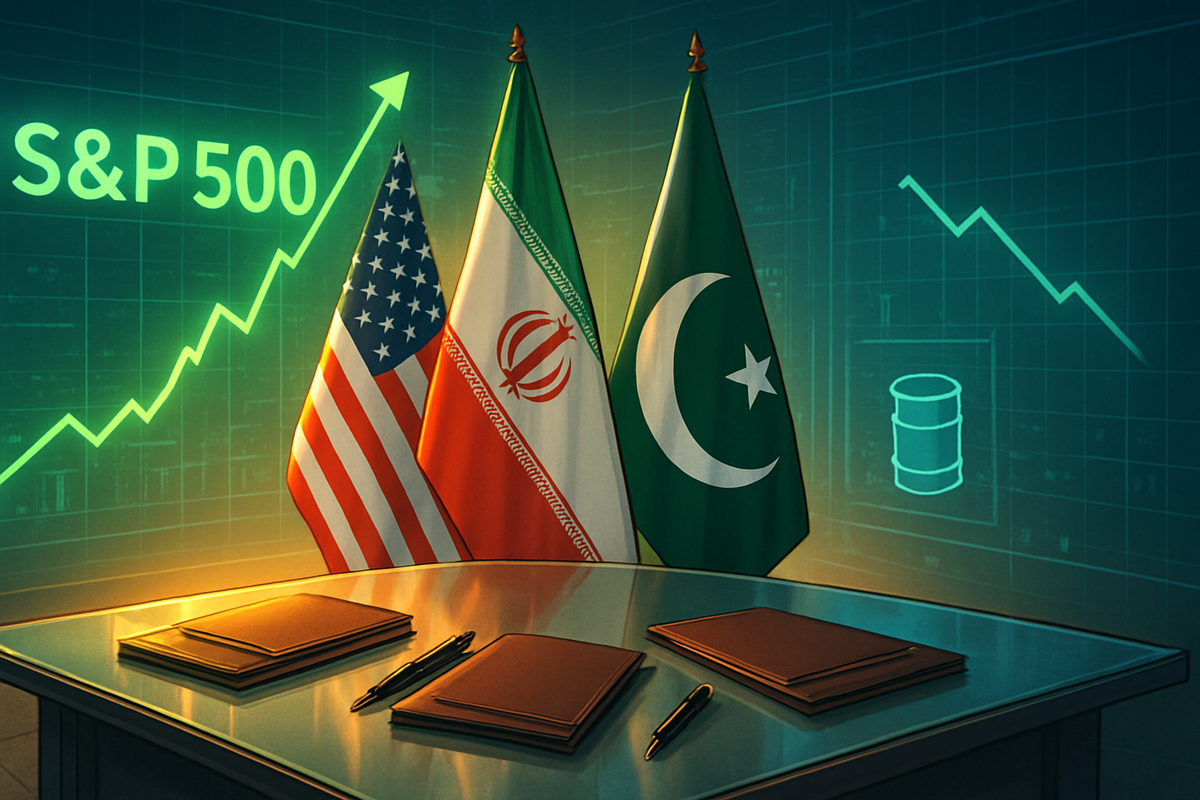
The S&P 500 surged more than 1.5% in early trading today, April 14, 2026, as investors bet on a dramatic diplomatic breakthrough in the Middle East. President Donald Trump, speaking from the South Lawn late yesterday, hinted that a "major historic deal" could be reached in Islamabad, Pakistan, within the week, signaling a potential end to the localized hostilities that have gripped the region since February.
This renewed optimism has acted as a cooling agent for a white-hot commodities market. Brent Crude, which had flirted with the $120 mark during the height of "Operation Epic Fury," has retreated toward the $100 level. For a market that has been held hostage by the threat of a closed Strait of Hormuz, the prospect of a negotiated settlement is providing the "oxygen" needed for a broad-based equity rally, pushing the S&P 500 near the 6,886 level.
The Diplomatic Pivot and Timeline of Tension
The road to this morning’s rally began with the dramatic ceasefire announced on April 7, 2026. After weeks of high-intensity strikes on Iranian nuclear facilities and retaliatory drone swarms targeting regional energy hubs, both sides appeared to hit a stalemate. The Trump administration, led by Vice President JD Vance and a diplomatic team including Jared Kushner, spent the weekend in Islamabad, utilizing Pakistan’s unique position as a regional bridge to Tehran. The presence of such high-level officials signaled to the markets that the administration was moving from military engagement to a "Bazaar-style" negotiation.
The timeline leading to this moment has been a rollercoaster for global indices. Following the initial outbreak of hostilities on February 28, 2026, the S&P 500 shed nearly 8% in March as the "war premium" on oil threatened to derail domestic growth and spike inflation. However, the mediation efforts by Pakistan’s Prime Minister Shehbaz Sharif and Field Marshal Asim Munir—whom President Trump has lauded as a "deal-maker"—have significantly shifted the narrative. The market's reaction today is a direct response to the President's latest comments that the "Bazaar is open," implying that Iran's leadership may be ready to trade nuclear concessions for an end to the recently threatened naval blockade.
Corporate Winners and the Retreat of the "War Trade"
The primary beneficiaries of this de-escalation are the broad-market titans. As the "fear trade" unwinds, tech giants like Microsoft (NASDAQ: MSFT) and Apple (NASDAQ: AAPL) are leading the S&P 500 higher, benefiting from the stabilization of global supply chains and a lower discount rate as inflation fears—linked to energy costs—recede. Conversely, the "war stocks" that thrived in March are seeing some profit-taking. RTX Corporation (NYSE: RTX) and Lockheed Martin (NYSE: LMT), both of which hit all-time highs earlier this month on the back of massive missile interceptor contracts, are trading slightly down today as the immediate demand for munitions might plateau.
In the energy sector, the impact is nuanced. While the "cooling" of oil prices hurts the immediate margin for producers like Occidental Petroleum (NYSE: OXY), the removal of the threat of total regional war is a net positive for diversified supermajors. ExxonMobil (NYSE: XOM) and Chevron (NYSE: CVX) have seen their stock prices stabilize after a volatile March. Investors are now pivoting toward oilfield service giants like Schlumberger (NYSE: SLB) and Halliburton (NYSE: HAL), betting that even with peace, the U.S. will continue to push for high domestic production levels to ensure long-term energy independence from the Gulf.
Geopolitical Ripple Effects and the Role of Middle Powers
This event fits into a broader shift in 2026 geopolitics, characterized by the emergence of mid-tier powers as essential brokers. Pakistan’s role, bolstered by a "5-point initiative" co-sponsored by China, marks a significant departure from previous decades where Western powers acted alone. This "triangular diplomacy" between Washington, Islamabad, and Beijing suggests that even a "Maximum Pressure" administration like Trump’s recognizes the necessity of international guarantors in a multi-polar world. Historically, this mirrors the post-1991 Gulf War era, where the market rallied on the prospect of a "New World Order" that promised stable energy flows.
The ripple effects are felt most acutely in the defense and technology sectors. Palantir (NYSE: PLTR), which saw its "Gotham" division integrated into the 2026 conflict’s AI-driven command-and-control systems, is now being evaluated for its "peace-time" utility in monitoring treaty compliance. The regulatory landscape is also changing, with the Trump administration’s proposed $1.5 trillion FY2027 defense budget likely to face new scrutiny if a long-term peace deal is signed. This could potentially shift federal funds toward domestic "Golden Dome" missile defense programs rather than active theater munitions, creating a new set of winners in the aerospace sector.
What Comes Next: Scenarios for the Summer
In the short term, the market will remain hyper-sensitive to every official dispatch coming out of Islamabad. A successful summit would likely propel the S&P 500 to new record highs above 7,000, as the "peace dividend" lowers energy costs and bolsters consumer confidence. However, the risk of a "spoiler" remains. Should hardliners in Tehran or Washington scuttle the talks, the naval blockade recently threatened by President Trump could be fully enforced, potentially sending Brent crude toward $150 and triggering a severe market correction.
Long-term, companies will need to adapt to a world where "energy security" is no longer just a buzzword but a strategic necessity. Even with a peace deal, the strategic pivot for investors will be identifying companies that can thrive in a "high-floor" energy environment. We expect to see continued aggressive investment in U.S. shale and LNG infrastructure as a hedge against future instability, regardless of the success of the Pakistan summit.
Summary and Investor Outlook
The April rally in the S&P 500 is a testament to the market's belief in diplomatic resilience and the power of the "deal." The move from the $120 oil peaks to more manageable levels has provided the liquidity needed for equities to rebound from their March lows. As of April 14, 2026, the diplomatic triangle between the U.S., Pakistan, and Iran has become the most watched economic indicator in the world.
For investors, the coming months will require a balanced approach. While the relief rally is encouraging, the "blockade threat" serves as a reminder that volatility is just one failed meeting away. Watch for the official confirmation of the Islamabad summit dates and keep a close eye on the performance of energy benchmarks and defense proxies. In 2026, geopolitical stability is the primary currency of market growth.
This content is intended for informational purposes only and is not financial advice.