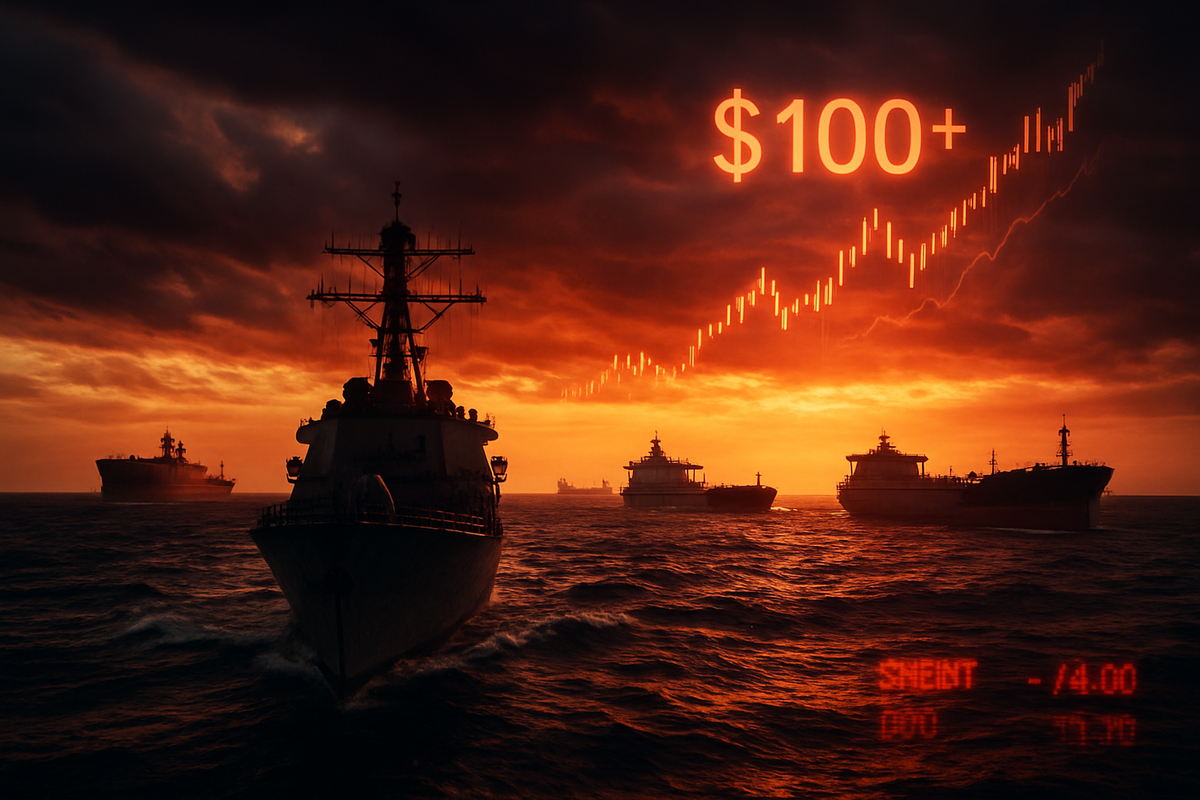
The global energy market was sent into a state of high-velocity shock on Monday morning as Brent crude prices shattered the $100 barrier, fueled by a dramatic directive from the White House. President Trump has officially ordered a military blockade of the Strait of Hormuz, effective as of 10:00 am ET today, April 13, 2026. This unprecedented move follows the total collapse of high-stakes diplomatic negotiations in Islamabad, Pakistan, over the weekend, leaving the world’s most critical maritime oil artery on the brink of a total shutdown.
Market reaction was instantaneous and violent. By the opening bell in New York, West Texas Intermediate (WTI) surged past $104 per barrel, while Brent crude—the global benchmark—rocketed to over $102. Traders are now pricing in a catastrophic disruption to the 21 million barrels of oil that transit the Strait daily, a volume representing nearly a quarter of the world’s total consumption. As the 10:00 am deadline passed, the "war premium" has been replaced by what analysts are calling a permanent "inflation price tag" added to every barrel of risk, signaling a new and volatile era for the global economy.
The Collapse in Islamabad: A Timeline of Escalation
The road to today’s blockade began with high hopes for a diplomatic breakthrough in Pakistan. Over the last 48 hours, representatives from the United States and Iran met in Islamabad for what was billed as the "Final Chance Summit." However, by Sunday evening, the talks reportedly disintegrated after disagreements over nuclear enrichment limits and the lifting of frozen assets reached an impasse. According to sources close to the administration, the Iranian delegation walked out of the summit after the U.S. refused to offer immediate sanctions relief, prompting President Trump to announce the blockade via an emergency broadcast early Monday morning.
The timeline of events moved with dizzying speed. At 6:00 am ET, the White House issued a statement declaring the Strait of Hormuz a "restricted maritime zone," citing national security interests and the need to prevent "hostile energy manipulation." By 8:30 am ET, as European markets were in mid-session, oil prices began their vertical ascent, jumping $8 in less than two hours. The formal order for U.S. Naval forces to begin intercepting and redirecting tankers suspected of violating the administration's new protocols went into effect at precisely 10:00 am ET, effectively placing a chokehold on the Persian Gulf.
Key stakeholders, including OPEC+ leadership and major Asian importers like China and Japan, have expressed "grave concern" over the move. The Strait is the primary exit point for oil from Saudi Arabia, Kuwait, Iraq, and the UAE. A blockade doesn't just stop Iranian exports; it threatens the entire regional output. The initial market reaction suggests that participants are not just fearing a temporary spike, but a structural shift in energy costs that could persist through the 2026 fiscal year.
Winners and Losers: Oil Majors in the Crosshairs
The immediate beneficiaries of the price surge are the global integrated oil majors, though the gains come with significant operational risks. Shell (NYSE: SHEL) and BP (NYSE: BP) saw their share prices climb by 4.5% and 5.2%, respectively, in pre-market trading as investors moved to capitalize on higher margins for non-Middle Eastern production. However, both companies face a double-edged sword. Shell, a dominant player in the Liquefied Natural Gas (LNG) market, is particularly vulnerable to the blockade, as a significant portion of its LNG supply originates from Qatar and must pass through the Strait. If deliveries are halted, the company could face force majeure declarations that could offset the gains from higher crude prices.
BP (NYSE: BP) similarly finds itself in a complex position. While its global upstream portfolio benefits from $100+ oil, BP has significant legacy interests and joint ventures in the Middle East, particularly in Iraq and the UAE. If the blockade leads to regional kinetic conflict, these physical assets could be at risk of damage or forced shutdowns. On the other side of the ledger, domestic U.S. producers like ExxonMobil (NYSE: XOM) and Chevron (NYSE: CVX) are seeing substantial inflows, as they are viewed as safer bets with production insulated from the immediate physical dangers of the Hormuz corridor.
The clear "losers" in this scenario are the global transport and manufacturing sectors. Airline stocks tumbled on the news, with Delta Air Lines (NYSE: DAL) and United Airlines (NASDAQ: UAL) falling over 6% on fears of a massive spike in jet fuel costs. The "inflation price tag" being added to every barrel is expected to hit consumer-facing companies the hardest, as the cost of shipping and logistics is set to rise across the board, potentially forcing another round of aggressive interest rate hikes by central banks later this year.
Broader Significance: The 'Inflation Price Tag' and Global Trade
The significance of this event extends far beyond the ticker tape. By ordering a blockade, the U.S. has effectively weaponized global energy transit in a way not seen since the tanker wars of the 1980s. However, unlike the 1980s, the world today is far more interconnected and reliant on "just-in-time" energy deliveries. This blockade injects a massive dose of volatility into an already fragile global recovery. The "inflation price tag" mentioned by market strategists refers to the reality that even if the blockade is short-lived, the risk premium will likely remain embedded in energy prices for months, if not years.
Regulatory and policy implications are already beginning to surface. In Washington, there are already calls for the emergency release of the Strategic Petroleum Reserve (SPR), though critics argue that the SPR is at historically low levels and cannot compensate for the 21 million barrels per day potentially lost in the Strait. Furthermore, this event marks a definitive end to the era of "low-cost energy" that fueled the early 2020s. We are seeing a historical precedent being set where energy security is being prioritized over market stability, a move that may force European and Asian allies to reconsider their own energy dependencies and security alliances.
The ripple effects will also be felt in the renewable sector. As oil crosses $100, the economic argument for electric vehicles and alternative energy sources like green hydrogen becomes much stronger. Companies like Tesla (NASDAQ: TSLA) and First Solar (NASDAQ: FSLR) may see a renewed surge in interest as governments scramble to "de-risk" their economies from Middle Eastern oil volatility.
What Comes Next: Scenarios and Strategic Pivots
In the short term, all eyes are on the U.S. Navy and the Iranian Revolutionary Guard. The potential for a "hot" conflict in the Strait is at its highest point in decades. If a tanker is fired upon or seized, we could see oil prices move toward $120 or even $150 per barrel. Market participants are bracing for "Headline Risk," where every tweet or military update can move the price of WTI by several dollars in minutes. Strategic pivots will be required for any company with a high energy-input cost; we may see a sudden rush to hedge fuel prices at these elevated levels to prevent bankruptcy.
Long-term, the blockade could lead to a permanent re-routing of global trade. We may see an acceleration of pipeline projects that bypass the Strait, such as the East-West Pipeline in Saudi Arabia or new routes through Turkey. However, these are years away from providing significant relief. In the immediate future, the market will likely remain in a "supply deficit" mindset, which will keep a floor under oil prices even if global demand begins to soften due to the high costs.
The most likely scenario is a period of "Stagflation 2.0," where high energy prices drive inflation up while simultaneously slowing down economic growth. Investors should be prepared for a period of extreme "sector rotation," where capital flees consumer discretionary stocks and flows into energy, defense, and commodities.
Summary and Investor Outlook
The events of April 13, 2026, will likely be remembered as a turning point in modern geopolitics. With Brent crude over $102 and WTI over $104, the era of triple-digit oil has returned with a vengeance. The failed peace talks in Islamabad have closed the door on diplomacy, and the U.S. blockade of the Strait of Hormuz has opened a Pandora’s box of economic and military uncertainty.
For investors, the key takeaways are clear:
- Volatilty is the New Normal: The "inflation price tag" on oil means that energy will remain a primary driver of market movements for the foreseeable future.
- Watch the Majors: While BP (NYSE: BP) and Shell (NYSE: SHEL) stand to profit from higher prices, their exposure to the Middle East makes them high-risk, high-reward plays.
- The Inflation Threat: Watch the Consumer Price Index (CPI) data closely in the coming months; a sustained oil spike will almost certainly force the hand of the Federal Reserve.
The market is moving into uncharted waters. As the blockade begins, the world waits to see if this is a brief show of force or the start of a prolonged global energy crisis.
This content is intended for informational purposes only and is not financial advice.