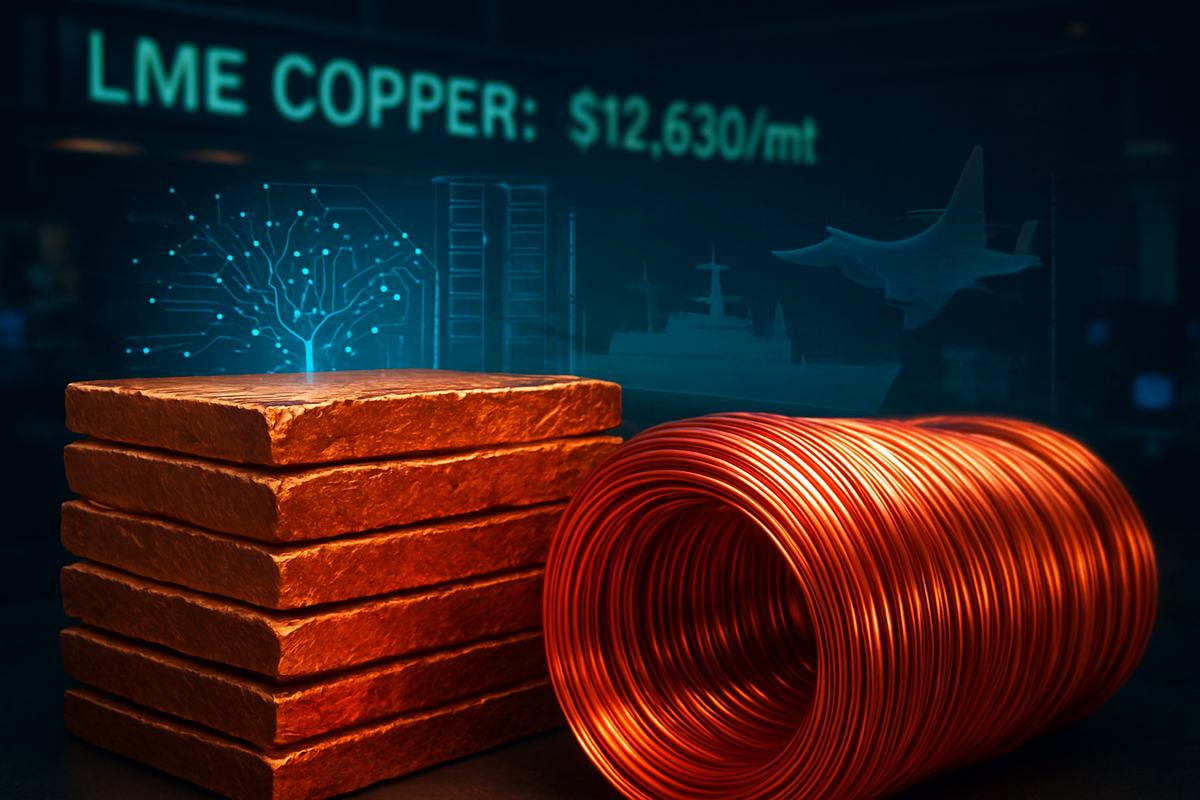
The global copper market has entered a volatile new era as benchmark prices on the London Metal Exchange (LME) hovered near a historic $12,630 per metric ton this week. This surge is being fueled by what analysts are calling a "Triple Demand" shock—a rare convergence of aggressive AI infrastructure buildouts, a massive spike in global defense procurement, and newly implemented U.S. trade protections. As of April 13, 2026, the red metal has solidified its status as the most critical commodity of the decade, leaving industrial consumers scrambling for supply while producers reap unprecedented windfalls.
The immediate implications are being felt across the manufacturing and technology sectors, where input costs for electrical components and power infrastructure have nearly doubled compared to two years ago. With global refined copper inventories at multi-year lows, the market is currently operating in a structural deficit estimated at 330,000 to 400,000 metric tons for the 2026 calendar year. This tight supply environment has forced a repricing of "green" and "digital" transition timelines, as the cost of the copper required to power the future begins to outweigh the subsidies intended to accelerate it.
The Anatomy of a Super-Squeeze: AI, Defense, and Trade Barriers
The climb to $12,630/mt is the result of a timeline that began accelerating in late 2025. By the first quarter of 2026, the London Metal Exchange saw prices average a record-breaking $5.83 per pound. This price action was initially ignited by the realization that AI-focused hyperscale data centers are significantly more copper-intensive than their predecessors. Unlike traditional facilities, modern AI "compute clusters" require between 30 to 47 tons of copper per megawatt (MW) for specialized liquid cooling and high-density power distribution. In 2026 alone, AI infrastructure is projected to add 110,000 tons of new demand, an 80% jump from just two years ago.
Adding fuel to the fire is a surge in global defense spending. As geopolitical tensions remain elevated, military hardware has emerged as an inelastic demand driver. Modern systems, such as the advanced missiles produced by Lockheed Martin (NYSE: LMT), require roughly 270 kg of copper for guidance systems and propulsion controls. Meanwhile, naval vessels and infantry combat vehicles are using record amounts of high-performance wiring. In a move that shocked the merchant market, the U.S. and several NATO allies recently designated copper as a "strategic mineral," initiating state-level stockpiling programs that have effectively removed large volumes of refined cathode from the public market.
The "Triple Threat" was completed on April 2, 2026, when the U.S. administration issued a proclamation restructuring Section 232 tariffs. Effective April 6, a new 15% transitional tariff was placed on certain metal-intensive electrical grid equipment and refined copper products. While intended to "reshore" the domestic smelting supply chain, the immediate effect has been a widening price premium in the United States. Domestic buyers are now paying significantly more than the LME benchmark as they navigate these new trade barriers, leading to concerns about inflationary pressures in the U.S. power and construction sectors.
Mining Giants and Secondary Producers Capitalize on Scarcity
The current price environment has created clear winners among copper producers, particularly those with low cost structures and efficient operations. Amerigo Resources (TSX: ARG) emerged as a standout performer this month, reporting record-breaking Q1 2026 results. Despite a planned maintenance shutdown, the company achieved a cash cost of just $1.82 per pound, far below its annual guidance of $1.98. On the back of these high prices, Amerigo’s board declared a record "performance dividend" of Cdn$0.16 per share, representing the largest return of capital in the company's history. This move highlights the massive cash-flow generation currently possible for secondary producers that process existing tailings rather than traditional mining.
Major miners like Freeport-McMoRan (NYSE: FCX) and BHP Group (NYSE: BHP) are also seeing their margins expand to levels not seen since the early 2010s. For these giants, the challenge is no longer the price of copper, but the speed of extraction. With no major "tier-one" mines slated to come online until at least 2028, these companies are shifting their strategies toward "brownfield" expansions and technological upgrades to squeeze more output from aging assets. Conversely, the "losers" in this scenario are the downstream manufacturers and tech hardware companies like Nvidia (NASDAQ: NVDA) and Tesla (NASDAQ: TSLA), which face surging bills for the copper-heavy components essential to their AI chips and electric vehicle motors.
The 15% U.S. tariff on refined copper has also created a rift in the industry. While domestic refiners benefit from the protectionist stance, international mining firms with heavy export reliance on the U.S. market are being forced to reroute shipments to Asian or European hubs. This shift is reorganizing global trade flows, making the copper market more fragmented and less efficient than it was a decade ago. Companies with flexible logistics chains and diverse geographic footprints are currently outperforming their more localized peers.
A Wider Significance: Copper as the New Oil
This event signifies a fundamental shift in how the world views industrial metals. Copper is no longer viewed merely as a cyclical proxy for construction; it is now the "new oil," a strategic asset essential for both economic growth and national security. The convergence of AI and defense demand represents a shift toward "priority" consumption, where buyers are willing to pay almost any price to secure supply. This mirrors historical precedents like the oil shocks of the 1970s, where resource scarcity dictated global foreign policy and industrial strategy.
The regulatory implications are profound. Governments are now intervening in the market in ways that would have been unthinkable five years ago. Beyond the 15% U.S. tariff, we are seeing the emergence of "resource nationalism" in South America and Africa, as nations seek to capture a larger share of the copper windfall through higher royalties and export restrictions. This policy environment is likely to lead to long-term volatility, as the free flow of copper is increasingly hampered by geopolitical maneuvering and trade wars.
The Path Forward: Strategic Pivots and Scenarios
In the short term, the market expects copper to remain above the $12,000/mt level, provided the "Triple Demand" drivers do not abate. We may see a strategic pivot toward copper substitution, with manufacturers attempting to use aluminum in applications where conductivity requirements are less stringent. However, for high-performance AI data centers and advanced defense systems, there is currently no viable alternative to copper, suggesting that demand will remain remarkably "sticky" despite the price.
Looking ahead to the next 12 to 24 months, the biggest challenge for the market will be the "supply response." If prices remain at these levels, we could see a rush of investment into recycling technologies and deep-sea mining exploration. However, the lead times for new mining projects remain stubbornly long, often exceeding 10 years from discovery to first production. This suggests that the "Triple Demand" shock is not a fleeting event but a multi-year structural shift that will require the market to adapt to a permanently higher price floor.
Navigating the High-Voltage Future
The copper market of April 2026 is a study in the power of converging trends. The "Triple Demand" shock of AI, defense, and tariffs has fundamentally rewritten the rules of commodity trading. For investors, the key takeaways are clear: low-cost producers like Amerigo Resources (TSX: ARG) are the primary beneficiaries of this environment, while downstream industrial consumers face a period of significant margin compression.
Moving forward, the market will be hyper-focused on two things: the June 2026 U.S. Commerce Secretary review of copper tariffs and the pace of AI data center permit approvals. Any sign of a slowdown in either could provide temporary relief to prices, but the underlying structural deficit remains. Investors should watch for further "strategic mineral" designations by other world powers, as these moves will signal just how much higher the "red gold" can go in a world where everyone needs it, but few can find it.
This content is intended for informational purposes only and is not financial advice.