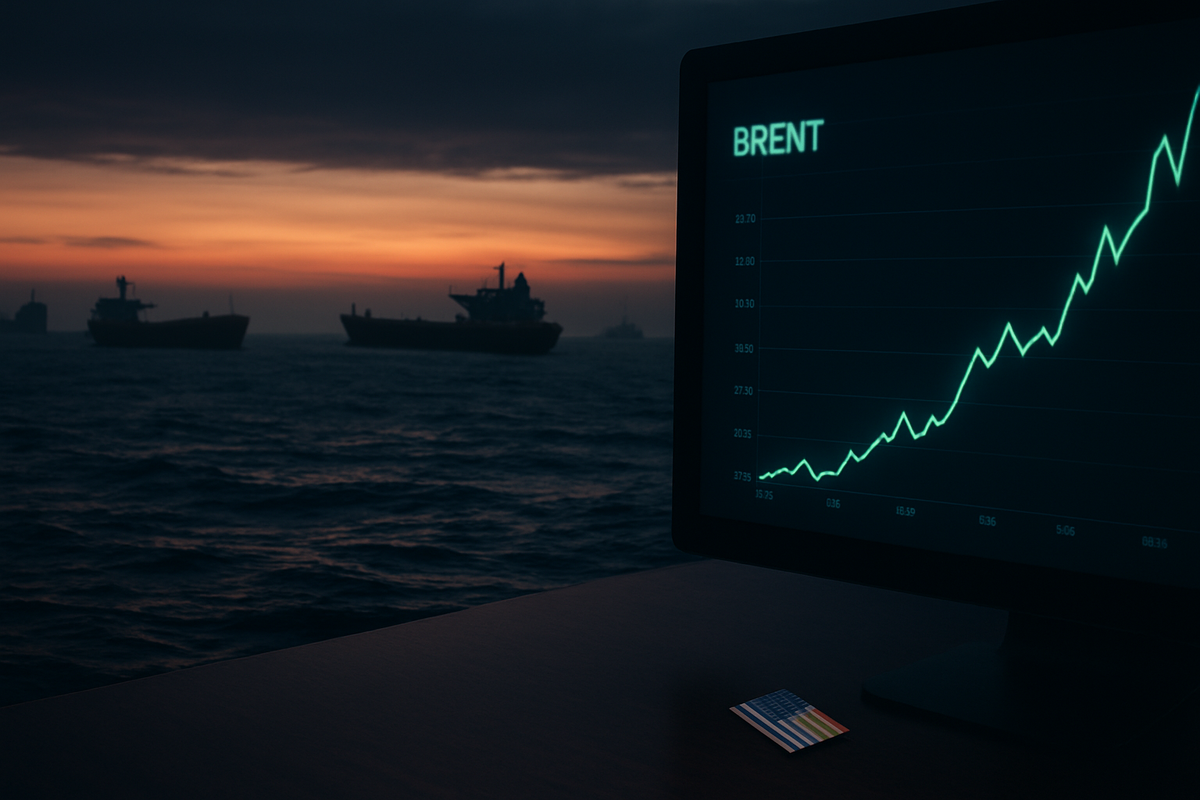
The benchmark international oil price, which had seen a brief respite earlier in the week, moved higher as traders priced in the growing risk of a total cessation of exports from the Persian Gulf should Tehran fail to meet Washington’s latest demands regarding the Strait of Hormuz and its nuclear enrichment program.
The surge in Brent futures to approximately $98.50 per barrel on April 10, 2026, marks a significant shift in market sentiment. While a tentative two-week ceasefire had cooled prices from their March peak of $120, the President’s Friday morning communications—warning of "devastating consequences" if the Strait is not fully cleared of Iranian naval interference—has effectively re-established a "war premium" that analysts suggest could persist through the fiscal quarter.
A Return to Maximum Pressure: The Road to the April Deadline
The current standoff is the culmination of nearly 14 months of escalating friction under the Trump administration’s "Maximum Pressure 2.0" campaign. Since early 2025, the U.S. has aggressively targeted Iran’s "shadow fleet," utilizing National Security Presidential Memorandum 2 (NSPM-2) to impose strict "Know Your Customer’s Customer" standards on global financial institutions. This policy succeeded in driving Iranian crude exports below 1.1 million barrels per day (bpd) by early 2026, but the strategy took a kinetic turn on February 28, 2026, with "Operation Epic Fury"—a series of joint U.S.-Israeli strikes on Iranian military assets and hardened nuclear sites.
In retaliation, Tehran effectively shuttered the Strait of Hormuz in March, disrupting nearly 20% of the world’s daily oil and LNG supply. The move forced heavyweights like Saudi Arabia and the UAE to shut in roughly 9 million bpd of production as storage tanks reached capacity. While a brief ceasefire brokered on April 8 allowed for limited technical inspections of the waterway, the Trump ultimatum issued on April 7 has fundamentally changed the calculus. The President demanded that Iran not only reopen the Strait to all international traffic but also permanently dismantle its Fordow enrichment facility, setting a hard deadline that has left the market on edge.
Winners and Losers in a Triple-Digit Oil World
The renewed tension has created a starkly bifurcated landscape for public energy companies. Domestic production giants like Exxon Mobil Corporation (NYSE: XOM) and Chevron Corporation (NYSE: CVX) have found themselves in a unique position. While both companies reported a roughly 6% hit to their global production in Q1 2026 due to the logistical nightmare in the Middle East, their aggressive expansion in the Permian Basin has provided a critical hedge. Exxon, which hit a production record of 1.8 million barrels of oil equivalent per day in West Texas late last year, is capturing massive refining margins as global fuel prices remain decoupled from standard benchmarks.
Conversely, European majors such as BP p.l.c. (NYSE: BP) and Shell plc (NYSE: SHEL) are navigating a more volatile environment. While both are projected to record combined windfall profits of nearly £5 billion this year due to record-high spot prices, their stock prices have been whipped around by the headlines of the ceasefire-and-ultimatum cycle. Shell, in particular, has faced increased operational costs associated with rerouting its LNG fleet around the Cape of Good Hope, a costly alternative that has become the new industry standard for tankers avoiding the Red Sea and Persian Gulf.
For "pure-play" upstream producers with heavy exposure to the Middle East, the ultimatum is a potential death knell for stability. However, service providers like SLB (NYSE: SLB) have seen a paradoxical uptick in demand as non-OPEC+ nations scramble to accelerate drilling projects in more stable regions, including Guyana and the North Sea, to fill the projected 8-million-barrel-per-day gap left by the Gulf disruption.
The Geopolitical Shift: Redefining Global Energy Security
The wider significance of this ultimatum extends far beyond the current price per barrel. This event marks the first time since the 1970s oil shocks that the Strait of Hormuz has been used so explicitly as both a military shield and a diplomatic cudgel by a major producer. The Trump administration’s decision to pair military strikes with a universal 10% tariff—the so-called "Liberation Day" tariffs—has further complicated the energy landscape, making it more expensive for traditional buyers like China to import crude regardless of its origin.
Furthermore, the IEA’s emergency release of 400 million barrels from strategic reserves in March 2026 has left Western "rainy day" funds at historic lows. This leaves the global market without its traditional safety valve should the current ultimatum lead to a direct military escalation. Regulatory shifts under the current administration have also signaled a pivot away from the "Green Transition" goals of the early 2020s, with a renewed focus on "energy dominance" that prioritizes immediate domestic output over long-term decarbonization targets, a move that is reshaping the ESG (Environmental, Social, and Governance) investment landscape.
Looking Ahead: The Fragile Ceasefire and the $100 Barrier
In the short term, the market is laser-focused on the expiration of the two-week ceasefire. If the April 21st deadline passes without a clear Iranian concession, energy analysts at Goldman Sachs warn that Brent could comfortably clear the $110 mark again, potentially testing the all-time inflation-adjusted highs of the 2008 era. Traders are closely monitoring the "oil on water"—the 190 million barrels Iran has stockpiled in floating storage—as a potential indicator of how long Tehran can survive a total blockade.
The long-term scenario remains even more clouded. A strategic pivot by major oil firms toward more expensive offshore and deep-water projects is already underway, as the Middle East is increasingly viewed as a "no-go" zone for predictable logistics. If the ultimatum results in a permanent reopening of the Strait under U.S. naval supervision, we could see a rapid correction back to the $80 range; however, the probability of such a clean resolution remains low in the eyes of the market.
The Bottom Line for Investors
As of April 10, 2026, the energy sector has reclaimed its spot as the primary driver of global inflation and market volatility. The key takeaway for investors is that the "Trump Factor" has introduced a level of geopolitical risk that traditional supply-and-demand models are struggling to quantify. The "supervised pause" in the Gulf is a temporary bandage on a systemic wound in global trade.
Moving forward, the market will likely see continued upward pressure on Brent crude as the ultimatum’s deadline nears. Investors should keep a close eye on weekly satellite imagery of the Strait and the export volumes from the Permian Basin. While the potential for windfall profits in the energy sector is high, the risk of a broader economic slowdown induced by triple-digit oil prices remains the primary shadow over the 2026 fiscal outlook.
This content is intended for informational purposes only and is not financial advice.