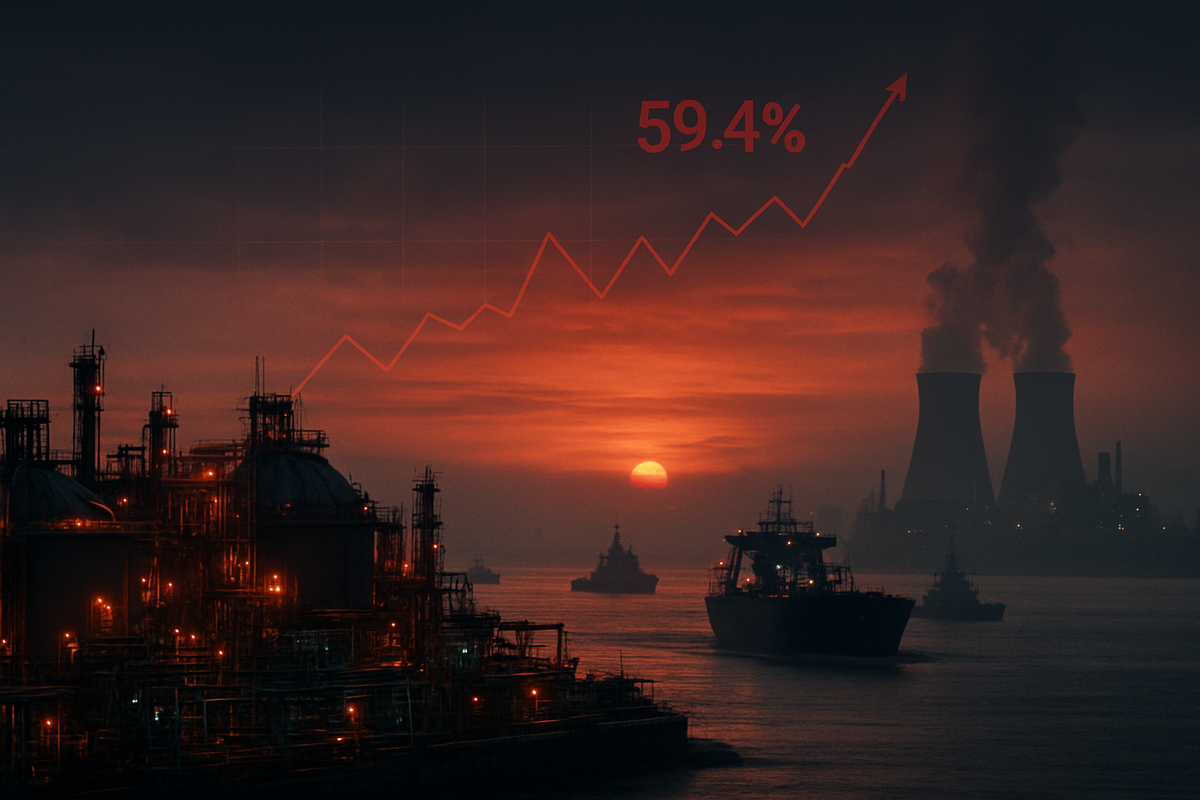
The European energy landscape has been rocked by a seismic shift this past month, as natural gas prices surged by a staggering 59.4% throughout March 2026. This sudden spike, which saw the Dutch TTF benchmark peak near €70/MWh, has sent shockwaves through global markets and reignited fears of a long-term energy crisis. The volatility was not confined to gas alone; the overall energy price index jumped 41.6%, driven by a combination of regional conflict and a secondary rally in crude oil that briefly pushed Brent over $100 per barrel.
For the European Union, the immediate implications are a harsh reminder of the fragile nature of energy security in a post-pipeline era. Consumers are facing renewed inflationary pressures, while industrial giants are once again forced to weigh the viability of domestic production against exorbitant energy costs. As of April 10, 2026, the market remains on a knife-edge, balancing tentative ceasefire hopes against the physical reality of damaged infrastructure and depleted reserves.
The Siege of Hormuz and the Qatar Shock
The catalyst for this unprecedented volatility was a rapid escalation of geopolitical tensions in West Asia, which culminated in what analysts are calling the "Siege of Hormuz." In late February, a series of naval skirmishes led to a partial blockade of the Strait of Hormuz, a critical maritime artery that facilitates the passage of approximately 20% of the world’s Liquefied Natural Gas (LNG). This blockade immediately strangled the flow of Qatari and Middle Eastern energy exports destined for European terminals.
The situation worsened in mid-March when targeted drone strikes hit the Ras Laffan Industrial City in Qatar. This "Qatar Shock" forced several massive liquefaction "trains" offline, effectively removing 17% of the country’s LNG export capacity from the global market. With Qatar being a primary partner in Europe's diversification strategy, the loss of these volumes created an immediate supply vacuum. European gas storage levels, already depleted to a seasonal low of 28% following a particularly frigid winter, offered no buffer, leaving utilities with no choice but to enter a frantic bidding war on the spot market.
Winners and Losers: A Divergent Market
In the wake of the price surge, the fortunes of major energy players have diverged sharply. Equinor (OSE: EQNR) has emerged as a primary "winner" in this crisis. As Europe’s largest remaining pipeline supplier, the Norwegian state-controlled giant has stepped in to fill the gap, reaping the rewards of record-high premiums. While Equinor has faced its own maintenance challenges, its strategic position as a bedrock of European supply has solidified its financial outlook for the first half of 2026. Similarly, global LNG majors such as Shell (NYSE: SHEL) and BP (NYSE: BP) have utilized their diversified portfolios to navigate the crisis. By diverting U.S.-sourced LNG cargoes to high-bidding European hubs, these companies have managed to capitalize on the price volatility, offsetting the disruptions in their Middle Eastern operations.
Conversely, the industrial sector is reeling. Yara International (OTC: YARIY), one of the world’s leading fertilizer producers, faces an existential threat as the 59.4% spike in natural gas—the primary feedstock for ammonia—has made European production economically unviable. Industrial heavyweight BASF (OTC: BASFY) has also been forced into "survival mode," further reducing production at its iconic Ludwigshafen site and accelerating a strategic pivot toward North American and Asian markets where energy costs remain comparatively stable. In the metals sector, ArcelorMittal (NYSE: MT) and ThyssenKrupp (OTC: TKAMY) have been forced to withdraw price offers for future steel contracts, citing "incalculable" energy input costs that have disrupted their furnace operations and downstream supply chains.
Infrastructure Gaps and the "Maritime Vulnerability"
The March 2026 crisis has exposed a fundamental flaw in Europe's energy transition: the shift from "pipeline dependency" to "maritime vulnerability." While the continent successfully reduced its reliance on Russian gas over the last four years, it replaced that dependency with a reliance on global LNG shipments that are susceptible to geopolitical chokepoints like the Strait of Hormuz. The current crisis has highlighted that the infrastructure to receive gas is only as reliable as the sea lanes that deliver it.
Furthermore, internal infrastructure limitations have exacerbated the crisis. Despite record solar generation in Spain and Italy this spring, the lack of robust cross-border interconnections prevented this "renewable surplus" from reaching industrial heartlands in Central Europe. This regulatory and physical bottleneck has hindered the EU’s ability to use its green energy transition as a shield against fossil fuel price shocks. Historically, this event draws comparisons to the 2022 energy crisis, yet it differs in its focus on the fragility of global shipping routes rather than unilateral pipeline shutdowns.
The Path Forward: Strategic Pivots and Storage Scrambles
As we move into the second quarter of 2026, the primary focus for European policymakers and energy firms is the "injection season." With storage levels at dangerously low levels, the race is on to refill reserves before the winter of 2026-2027. Short-term relief may come from a tentative ceasefire currently being negotiated in West Asia, which has already seen prices retreat by roughly 18% from their March peaks. However, the damage to Qatari infrastructure will take months, if not years, to fully repair, suggesting that a structural supply deficit will persist.
Market opportunities are emerging in the expansion of "floating" LNG terminals and the acceleration of hydrogen-ready infrastructure. Companies that can provide modular, flexible energy solutions are expected to see increased investment. However, the challenge remains for heavy industry; without long-term price stability or significant government subsidies, the "deindustrialization" of Europe's core manufacturing sectors could become a permanent reality rather than a temporary trend.
Conclusion: A Market Forever Changed
The "March Shock" of 2026 serves as a definitive turning point in the global energy narrative. The 59.4% surge in natural gas prices and the 41.6% rise in the overall energy index have proven that energy security is not a destination, but a continuous and high-stakes effort. The primary takeaway for investors and policymakers alike is that diversification of supply is insufficient without also ensuring the security of the transport routes and the flexibility of the internal grid.
Moving forward, the market will remain highly sensitive to any geopolitical developments in the Middle East and the progress of infrastructure repairs in Qatar. Investors should keep a close eye on storage refill rates throughout the summer and watch for any signs of permanent industrial demand destruction. While the immediate panic of March has subsided, the lasting impact on Europe’s strategic energy policy and its industrial competitiveness will be felt for years to come.
This content is intended for informational purposes only and is not financial advice